Is Precision Metal Stamping Right for Your Application?
Comments Off on Is Precision Metal Stamping Right for Your Application?Precision metal stamping is a manufacturing process that utilizes a custom tool and die set installed in a stamping press to turn sheet metal into the desired components. It is used in a wide range of industries to create large quantities of parts and products with high precision, accuracy, and speed. While this process offers manufacturing advantages, it is not appropriate for every production project.
The following article discusses some of the considerations to keep in mind when determining whether precision metal stamping is right for your project. It provides an overview of the process, the benefits it offers, and the typical industries that use it.
An Overview of Precision Metal Stamping
Metal stamping—also sometimes referred to as pressing—relies on specialized tooling (i.e., a tool and die set) and equipment (i.e., a press) to form metal sheets and coils into the required shape and size. The pressure exerted on the workpiece by the press forces the material to conform to the shape formed by the tool and die. This process can occur in a single stage or across several stages, depending on the simplicity or complexity of the end product. Precision metal stamping operations largely rely on the use of automated equipment, which ensures the finished components are both precise and accurate.
In addition to higher precision and accuracy, some of the other advantages the precision metal stamping process demonstrates over other manufacturing processes include:
- Greater product and process quality. Accuracy offered by the precision metal stamping process translates to a lower error rate during production. This means there is a smaller chance of producing faulty or flawed parts making it into the hands of customers.
- Lower production costs. A generally automated process, precision metal stamping mitigates the need for manual labor. This quality also results in a lower error rate, which translates to less material utilization and waste during a production run.
Industries Served
As indicated above, the precision metal stamping process finds application in a wide range of industries. Some of the industries that regularly employ the process for the production of their parts and products include:
Automotive
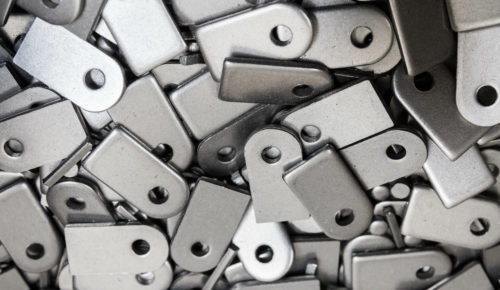 In the automotive industry, stamping is used to create a variety of structural and functional parts used in vehicle bodies and frames, electrical systems, steering systems, and more. Some examples of typical automobile parts made in metal stamping operations include:
- Brackets and hangers
- Electrical terminals and connectors
- Wire forms (e.g., tire and under chassis components)
Aerospace
In the aerospace industry, parts and products are subject to strict manufacturing requirements and restrictions. These guidelines are in place to ensure the safety of the aircraft’s personnel and passengers and the public. For this reason, aerospace components manufacturers (e.g., Keats Manufacturing Co.) maintain certification and compliance with various industry standards such as Mil-spec and RoHS. Some of the metal stamped parts and products commonly produced for aerospace applications include:
- Assemblies
- Brackets
- Bushings
- Clips
- Lead frames
- Shields
- Terminals
- Wire forms
Medical Devices
 Similar to the aerospace industry, the medical device industry has many standards dictating how a component should be made. These exceptionally high standards ensure the safety of medical practitioners and patients. Standard and custom metal stampings are found in a variety of medical devices, including:
- Connectors, couplings, and fittings
- Equipment housing and sleeves
- Implants and prosthetics
- Pump and motor components
- Surgical instruments and equipment
- Temperature probes
Electrical Distribution
Professionals in the electrical distribution industry make use of many different metal stamped parts and products in circuit breakers, distribution boxes, switches, transformers, and other critical equipment. Some examples include:
- Brackets
- Clips
- Contacts
- Inserts
- Shields
- Terminals
Appliances
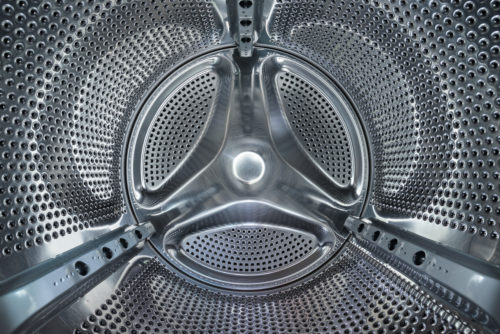 Precision metal stampings are found in a wide range of commercial and residential appliances, such as:
- Automatic garage doors
- Dishwashers
- Dryers
- Garbage disposals
- Grills
- HVAC units
- Irrigation systems
- Ovens
- Pool filtration and pump systems
- Refrigerators
- Security systems
- Stoves
- Thermostats
- Washers
- Water heaters
Renewable Energy
The renewable energy industry encompasses solar, wind, geothermal, and other clean energy operations. As the industry grows in response to the push for greater sustainability, so too does the need for reliable parts for power generation and distribution equipment and systems. Some of the metal stamped components regularly produced for such applications are:
- Antennas
- Brackets and clips
- Cases, inserts, and retainers
- Fan blades
- Grounding straps and busbars
- Heat sinks
- Plates
- Shields
- Terminals and contacts
Contact the Precision Metal Stamping Experts at Keats Manufacturing Today
The precision metal stamping process plays a critical role in the production of components for many industries. For customers looking for an experienced and knowledgeable metal stamping partner, the Keats Manufacturing team is here to help.
At Keats Manufacturing, we’ve provided custom small metal stamping solutions for over 60 years. Armed with extensive manufacturing experience and state-of-the-art manufacturing facilities, we can fulfill nearly every metal stamping request with a high-quality product solution. To find out more about our metalworking capabilities or partner with us on your next project, contact us or request a quote today.
Frequently Asked Questions
What industries benefit from precision metal stamping?
At Keats Manufacturing Co., we serve a wide range of industries that rely on high-volume precision components.
- Our expertise spans automotive, appliances, electronics, and medical sectors.
- With high-precision tolerances, we meet the specific needs of each industry.
- Our in-house tool & die development ensures tailored solutions for your unique applications.
How does Keats Manufacturing ensure precision in metal stamping?
Precision is at the core of our operations at Keats Manufacturing Co.
- We utilize one of the largest fleets of four-slide machines in North America, including advanced Wünsch multi-slide machines.
- Our commitment to tolerances of ±0.0002 in. for stamping guarantees the accuracy you require.
- All processes adhere to ISO 9001, ISO 14001, and IATF 16949 standards for consistent quality.
Can I get custom designs for my metal stamped parts?
Absolutely! Keats Manufacturing Co. specializes in custom precision metal stamping. Every part we make is custom.
- Our in-house tool & die development allows us to create bespoke designs tailored to your specifications.
- We offer a lifetime guarantee on tooling, ensuring your investment is protected.
- Our engineers work closely with you to optimize designs for manufacturability and cost-effectiveness.
What is the lead time for precision metal stamping projects?
Lead times at Keats Manufacturing Co. can vary based on project complexity and volume.
- Generally, we strive for efficient turnaround times, particularly for high-volume orders.
- Lead time depends on multiple factors such as part complexity, material type, volume requirements, heat treatment and/or plating requirements.
- Contact us for a quote and a detailed timeline tailored to your specific project needs.
How does Keats handle quality control in its manufacturing processes?
Quality control is paramount at Keats Manufacturing Co.
- We implement rigorous in-process inspection procedures throughout the manufacturing process to ensure compliance with high standards.
- Our facilities are certified in ISO 9001, ISO 14001, and IATF 16949, emphasizing our commitment to quality.
- We also accommodate other specialized quality requirements for various industries.
What are the advantages of using four-slide machines for stamping?
Four-slide machines offer significant advantages that Keats Manufacturing Co. leverages for your projects.
- They allow for complex shapes and high-volume production, reducing overall costs.
- Our fleet includes advanced Wünsch multi-slide machines, enhancing precision and speed.
- This technology enables us to achieve tighter tolerances and intricate designs efficiently.
How do you ensure compliance with industry standards?
At Keats Manufacturing Co., compliance with industry standards is integral to our operations.
- We are certified to ISO 9001, ISO 14001, and IATF 16949, ensuring our processes meet rigorous quality benchmarks.
- Regular audits and updates keep our practices aligned with evolving industry requirements.
What types of materials can be used in precision metal stamping?
Keats Manufacturing Co. works with a diverse range of materials for precision metal stamping.
- We handle various metals, including stainless steel, aluminum, copper, bronze, and brass, tailored to your project needs.
- Our expertise ensures optimal material selection for durability and performance in applications.
- Consult with our engineers to determine the best material choices for your specific requirements.
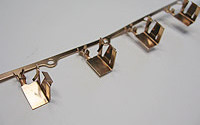 Creating reels of close tolerance terminals and contacts requires advanced stamping techniques. We employ progressive die and four-slide/multi-slide stamping to manufacture enormous volumes of high-precision components (sometimes 20 million or more parts) with the industry’s closest tolerances, including down to ± .001”.
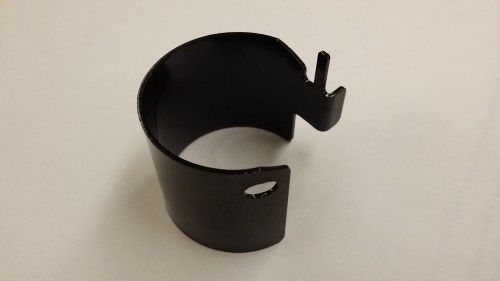 Highly efficient and cost effective,