

Tool & Die Manufacturing
Crafting Consistent and Precise Metal Components
One of the most common and versatile manufacturing techniques, metal stamping is a cold-forming process that presses raw material into a die to change its shape. Stamping allows manufacturers to quickly process high-volume runs, crafting consistent and precise metal components at minimal expense.
Tooling is key to the success of any stamping project. In particular, the stamping die itself must be designed to yield precise results, and it must be well-made to prevent premature wear. In this guide, the experts at Keats Manufacturing have compiled everything you need to know about manufacturing custom stamping dies to help you better assess your tooling needs. The information that follows will put readers in a more informed position when it comes time to assess and select stamping die suppliers.
What is a Stamping Die?
In metal stamping, a male punch forces a piece of sheet metal into a female die with a matching concave shape. The stamping machine applies sufficient pressure until the metal is forced to conform to the die’s shape without the application of heat. Depending on the application, the die may be designed to form or cut the metal or may do both at once.
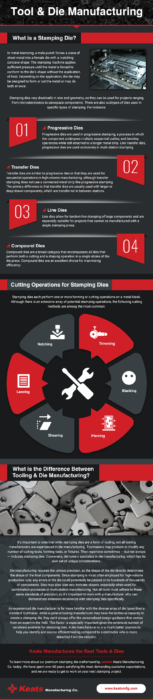
Stamping dies vary drastically in size and geometry, as they can be used for projects ranging from microelectronics to aerospace components. There are also subtypes of dies used in specific types of stamping. For instance:
- Progressive dies are used in progressive stamping, a process in which the component undergoes multiple sequential cutting and bending operations while still attached to a longer metal strip. Like transfer dies, progressive dies are used exclusively in multi-station stamping.
- Transfer dies are similar to progressive dies in that they are used for sequential operations in high-volume manufacturing, although transfer stamping does not use a connected metal strip like progressive stamping. The primary difference is that transfer dies are usually used with larger or deep-drawn components, which are transferred in between stations.
- Line dies allow for tandem-line stamping of large components and are especially suitable for projects that cannot be manufactured with a single stamping press.
- Compound dies are a broad category that encompasses all dies that perform both a cutting and a shaping operation in a single stroke of the die press. Compound dies are an excellent choice for maximizing efficiency.
The best type of stamping die for your project depends on the manufacturing technique and the geometry of your component. Your supplier can help you determine the most suitable option for your needs.
Cutting Operations for Stamping Dies
Stamping dies each perform one or more forming or cutting operations on a metal blank. Although there is an extensive array of potential stamping operations, the following cutting methods are among the most common:
What is the Difference Between Tooling & Die Manufacturing?
It’s important to note that while stamping dies are a form of tooling, not all tooling manufacturers are experienced in die manufacturing. Toolmakers may produce or modify any number of cutting tools, forming tools, or fixtures. Their repertoire sometimes — but not always — includes stamping dies. Conversely, diemakers specialize in die manufacturing, which has its own set of unique considerations.
Die manufacturing requires the utmost precision, as the shape of the die directly determines the shape of the final components. Since stamping is most often employed for high-volume production runs, any errors in the die could potentially be passed on to hundreds of thousands of components. Dies may also take very intricate shapes, especially when used for combination processes or multi-station manufacturing. Not all tools must adhere to these same standards of precision, so it’s important to work with a manufacturer who can demonstrate extensive experience with stamping dies specifically.
An experienced die manufacturer is far more familiar with the diverse array of die types than a standard toolmaker. While a general tooling manufacturer may have the technical capacity to create a stamping die, they can’t always offer the personalized design guidance that comes from an expert in the field. This factor is especially important given the extensive number of variations available for stamping dies. A die manufacturer is in a much better position to help you identify and source efficient tooling compared to a contractor who is more detached from the industry.
Keats Manufactures the Best Tools & Dies
At Keats Manufacturing Co., we don’t hesitate to take on the most complex stamping die challenges. In fact we have relished in the challenge to develop stamping dies which produce the most complex parts in the world since 1958, drawing on our industry-specific knowledge to deliver premium results every time. Our decades of extensive tooling design experience, and specific expertise in crafting efficient and precise dies make us the industry leader.
Our cutting, forming, and combination dies are crafted from durable materials and optimized for quick changeovers and easy maintenance, so you can trust in the longevity of your investment. We also adhere to rigorous ISO 9001, ISO 14001, and IATF 16949 quality management protocols in all of our processes, and we are so confident in our tooling’s performance that we offer a lifetime guarantee.
To learn more about our premium stamping die craftsmanship, contact Keats Manufacturing Co. today. We have spent over 60 years satisfying the most demanding customer expectations, and we are ready to get to work on your next stamping project.
Frequently Asked Questions
What steps does Keats Manufacturing take in tool and die development?
At Keats Manufacturing Co., our tool and die development process includes:
- In-house design and engineering to ensure precision and efficiency.
- Utilization of one of the largest fleets of four-slide machines in North America, including unique Wünsch multi-slide machines.
- A lifetime guarantee on tooling, ensuring our clients receive durable, high-quality products.
How does Keats ensure precision in its tooling and die manufacturing?
Keats Manufacturing Co. guarantees exceptional precision through:
- Extensive high-precision tolerances of ±0.0002 inches for stamping.
- State-of-the-art facilities located in Illinois, Texas, and Mexico to leverage advanced technology.
- Certified to ISO 9001, ISO 14001, and IATF 16949 standards, ensuring quality throughout the manufacturing process.
Can Keats Manufacturing develop custom tooling for unique projects?
Yes, Keats Manufacturing Co. specializes in custom tooling development for various applications:
- Our engineering team collaborates closely with clients to understand specific requirements.
- We leverage our advanced equipment and expertise to develop tailored solutions.
- Each tooling project is backed by our lifetime guarantee, ensuring reliability and performance.
What types of materials can Keats use for tool and die development?
Keats Manufacturing Co. works with a variety of materials for tool and die development:
- Keats selects only the best tool steel for each application. Specific tool steel grades depend on the function of the die component.
- Our in-house capabilities allow us to select the best materials for durability and precision.
- We prioritize material selection to meet both performance and cost-efficiency.
How long does the tool and die development process take at Keats?
The timeline for tool and die development at Keats Manufacturing Co. can vary based on project complexity:
- Simple designs may take 4 to 6 weeks, while more complex tooling can take 20-26 weeks.
- We maintain open communication with clients to provide updates and manage expectations.
- Our efficient in-house processes help expedite development while ensuring quality.
What industries does Keats Manufacturing serve with its tool and die services?
Keats Manufacturing Co. serves a variety of industries with our tool and die expertise:
- We cater to high-volume industrial and engineering applications, including automotive and appliances.
- Keats is a key supplier to the electrical distribution and circuit breaker industry.
- Our diverse experience positions us to meet the specific needs of different markets.
Does Keats offer support after the tool and die development is complete?
Yes, Keats Manufacturing Co. provides ongoing support after tool and die development:
- We offer maintenance and repair services to ensure optimal performance of your tooling.
- Our team is available for consultation and troubleshooting as needed.
- Our commitment to quality includes continuous support to maximize your investment.
What distinguishes Keats' tool and die development from competitors?
Keats Manufacturing Co. stands out in tool and die development due to:
- Ownership of one of North America's largest fleets of advanced four-slide machines.
- Our in-house tool and die development process, backed by a lifetime guarantee.
- Comprehensive compliance with industry standards, ensuring reliability and excellence in every project.