Custom Metal Stamping Manufacturer

What Are Metal Stamping Parts?
Metal stamping parts are components created through a manufacturing process that involves the deformation of metal sheets. This technique produces complex shapes and designs with high precision and repeatability.
Common materials used in metal stamping include:
| Material | Key Properties |
|---|---|
| Steel | Known for its strength and durability. |
| Aluminum | Lightweight and resistant to corrosion. |
| Stainless Steel | Known for its corrosion resistance and strength. |
| Brass | Offers excellent machinability and conductivity. |
| Copper | Known for its electrical conductivity. |
These materials are chosen based on the specific requirements of the application, ensuring that the final product meets performance and durability standards. At Keats Manufacturing Co., we utilize techniques such as CNC (computer numerical control) and CAD/CAM to ensure that every part is manufactured with exceptional precision. Our commitment to quality means that we can achieve tolerances as tight as ±0.0002 in / 0.005mm., ensuring that your components meet the highest standards.
What Is Metal Stamping Called?
What Is Metal Stamping? refers to the process of shaping sheet metal using dies and presses. The industry uses various related terms to describe similar or overlapping processes. Some synonyms and related terms include:
- Sheet Metal Fabrication: A broader term encompassing various processes, including stamping.
- Metal Forming: An umbrella term that includes any process that shapes metal.
- Progressive Stamping: A term that refers to producing parts on a progressive die
Understanding these terms can help clarify the specific processes and capabilities offered by custom metal stamping manufacturers. At Keats, all dies and tooling are engineered and built in-house, allowing us to maintain strict quality control and customization capabilities. This in-house development ensures that we can adapt quickly to your specific needs, whether you are looking for a prototype or high-volume production runs.
Can You Explain the Different Types of Metal Stamping Processes Used in Manufacturing?
Metal stamping is one of the most widely used manufacturing processes today, utilizing metal presses to stamp, punch, bend, emboss, tool, and notch metal sheets to form complex parts. This process encompasses a variety of specific techniques and large-scale methodologies.
1. Four-Slide/Multi-Slide Stamping: Four-slide stamping is a sophisticated alternative to conventional progressive die stamping that excels at producing complex metal goods with a high degree of accuracy and control. Additionally, Four-Slide/Multi-Slide Stamping often utilizes less material to produce a part than other methods.
2. Progressive Die Stamping: Progressive die stamping, often associated with a traditional punch press, is a high-volume manufacturing method where the part stays attached to the strip as it progresses through multiple bending, cutting and forming operations until it is finally broken free in the last operation.
Specific Metal Stamping Operations:
Blanking, Piercing, Punching, Bending, Coining, Flanging, Embossing, Drawing, and Curling.

Manufacturers use several metal stamping processes, within the same set of tooling, each suited for different part requirements, each performed by its own punch and die within the larger toolset.
Understanding these sheet metal stamping processes enables manufacturers to choose the right method for their specific needs. At Keats Manufacturing Co., we leverage over 150–175 stamping and wire-forming machines across three facilities, allowing us to offer a diverse range of stamping processes tailored to your project requirements. We offer The Many Benefits of Just-In-Time Inventory delivery, which ensures that your components are delivered exactly when you need them, minimizing inventory costs and streamlining your supply chain.
Our lifetime guarantee on tooling protects your investment and enables long-term partnerships built on trust and reliability. We also offer secondary services such as deburring, plating, and heat treating, ensuring complete process coverage.. This full-service approach enhances efficiency and simplifies communication and project management for our clients. Our decades of experience, since 1958, across multiple industries, provide the expertise to guide you through every step of the custom metal stamping process.
What are some common applications or industries that utilize sheet metal stamping?
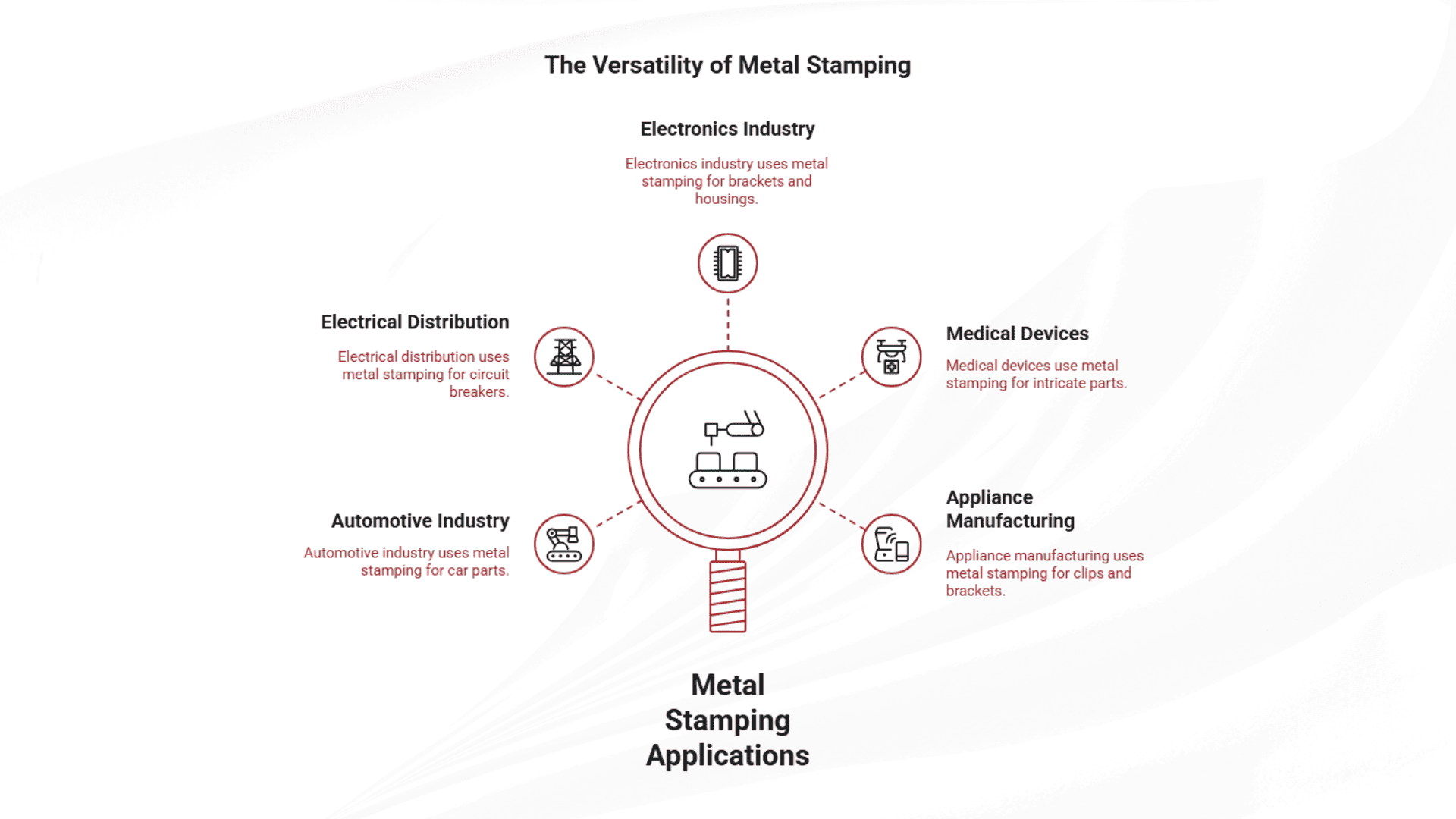
Sheet metal stamping is widely used across multiple industries because it enables consistent, repeatable component production :
Appliance
Medical devices
Electrical distribution
Renewable energy
- Automotive: Components like brackets, chassis parts, and engine components.
- Appliance: Structural parts, brackets, and enclosures.
- Medical devices: Surgical instruments and housings.
- Electrical distribution: Connectors and enclosures.
- Renewable energy: Components for solar panels and wind turbines.
These applications highlight the versatility and importance of metal stamping in various sectors. Keats Manufacturing Co. has played a meaningful role in the automotive industry, with nearly every car in North America containing a part manufactured by us, showcasing our extensive experience and capability in delivering high-quality components.

What are the key features to look for when choosing a stamping manufacturer?
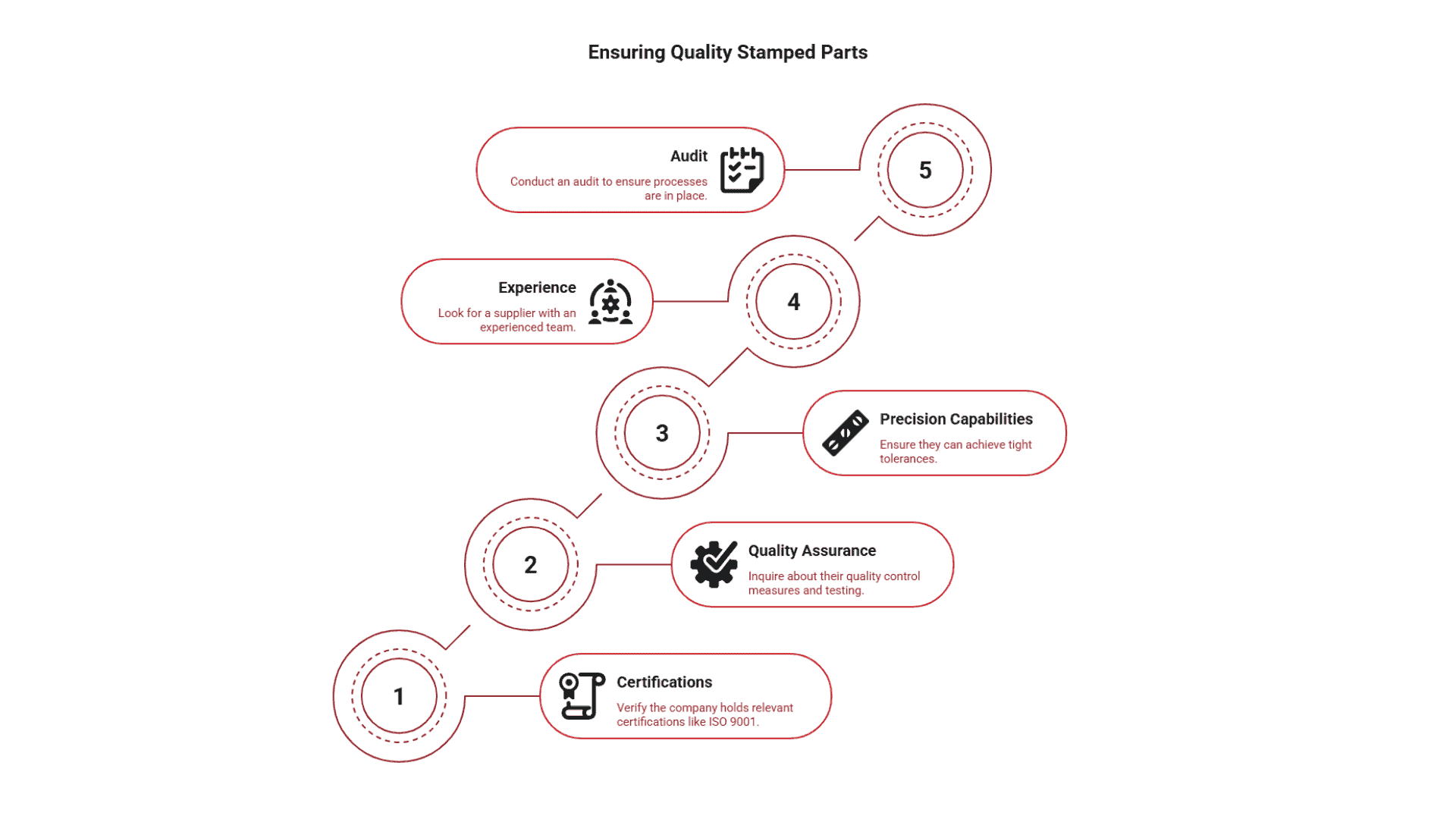
The most important features to consider when choosing the best custom metal stamping manufacturer include experience, technology, customer support, and certifications:
- Experience: Look for manufacturers with a proven track record in your industry.
- Technology: Advanced machinery and techniques can enhance precision and efficiency. At Keats, we operate over 150–175 stamping and wire-forming machines across three facilities, ensuring that we can meet diverse manufacturing needs.
- Customer service: A responsive and knowledgeable team can address your needs successfully.
- Certifications: Ensure the manufacturer holds relevant quality certifications, such as ISO 9001, IATF 16949, and ISO:14001, to guarantee adherence to industry standards. Our multiple high-level certifications reflect our commitment to quality and reliability.
These factors are essential for ensuring quality and reliability in your manufacturing processes. Additionally, Keats offers in-house tooling backed by a lifetime guarantee, which further enhances our reliability as a manufacturing partner.
Evaluating these criteria together can significantly reduce sourcing risk and improve long-term program success. Our blog Key Considerations When Choosing a Metal Stamping Partner, explores this evaluation process in more detail.
Are there any stamping trends right now?
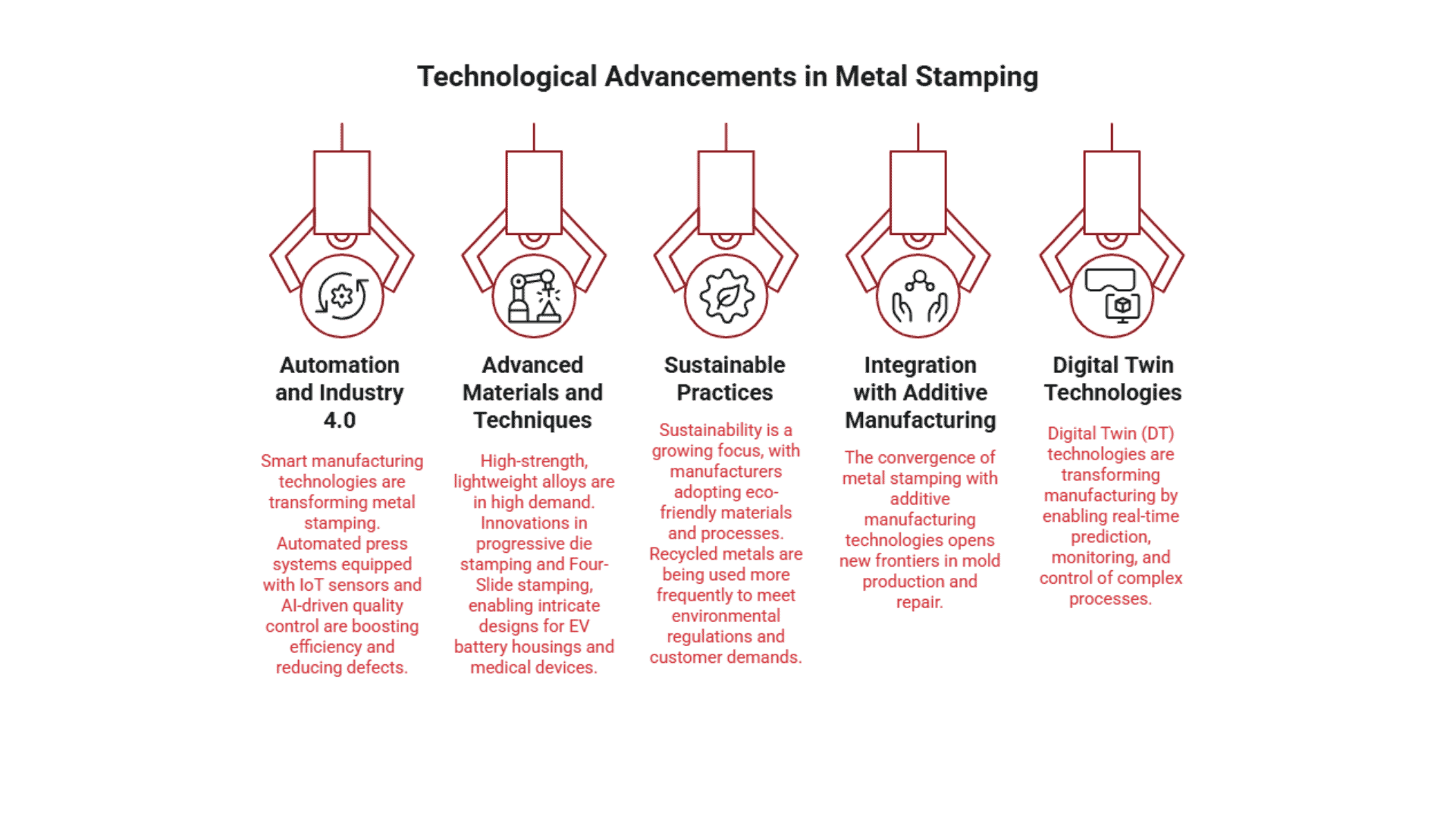
The metal stamping industry is evolving, with several notable trends:
- Automation: Increased use of automated processes enhances efficiency and reduces labor costs. At Keats, our just-in-time (JIT) delivery capability includes automated assembly processes that can handle up to 200 pieces per minute, demonstrating our commitment to efficiency.
- Sustainability: Manufacturers are focusing on eco-friendly practices, such as reducing waste and using recyclable materials.
- Advanced materials: The adoption of high-strength materials allows for lighter and more robust designs.
How long has metal stamping been around?
The history of metal stamping dates back to the 19th century, with considerable advancements occurring during the Industrial Revolution. Initially, metal stamping was done manually, but the introduction of mechanized processes revolutionized the industry. Over the years, the technology has evolved, leading to the development of sophisticated machinery that allows for high precision and efficiency in production. Today, manufacturers like us leverage technologies such as CNC and CAD/CAM to achieve tolerances as tight as ±0.0002 in., ensuring that our products meet the highest standards of quality.
Who makes stamping presses?
Major stamping manufacturers worldwide include both large corporations and specialized firms. When choosing press equipment for metal stamping operations, consider:
- Type of press: Mechanical vs. hydraulic presses, each with its advantages.
- Capacity: Ensure the press can handle the required tonnage for your applications.
- Technology: Look for features like CNC controls for enhanced precision.
Selecting the right equipment ensures optimal results in your metal stamping operations. Keats Manufacturing Co. stands out by engineering and building all dies and tooling for our presses in-house, ensuring that we maintain strict quality control throughout the manufacturing process. Our in-house tool and die development capabilities, including EDM (electrical discharge machining), further enhance our ability to produce high-quality stamped parts.
Conclusion
The most important features to consider when choosing the best custom metal stamping manufacturer include experience, technology, customer support, and certifications:
Ready to explore the metal stamping industry further?
Discover the top companies, innovative techniques, and industry insights that can elevate your projects.
Frequently Asked Questions
What industries benefit from custom metal stamping services?
At Keats Manufacturing Co., our custom metal stamping services are tailored for a wide range of industries, including:
- Medical, where our precision stamping ensures reliability for life-saving devices with tolerances of ±0.0005 in.
- Consumer products, enabling innovative designs for everyday items. With extensive industry knowledge since 1958, we meet the unique requirements of each sector through in-house tool & die development and a commitment to quality.
How does Keats ensure high precision in metal stamping?
Keats Manufacturing Co. ensures high precision in metal stamping by:
- Utilizing one of the largest fleets of four-slide machines in North America, including unique Wünsch multi-slide machines for complex designs
- Implementing rigorous quality control measures throughout the production process, including extensive high-precision tolerances of ±0.0005 in. for stamping
- Leveraging skilled technicians with extensive experience in metal forming techniques. This dedication guarantees that your components consistently meet the required specifications.
Can you explain the metal stamping process used at Keats?
The metal stamping process at Keats Manufacturing Co. includes several essential stages:
- Initial design consultation to tailor solutions to your needs as a custom metal stamping manufacturer
- High-speed stamping with our state-of-the-art equipment for intricate designs
- Rigorous inspection protocols that comply with industry standards, ensuring product reliability and consistency. This method guarantees precision and quality throughout the production cycle.
What types of materials can Keats use for metal stamping?
Keats Manufacturing Co. utilizes a diverse range of materials for metal stamping, including:
- High carbon steel for parts requiring strength, hardness, and wear resistance.
- Low carbon steel for cost-effective components that need good formability and versatility.
- Stainless steel for applications requiring corrosion resistance, durability, and a clean finished appearance.
- Copper and brass alloys for electrical conductivity, corrosion resistance, and forming performance.
- Aluminum for lightweight components with strong strength-to-weight advantages.
Custom-engineered and specialty alloys selected to meet unique performance, environmental, or application-specific requirements
How does Keats handle high-volume production for metal stamping?
At Keats Manufacturing Co., we manage high-volume production effectively by:
- Leveraging our extensive fleet of four-slide machines, including unique Wünsch multi-slide machines, to enhance operational efficiency as a Custom Metal Stamping Manufacturer.
- Implementing rigorous quality control measures throughout the manufacturing process, including ISO 9001 and IATF 16949 certification.
- Utilizing a skilled workforce trained in advanced metal stamping techniques. This allows us to fulfill large orders promptly while ensuring exceptional quality.
What is the lead time for custom metal stamping orders at Keats?
Lead times for custom metal stamping at Keats Manufacturing Co. typically depend on:
- The intricacy of the design and any required revisions
- Our current workload and resource allocation across our facilities in IL, TX, and Mexico
- The sourcing and readiness of raw materials, which are critical for any custom metal stamping manufacturer. We prioritize timely delivery and will provide a precise timeline during the order consultation process.
Does Keats Manufacturing Co. provide design assistance for custom parts?
Yes, Keats Manufacturing Co. offers comprehensive design assistance, including:
- Collaboration with your engineering team to refine prototypes specific to custom metal stamping projects
- Insights on material selection to enhance durability and performance
- Access to simulation tools for evaluating design functionality. Our goal is to ensure your custom parts are produced to the highest standards.
What quality assurance measures does Keats have in place?
Keats Manufacturing Co. emphasizes quality assurance through:
- Implementation of a robust internal audit system to monitor compliance with custom metal stamping standards
- Use of state-of-the-art inspection technology for precise measurements
- Regular training programs for staff to uphold quality standards These initiatives guarantee that each component adheres to your exacting quality specifications.