

What types of metal stamping services do these companies typically offer?
Comments Off on What types of metal stamping services do these companies typically offer?
Metal stamping is an essential process in manufacturing, integral to producing high-precision components across various industries. Understanding the types of metal stamping services available can help engineering and procurement professionals make informed decisions when selecting a supplier. This article delves into the different metal stamping services offered by companies, the processes involved, and their applications, providing a comprehensive overview for those in need of custom solutions.
What is precision metal stamping?
Precision metal stamping is a manufacturing process that involves shaping and cutting metal using specialized dies and presses. This method is crucial for producing components with high accuracy and tight tolerances, which are essential in industries where even minor deviations can lead to significant issues.
±0.0002″
Tolerances for stamping
The importance of precision metal stamping lies in its ability to achieve tolerances as tight as ±0.0002 inches for stamping. These precise specifications ensure that parts fit together perfectly, enhancing the overall quality and reliability of the final product. Companies often rely on custom metal stamping dies designed specifically for their unique applications, further improving the accuracy of the components produced. Keats Manufacturing Co. excels in this area, offering in-house tool and die development with a lifetime guarantee, ensuring that your custom solutions are built to last.
What are the different types of metal stamping?
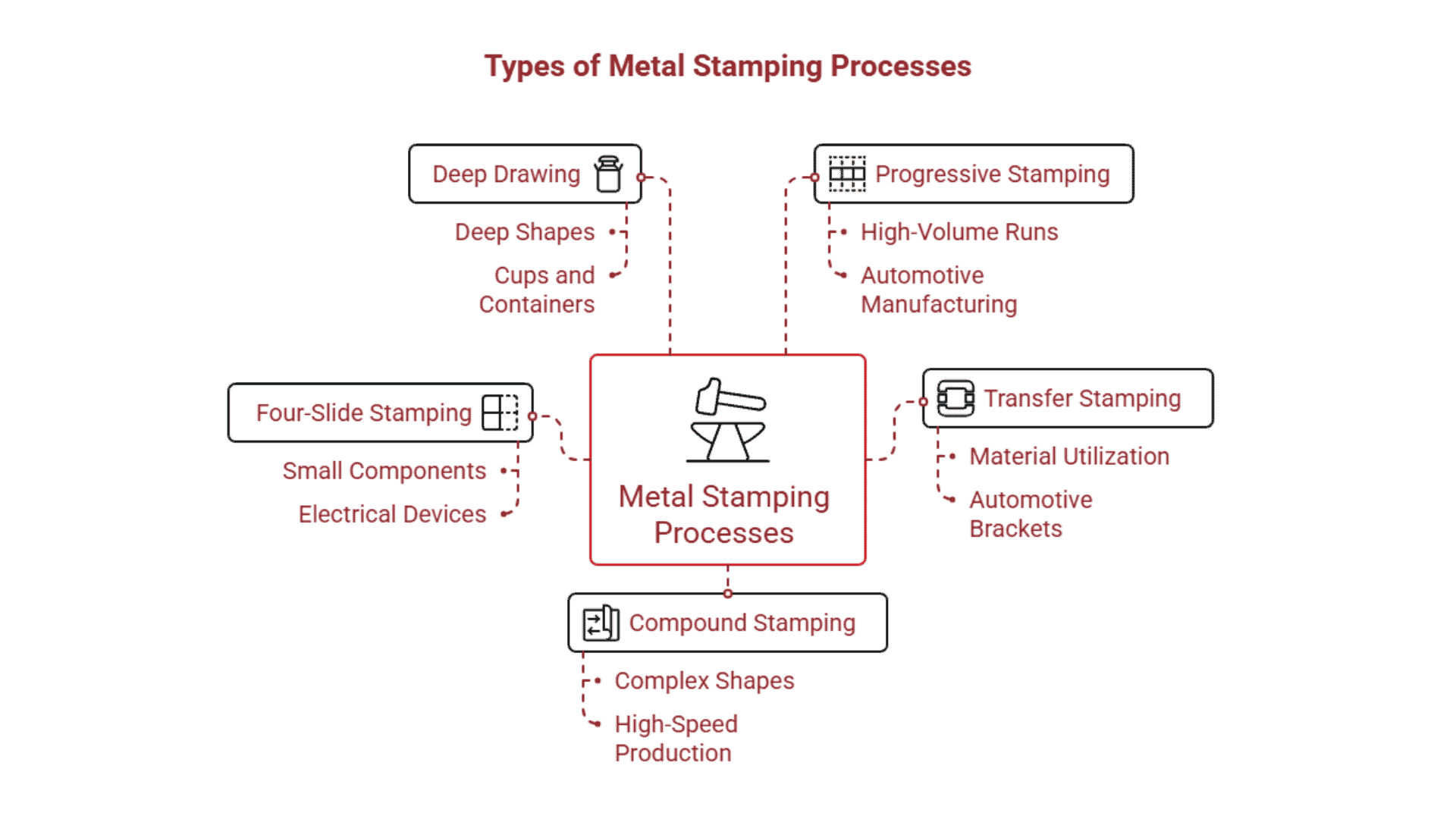
Metal stamping encompasses various processes, each suited to specific applications and industries. Here are some of the primary types of stamping processes:
- Progressive Stamping:
This method uses a series of dies in a single press stroke, allowing for the continuous production of parts. It’s ideal for high-volume runs and is commonly used in automotive and appliance manufacturing. - Transfer Stamping:
Similar to progressive stamping, this process uses a mechanical actuating system to move the part through the tool instead of keeping it attached to the carrier strip. This allows for better material utilisation and complete workability of the part. It is frequently used in the production of large automotive parts like brackets. - Compound Stamping:
This combines multiple operations into one press stroke, enabling the creation of complex shapes and features in a single step. It’s often used for producing simple parts at high rates of speed. - Four-Slide Stamping:
Utilizes multiple mechanically actuated or servo driven slides to form parts from metal strips. This process is particularly beneficial for creating small components, commonly found in electrical and medical device applications. Keats Manufacturing operates one of the largest fleets of four-slide machines in North America, including unique Wünsch multi-slide machines, which enhance production capabilities for complex geometries. - Deep Drawing:
This technique involves pulling a metal sheet into a die to create deep, hollow shapes. It’s widely used in the manufacturing of cups, containers and automotive parts.
Understanding these processes helps companies select the right method based on their specific needs, ensuring they receive the best possible solutions for their applications.
What are the different types of metal stamping presses?
The choice of stamping press significantly impacts the efficiency and quality of the metal stamping process. Here are the main types of stamping presses:
Mechanical Presses
Most common type, using motor-driven flywheels for speed and efficiency. Preferred for high-volume production.
Servo Presses
Utilize servo motors for precise control, energy efficiency, and flexibility in complex operations.
Hydraulic Presses
Use fluid pressure for high-force control. Ideal for deep drawing and heavy-duty applications.
Each press type has its advantages and disadvantages, which companies must consider when selecting the best option for their specific metal stamping needs.
What industry is metal stamping in?
Metal stamping plays a vital role in several key industries, including:
| Industry | Core Applications |
|---|---|
| Automotive | Brackets, clips, and electrical terminals for vehicle reliability and safety. |
| Appliance | Critical durable and high-precision parts for household appliances. |
| Electronics | Connectors and housings requiring intricate design and high reliability. |
| Medical Devices | Components meeting stringent regulatory standards and tight tolerances. |
The impact of metal stamping in these industries cannot be overstated; it enhances production efficiency and ensures the quality of components that are integral to the functionality of various products.
What are sheet metal stamping dies?
Sheet metal stamping dies are critical tools in the metal stamping process. They are designed to shape and cut metal sheets into specified forms. There are several types of dies used in stamping:
- Progressive Dies: Allow for multiple operations in a single press stroke, ideal for high-volume production.
- Single-Operation Dies: Used for simple parts that require only one stamping operation.
- Compound Dies: Combine multiple operations into one, suitable for more complex shapes.
Understanding the range of die configurations available is only part of the decision process. Our blogKey Considerations When Choosing a Metal Stamping Partner outlines the factors that help ensure those capabilities align with your production, quality, and long-term manufacturing goals.
Custom metal stamping dies are tailored to meet specific application requirements, ensuring that the components produced are not only precise but also optimized for performance.
Conclusion
In conclusion, understanding the various metal stamping services and processes available empowers companies to make informed decisions that enhance their manufacturing capabilities. From precision metal stamping to the different types of presses and dies, each element plays a vital role in producing high-quality components.
Ready to explore the world of metal stamping?
Dive deeper into our custom metal stamping services for expert insights, industry trends, and tips on choosing the right metal stamping company for your needs.
What are the benefits of metal stamping?
Comments Off on What are the benefits of metal stamping?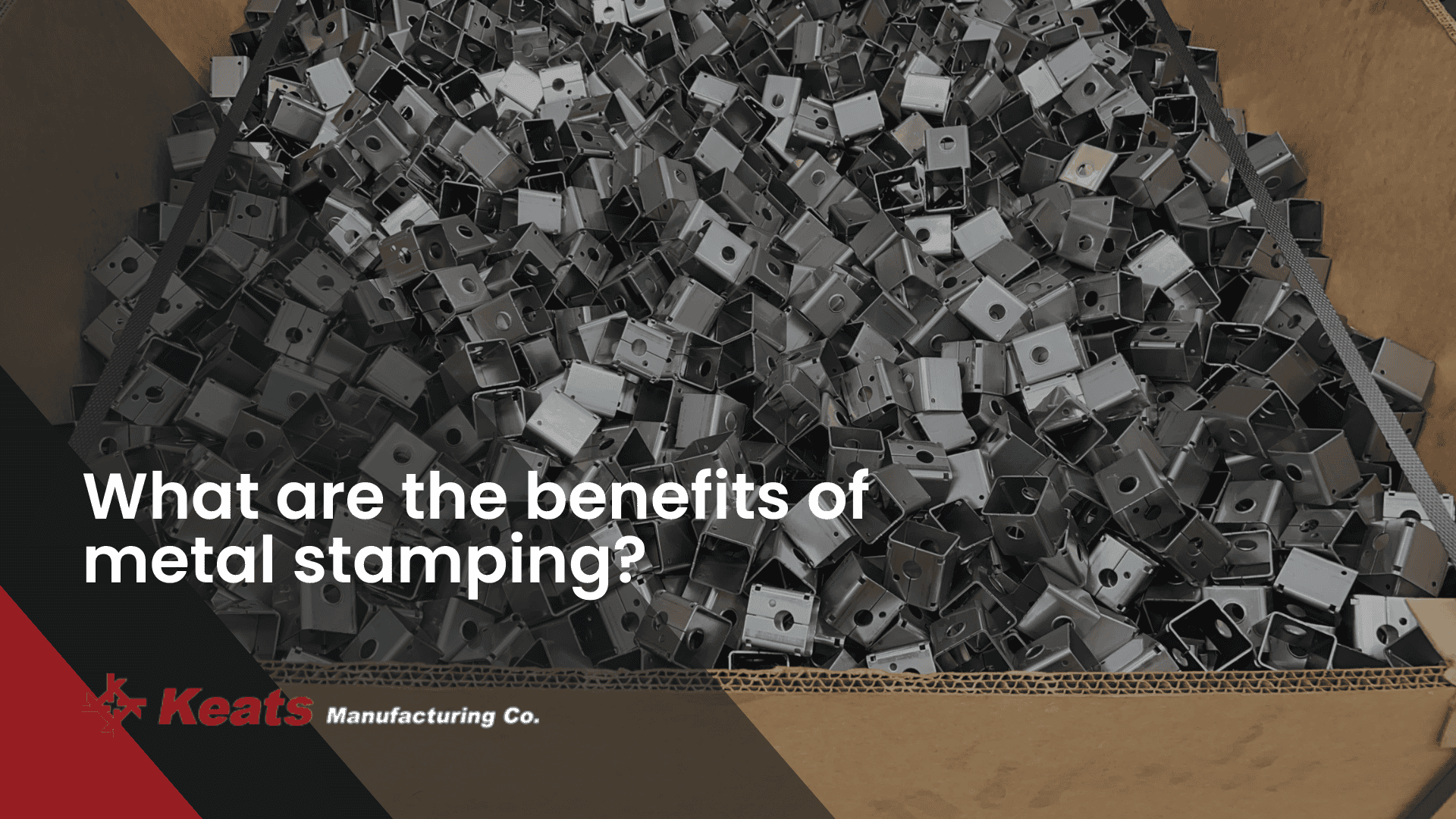
Metal stamping is a cornerstone of modern manufacturing, offering a range of advantages that enhance efficiency, precision, and cost-effectiveness. As industries continue to demand high-quality components, understanding the benefits of metal stamping becomes essential for engineering and procurement professionals. In this article, we will explore the purpose of stamping, its applications across various sectors, the advantages over traditional methods, potential drawbacks, and considerations for materials like stainless steel.
What is the purpose of stamping?
Metal stamping is a manufacturing process that involves converting flat metal sheets into specific shapes using a series of dies and presses. This technique plays a crucial role in various industries, providing a reliable method for producing high-quality components.
Basic Mechanics of the Metal Stamping Process
- Material Selection: Choosing the appropriate metal based on application requirements.
- Die Design: Custom dies to shape the metal according to specifications.
- Stamping: Applying pressure to the metal sheet with a stamping press, which shapes the material into the desired form.
- Finishing: Implementing secondary processes such as plating or coating to enhance durability and performance.
This method is especially favored for its ability to produce intricate designs with tight tolerances, making it ideal for high-volume production.
What are metal stampings used for?
Metal stampings find applications across a multitude of industries, showcasing their versatility and essential role in manufacturing. Some examples include:
Used for components such as brackets, clips, and electrical terminals.
Essential for producing parts like connectors and housings.
Critical in the manufacture of precision components that meet stringent regulatory standards.
The focus is on high volume / low cost.
For those seeking reliable solutions, partnering with automotive stamping companies can ensure the delivery of high-quality components tailored to specific needs.
Can you explain the key advantages of using stamping over traditional methods?
When comparing stamping techniques to traditional manufacturing methods like die casting and machining, several key advantages come to light:
Extreme Precision Metric±0.0002 in.
Maximum tolerances achievable for complex applications.
When these advantages are paired with custom tooling and process optimization, the impact on performance and scalability becomes even greater. Our blog Benefits of Custom Metal Stamping explores how tailored stamping solutions amplify these benefits.
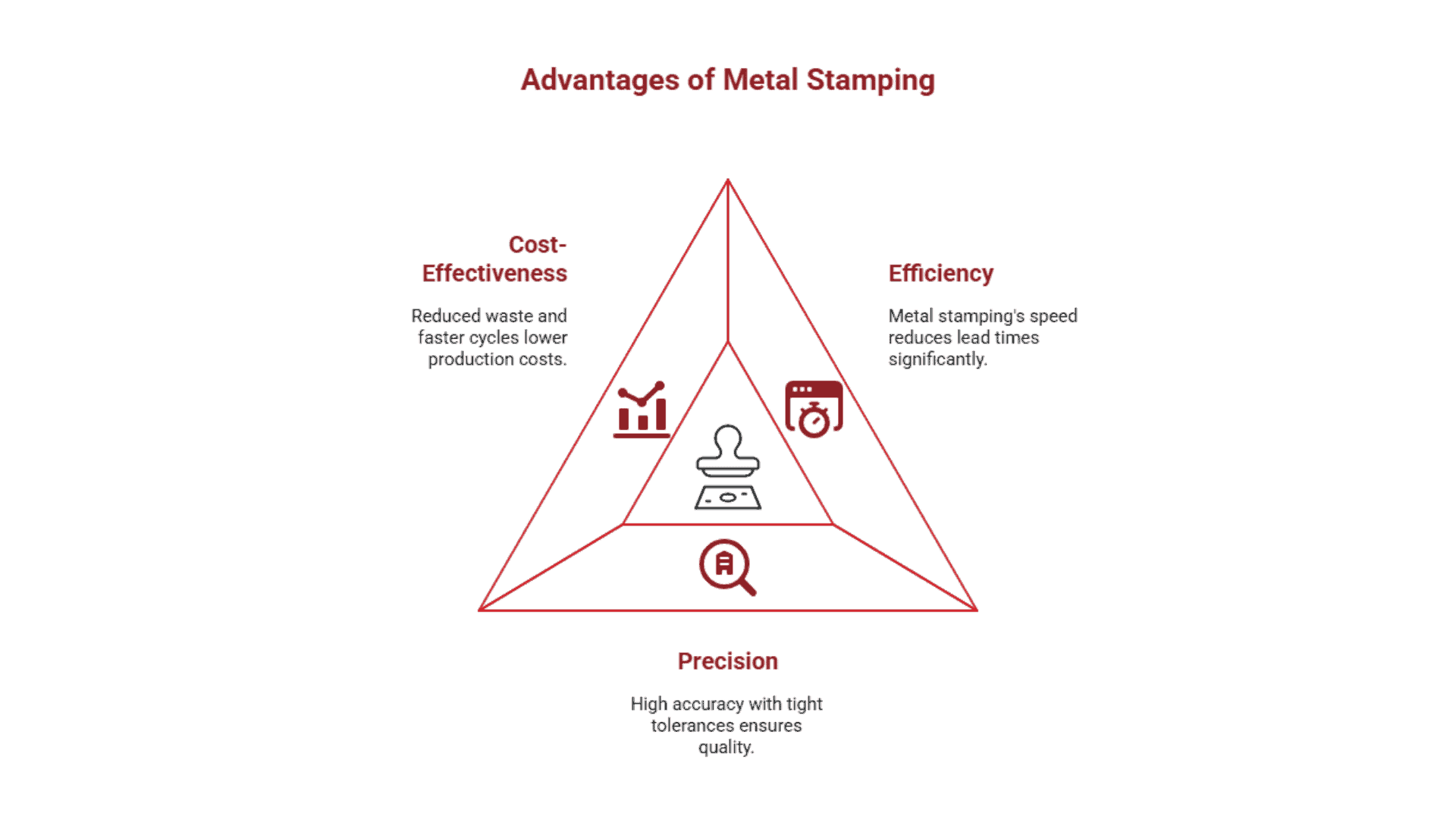
These benefits make metal stamping a preferred choice for industries that demand both quality and efficiency in their manufacturing processes. Notably, Keats Manufacturing operates one of the largest fleets of four-slide machines and power presses in North America, enabling the production of complex shapes and designs with high precision.
What are the disadvantages of metal pressing?
While metal stamping offers numerous advantages, it is essential to consider potential drawbacks:
- Material Waste: Depending on the design, there can be significant scrap material generated during the stamping process.
- Initial Setup Costs: The cost of developing custom tooling and dies can be high, which may deter some businesses from adopting this method.
- Material Limitations: Not all materials are suitable for stamping, and some may require specialized techniques or tools.
Understanding these limitations is crucial for making informed decisions about manufacturing processes.
Can you stamp stainless steel?
Yes, stamping stainless steel is feasible, but it requires specific considerations and techniques. The properties of stainless steel, such as its strength and ductility, present unique challenges during the stamping process.
Techniques and Tools Required
To effectively stamp stainless steel, manufacturers often employ:
- High-Strength Tools: Specialized dies are necessary to handle the toughness of the material.
- Lubrication: Proper lubrication is essential to reduce friction and prevent tool wear.
- Sheet Metal Design Guidelines: Following sheet metal design guidelines can help ensure successful stamping outcomes by optimizing part geometry.
By utilizing the right techniques and tools, manufacturers can achieve high-quality stainless steel components that meet rigorous industry standards. Keats Manufacturing’s in-house tool and die development ensures that tooling is tailored to specific needs, backed by a lifetime guarantee.
Conclusion
In summary, the benefits of metal stamping are significant, providing efficiency, precision, and cost-effectiveness that are vital for high-volume production. From automotive components to medical devices, the versatility of metal stampings makes them indispensable in various industries. Understanding both the advantages and limitations of this process equips engineering and procurement professionals to make informed decisions.
Ready to explore the world of metal stamping?
Discover how our custom metal stamping solutions can transform your projects. Visit our offerings at Keats Manufacturing or contact our engineering team to discuss your specific requirements!
Frequently Asked Questions
What are the major advantages of using metal stamping in manufacturing?
Metal stamping offers several significant advantages through Keats Manufacturing Co.:
- Precision: Our advanced CNC technology allows for intricate designs with tolerances as tight as ±0.0005 in. for stamping.
- Efficiency: Utilizing our state-of-the-art four-slide machines, we significantly reduce production time while maintaining quality.
- Custom Solutions: Our in-house tool & die development ensures that we meet specific client needs effectively and innovatively, backed by a lifetime guarantee.
How does metal stamping contribute to cost savings?
Metal stamping contributes to cost savings by offering several efficiencies:
- High-speed production: Rapid processing reduces labor costs and increases output.
- Material efficiency: Precision techniques minimize waste, optimizing material use.
- Scalability: Economies of scale lower per-unit costs for large orders.
- Tooling longevity: Durable dies reduce the need for frequent replacements.
- Automation potential: Streamlined automation further decreases production expenses.
What industries benefit most from metal stamping?
Various industries benefit from metal stamping, and at Keats Manufacturing Co., we specialize in:
- Automotive
- Electrical distribution
- Appliance
- Industrial
- HVAC
- Medical
- Telecommunications
- Solar and renewable energy
- Irrigation
- General machinery
Can metal stamping be used for complex shapes and designs?
Yes, metal stamping excels in producing complex shapes, and Keats Manufacturing Co. offers:
- Precision Engineering: Our state-of-the-art Wünsch multi-slide machines ensure tight tolerances for intricate designs, achieving precision up to ±0.0003 in. for stamping.
- Custom Tooling: We collaborate closely with clients to create tailored tooling that meets specific design needs, backed by our in-house tool & die development.
- Material Adaptability: We work with various metals, allowing for diverse applications and design complexities.
What is the role of quality assurance in metal stamping?
At Keats Manufacturing Co., quality assurance is paramount in metal stamping, featuring:
- Advanced Technology: We utilize our unique Wünsch multi-slide machines and state-of-the-art equipment to enhance precision and efficiency, ensuring high-quality, consistent parts.
- Comprehensive Inspections: Our team conducts detailed inspections throughout the production process, including in-house tool & die development, to ensure each part meets our stringent specifications.
- Customer Satisfaction: We prioritize client feedback to continuously improve our quality standards and adhere with ISO 9001, ISO 14001, and IATF 16949.
How does metal stamping improve product durability?
Metal stamping enhances product durability by leveraging precise and consistent manufacturing techniques. Key benefits include:
- Superior Strength: Metal stamping processes like deep drawing increase the tensile strength of components.
- Material Efficiency: Optimizes metal properties, ensuring less wear and tear over time.
- Precision Engineering: Produces uniform parts, reducing weak spots that could lead to failure.
- Cost-Effectiveness: Enables mass production without compromising quality, ensuring long-lasting products.
What types of materials can be used in metal stamping?
Metal stamping accommodates a diverse range of materials, each offering unique properties for specific applications:
- Steel: Ideal for strength and durability.
- Aluminum: Lightweight and corrosion-resistant.
- Copper: Excellent electrical conductivity.
- Brass: Good machinability and corrosion resistance.
- Stainless Steel: Offers high corrosion resistance and strength.
Choosing the right material enhances performance and cost-efficiency in manufacturing processes.
How does Keats Manufacturing Co. ensure environmental compliance in metal stamping?
Keats Manufacturing Co. prioritizes environmental compliance in metal stamping through several key initiatives:
- Adherence to stringent environmental regulations and standards.
- Implementation of waste reduction and recycling programs.
- Utilization of eco-friendly materials whenever possible.
- Continuous monitoring and improvement of energy efficiency in operations.
- Regular training for employees on sustainable practices and compliance requirements.
These actions ensure that our processes align with both industry standards and environmental responsibilities.
Can you explain the different types of metal stamping processes used in manufacturing?
Comments Off on Can you explain the different types of metal stamping processes used in manufacturing?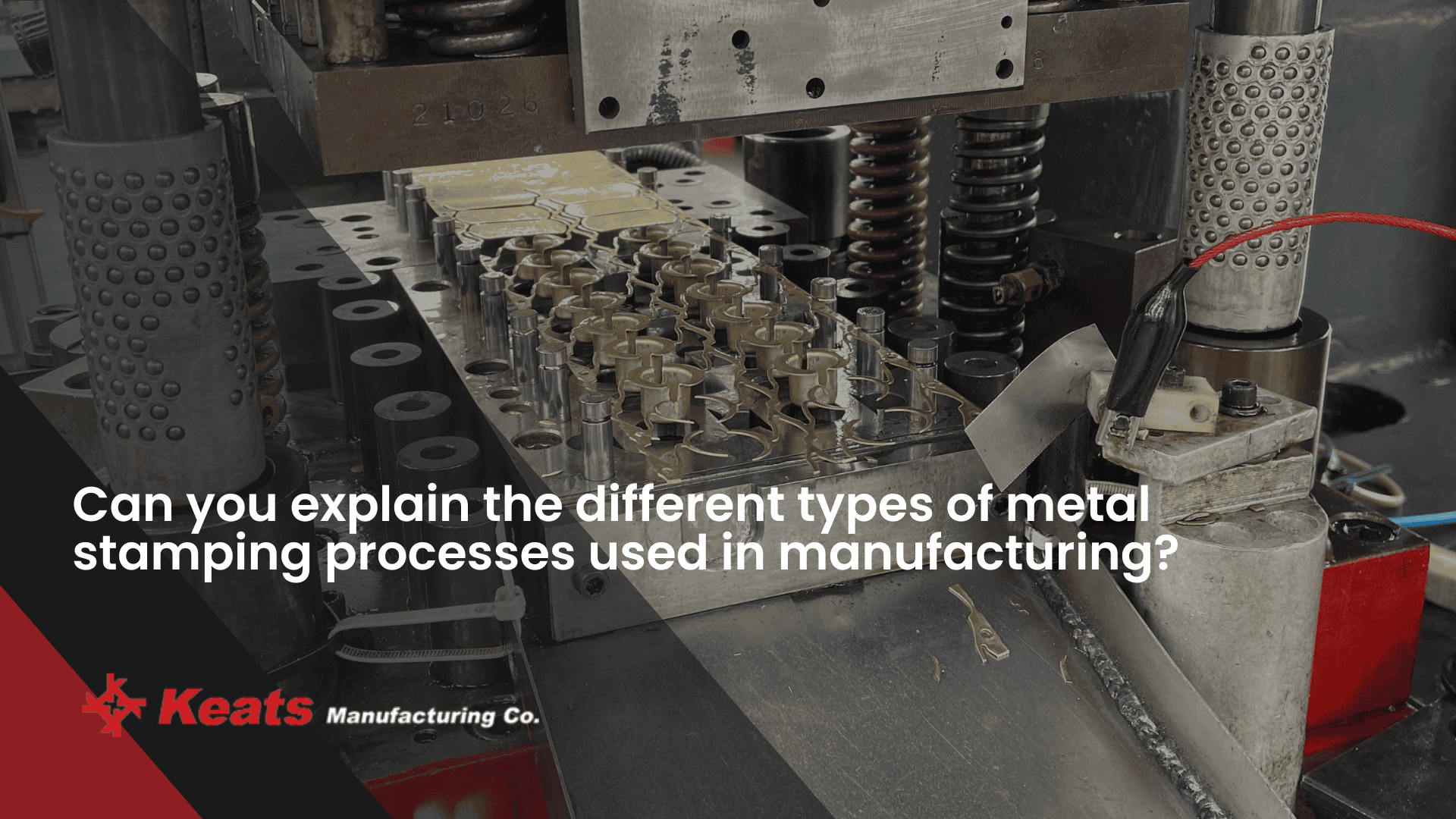
In the realm of industrial manufacturing, the metal stamping process is a cornerstone technique that enables the production of high-precision components across various sectors. Whether it’s automotive, aerospace, or medical devices, understanding the different types of metal stamping processes can significantly impact production efficiency and product quality. This article delves into the intricacies of metal stamping, exploring its applications, mechanics, and specific processes tailored for diverse industries.
What is the process of stamping in manufacturing?
The metal stamping process is a manufacturing technique that involves the use of dies and presses to shape metal sheets into desired forms. This process is significant due to its ability to produce high-volume parts with exceptional accuracy and repeatability. The metal stamping process, step by step, typically includes blanking, piercing, bending, and forming, resulting in a wide array of components used in various applications.
Applications of Metal Stamping
Components like brackets, clips, and electrical terminals.
Parts requiring high volume / low cost components.
Custom assemblies and wire forms for critical applications.
Terminals and bus bars for efficient power distribution.
These applications highlight the versatility and importance of metal stamping in modern manufacturing.
What are the different types of metal stampings?
In the context of metal stamping, various part types are produced to meet specific industry requirements. At Keats Manufacturing Co., we specialize in producing metal stamping examples such as:
- Electrical Terminals: for EVs, automotive steering wheel sensor terminals, and circuit breaker terminals. Terminals are generally crucial for power distribution.
- Brackets: are used to hold other components in place for all industries.
- Clips for Vehicles: using four-slide stamping used to hold vehicle trim and wires
- Custom beryllium copper spring contact: for hearing aids and automotive electrical contacts and connectors.
- Heat Shields: for EVs and engine fuel injection shields.
These diverse types of stamping processes and applications enable us to cater to a wide range of client needs across automotive, aerospace, medical device, and electrical distribution industries. Each component represents our commitment to precision and excellence in custom metal fabrication.
How does sheet metal stamping work?
Sheet metal stamping involves the manipulation of flat metal sheets into various shapes and forms. The mechanics of this process include:
Material Selection
Choosing the right metal, such as steel, aluminium, or brass.
Die Design
Creating custom dies that shape the metal according to specifications.
Press Operation
Using hydraulic or mechanical presses to apply force to the metal sheet.
Advantages of Sheet Metal Stamping
- High Precision: Achieves tight tolerances, essential for components in critical applications.
- Cost-Effectiveness: Ideal for high-volume production, reducing per-unit costs.
- Flexibility: Capable of producing complex geometries and custom designs.
The metal stamping process, step by step, ensures that each component meets stringent quality standards, contributing to the overall efficiency of production.
What are the steps in the stamping method?
The metal stamping process, step by step consists of key stages that ensure precision and quality in every component produced:
| Stage | Description |
|---|---|
| Design | Creating detailed CAD drawings of the part. |
| Tooling | Developing the necessary dies and tools for production. |
| Material Preparation | Sourcing and preparing the metal sheets. |
| Stamping | Applying force to shape the metal. |
| Secondary Operations | Performing additional processes such as bending or punching. |
| Quality Inspection | Ensuring parts meet specifications through rigorous testing. |
| Packaging and Delivery | Preparing parts for shipment to clients. |
Each step is crucial in ensuring quality and efficiency, aligning with our commitment to delivering custom small metal stampings and wire forms with the highest standards.
How does the stamping process in car manufacturing differ from other industries?
The stamping process in car manufacturing is particularly demanding, requiring adherence to strict industry standards, such as IATF 16949 certification. This certification ensures that suppliers meet the rigorous quality management requirements essential for automotive components.
Comparison with Other Industries
Automotive: Emphasizes high-volume production, tight tolerances, and compliance with safety standards.
Appliance: Focuses on high-volume / low-cost parts.
Medical Devices: Prioritizes precision and biocompatibility for safety.
The specific requirements and challenges faced in car manufacturing underscore the importance of a specialised approach to metal stamping, ensuring reliability and performance in critical applications.
Types of Metal Stamping Processes
Multi-Slide and Four-Slide Stamping
These processes employ multiple slides actuated by cams or servomotors to perform stamping and forming operations from various directions, enabling the production of complex shapes and bends at high volumes. Our ownership of one of the largest fleets of four-slide machines in North America, including unique Wünsch multi-slide machines, enhances our capability to produce intricate components efficiently.
When evaluating multi-slide capabilities, it’s helpful to understand how they compare to progressive die approaches in terms of tooling, part complexity, and production volume. Our blog Difference Between Multi-Slide and Progressive Die Stamping, breaks down these differences in detail.
Progressive Die Stamping
This method involves a series of workstations, each performing different operations on the metal piece, allowing for the creation of complex components efficiently. Our in-house tool and die development ensures that we can create custom dies tailored to specific applications, backed by a lifetime guarantee.
Custom Metal Stamping Operations
We offer a range of stamping operations, including blanking, bending, punching, coining, drawing, embossing, piercing, and curling, to meet diverse customer requirements. Our extensive high-precision tolerances (±0.0002 in.) ensure that every component meets the highest quality standards.
Frequently Asked Questions
What are the main types of metal stamping processes used in manufacturing?
Metal stamping processes are essential in manufacturing for creating precise metal components. Key types include:
- Progressive Die Stamping: Utilizes a series of stations to progressively shape the metal.
- Deep Draw Stamping: Forms complex, deep shapes by drawing the metal into a die.
- Transfer Die Stamping: Moves individual parts between stations for separate operations.
- Four-Slide Stamping: Offers versatility with multiple slides for intricate bends and cuts.
These processes enable high efficiency and precision in metal fabrication.
How does progressive stamping work in manufacturing?
Progressive stamping is a manufacturing process used for creating complex metal parts efficiently. It involves several stages, each performing a specific operation on a metal strip as it unrolls through a series of dies. Key elements include:
- Multiple stations in sequence, each with a unique function.
- Continuous feed of metal strip through the die.
- Efficient production of intricate parts with high precision.
- Reduced waste and cost-effective for high-volume manufacturing.
What advantages does four-slide stamping provide?
Four-slide stamping offers several advantages for manufacturing:
- Complex Designs: Ideal for intricate parts with multiple bends.
- Efficiency: Simultaneous operations reduce production time.
- Cost-Effective: Minimizes material waste and tooling costs.
- Flexibility: Easily adaptable to design changes.
- Precision: Ensures high accuracy and consistency in parts.
These benefits make four-slide stamping a valuable choice for complex metal components.
Can you explain the deep drawing process?
Deep drawing is a metal stamping technique we excel in at Keats Manufacturing Co., used to form deep, cylindrical parts.
- This process enables the production of complex geometries while optimizing material usage.
- Our advanced machinery, including our unique Wünsch multi-slide machines, allows us to achieve precise dimensions of ±0.0005 in., ensuring consistency and reliability in the parts we manufacture.
- We have a proven track record of delivering deep-drawn components tailored for diverse applications across multiple sectors.
What role does tool and die development play in metal stamping?
Tool and die development is crucial in metal stamping, ensuring precision and efficiency.
- Designs custom tools and dies tailored to specific components
- Enhances production speed while maintaining accuracy
- Reduces material waste and operational costs
- Supports complex geometries and tight tolerances
- Increases overall product quality and consistency.
By investing in advanced tool and die development, manufacturers can achieve superior performance and reliability in their stamping processes.
How do you ensure precision in metal stamping?
Precision in metal stamping is ensured through:
- Rigorous quality control measures, including regular inspections and testing.
- Utilizing advanced computer-aided design (CAD) software for accurate die design.
- Employing state-of-the-art machinery equipped with precision tools.
- Continuous training for operators to maintain high skill levels.
- Implementing statistical process control to monitor production consistency.
- Regular maintenance and calibration of equipment to prevent deviations.
These practices help achieve consistent, high-quality results.
What industries benefit from your metal stamping services?
Keats Manufacturing Co. serves a wide range of industries with our metal stamping services, including:
- Automotive
- Electrical distribution
- Appliance
- Industrial
- HVAC
- Medical
- Telecommunications
- Solar and renewable energy
- Irrigation
- General machinery
How do you handle high-volume production needs?
At Keats Manufacturing Co., we handle high-volume production needs through:
- Advanced automation technologies, such as our unique Wünsch multi-slide machines, that enhance production speed and consistency in metal stamping.
- A dedicated team of engineers focused on optimizing workflows for increased output, ensuring efficient use of our extensive fleet of four-slide machines.
- Robust quality control measures, including certification in ISO 9001 and IATF 16949, that ensure each batch meets our rigorous standards.
- 3 Shifts working 24 hours per day.
What is a die in metal stamping?
Comments Off on What is a die in metal stamping?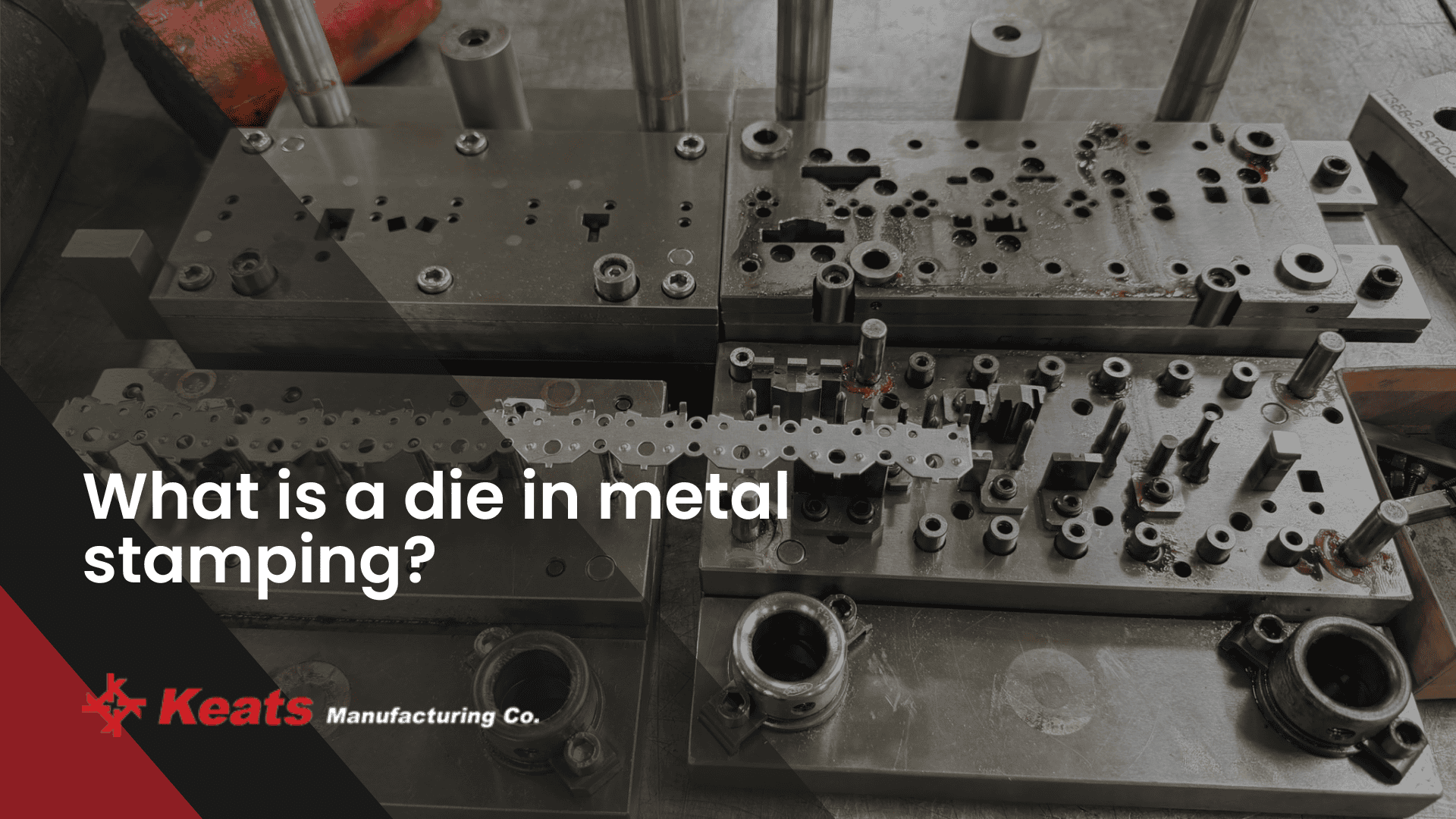
The die is the essential element in any metal stamping operation, defining the geometry and precision of the final component. Understanding the function of this specialized tool is vital for manufacturers focusing on high-volume production and complex parts, as specialized machine tooling has allowed for the mass production of durable, high-quality items. This article provides a comprehensive overview of how this specialized component functions within precision metal stamping and how leading Metal Stamping Companies leverage superior design and technical expertise to ensure stringent quality, consistent component accuracy, and supply chain control.
What is a metal stamping die?
It is the customized equipment used within a power press or similar machine that applies force to cut, form, draw, or pierce raw sheet metal into a finished part. Dies are highly calibrated instruments that consist of a customized metal cavity designed to help shape the target material. This component is critical for transferring the immense pressure from the machine slide to the metal strip during the metal stamping operation. Dies are an essential part of the overall tooling assembly engineered for a specific part.
What is the purpose of a die?
The primary purpose of a die in the manufacturing process is to execute precise operations that transform raw material into components. The manufacturing process known as what is die stamping uses these specialized instruments to achieve the required cuts, bends, and forms. Dies are fundamental to ensuring mass-produced parts maintain consistent dimensional accuracy, which is essential for meeting the requirements of complex components and preventing part failure.
0.0002”
Precision Standard
High-quality tooling and practices enable manufacturers to maintain extremely tight tolerances of up to 0.0002” during every step of the production process. This specialized tooling maximizes efficiency by minimizing raw material usage, leading to substantial material cost savings.
What is a die in metal stamping?
A die in metal stamping is a specialized tool engineered to perform specific manufacturing processes, with the most common types of stamping dies distinguished by how they conduct sequential operations. These complex tools are essential to transforming raw material into finished components. For instance, progressive die tooling involves the use of successive forming or stamping operations on a single metal strip. The finished part is cut away from the strip only at the end of the progressive process. Alternatively, four-slide or multi-slide tooling uses four slides that move laterally, forming complex shapes simultaneously by striking the metal workpiece from four orthogonal directions. Dies are engineered to execute fundamental processes such as piercing (creating holes or slots), blanking (cutting the outside contours of a workpiece), or forming (bending the material).
Each die configuration supports different production strategies depending on part complexity and volume. Our blog Compound vs. Progressive vs. Transfer Die, breaks down how these tooling approaches compare and when each is most efficient.
What’s the difference between a tool and a die?
In metal stamping terminology, tooling is the broad, general term for all equipment engineered for a specific component, encompassing dies, punches, and related fixtures. The die is the essential physical part of this tooling, serving as the customized metal cavity used to form, cut, or pierce the sheet metal. The punch functions alongside the die as the element that pushes the material through this die cavity to achieve the specified shape or pattern. Because specialized machine tooling allows manufacturers to mass-produce precise, durable components economically, quality tooling remains one of the most valuable resources in the manufacturing industry.
Stamping die components and design
Progressive stamping dies may look like a single block of steel from the outside, but inside they are highly engineered systems made up of many interdependent components. Each element plays a specific role—from supporting and guiding the die set to cutting, forming, and tracking the strip as it moves through each station. Understanding these key components helps explain how progressive dies achieve high speeds, tight tolerances, and consistent part quality over long production runs.
Key Components of a Progressive Stamping Die
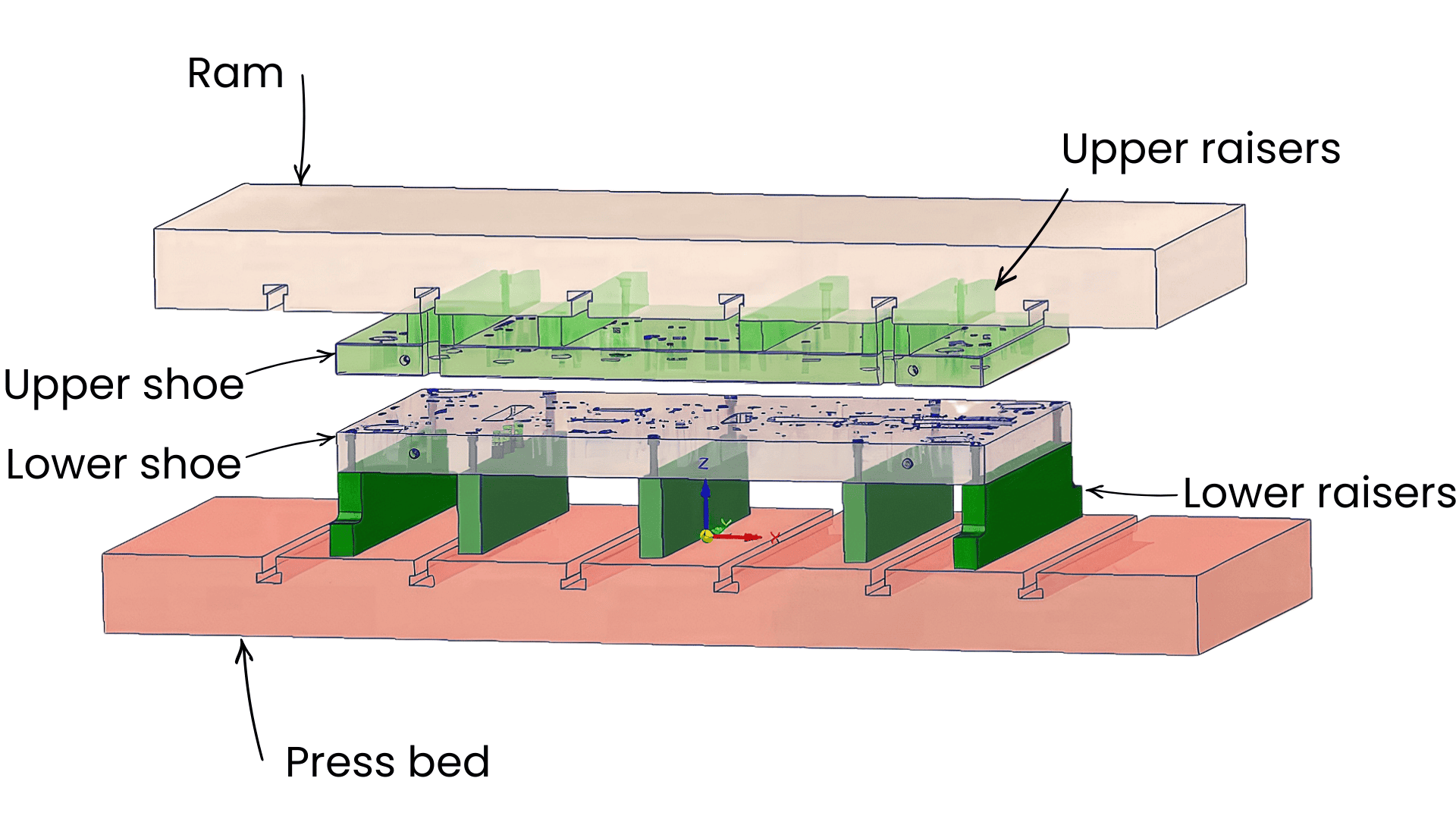
1. Structural Base Components
The structural base of a progressive stamping die consists of the upper and lower die shoes, which support and locate all other components. The lower shoe mounts to the press bed (often on a bolster plate), while the upper shoe mounts to the press ram, creating a rigid, stable foundation for accurate, repeatable stamping.
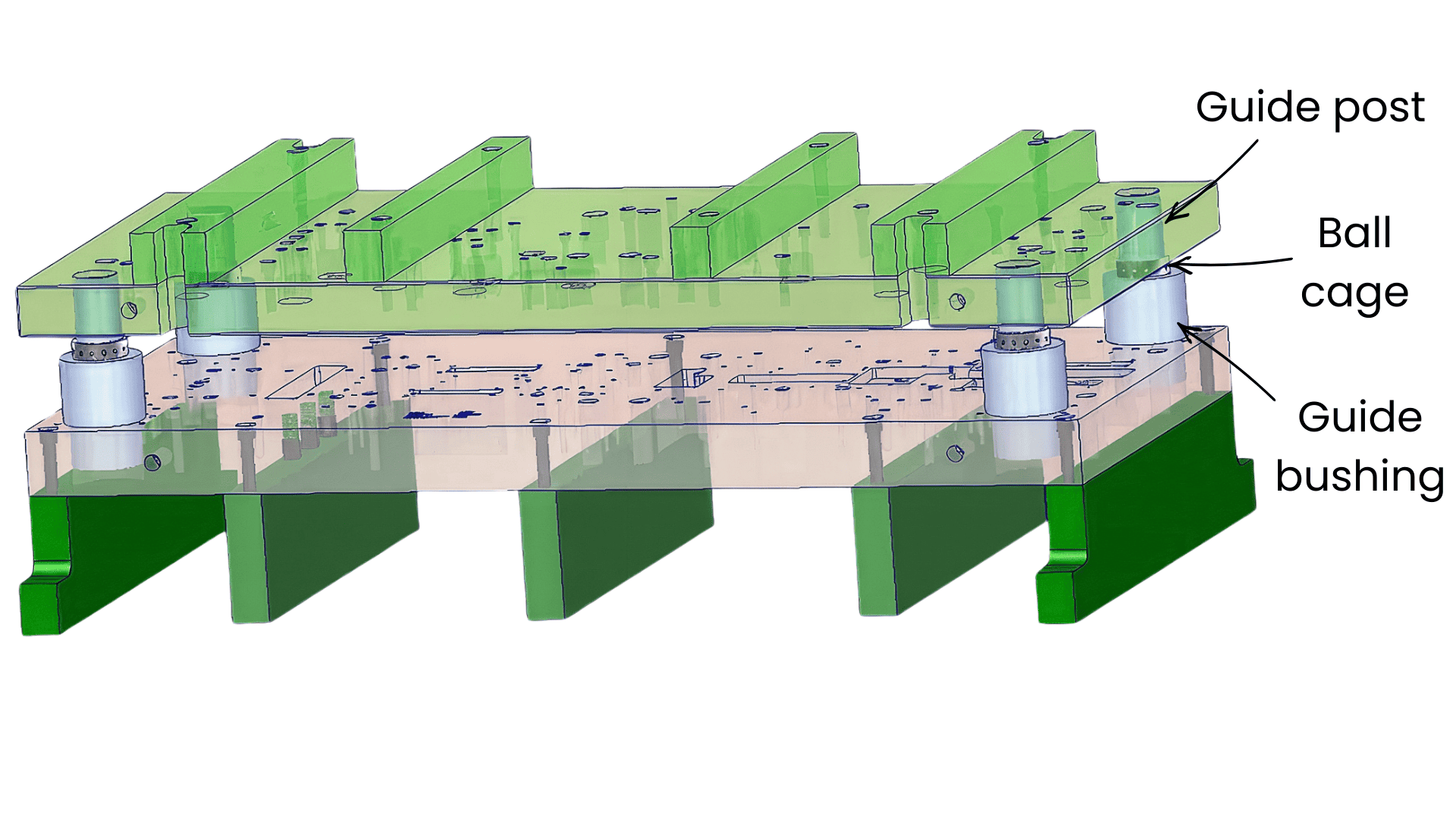
2. Guiding & Alignment Components
Guide posts and bushings keep the upper and lower die shoes perfectly aligned throughout the press stroke, ensuring tight tolerances and long tool life. Additional alignment features like heel blocks or heel plates help control side thrust during forming, protecting both the die and the press.
3. Cutting & Forming Components
Punches and die inserts are the working elements that blank, pierce, notch, and form the metal strip at each station. Dedicated forming inserts—such as bending, coining, or embossing blocks—shape the part as it progresses through the die, while pilots precisely locate the strip to maintain accurate pitch and feature position.
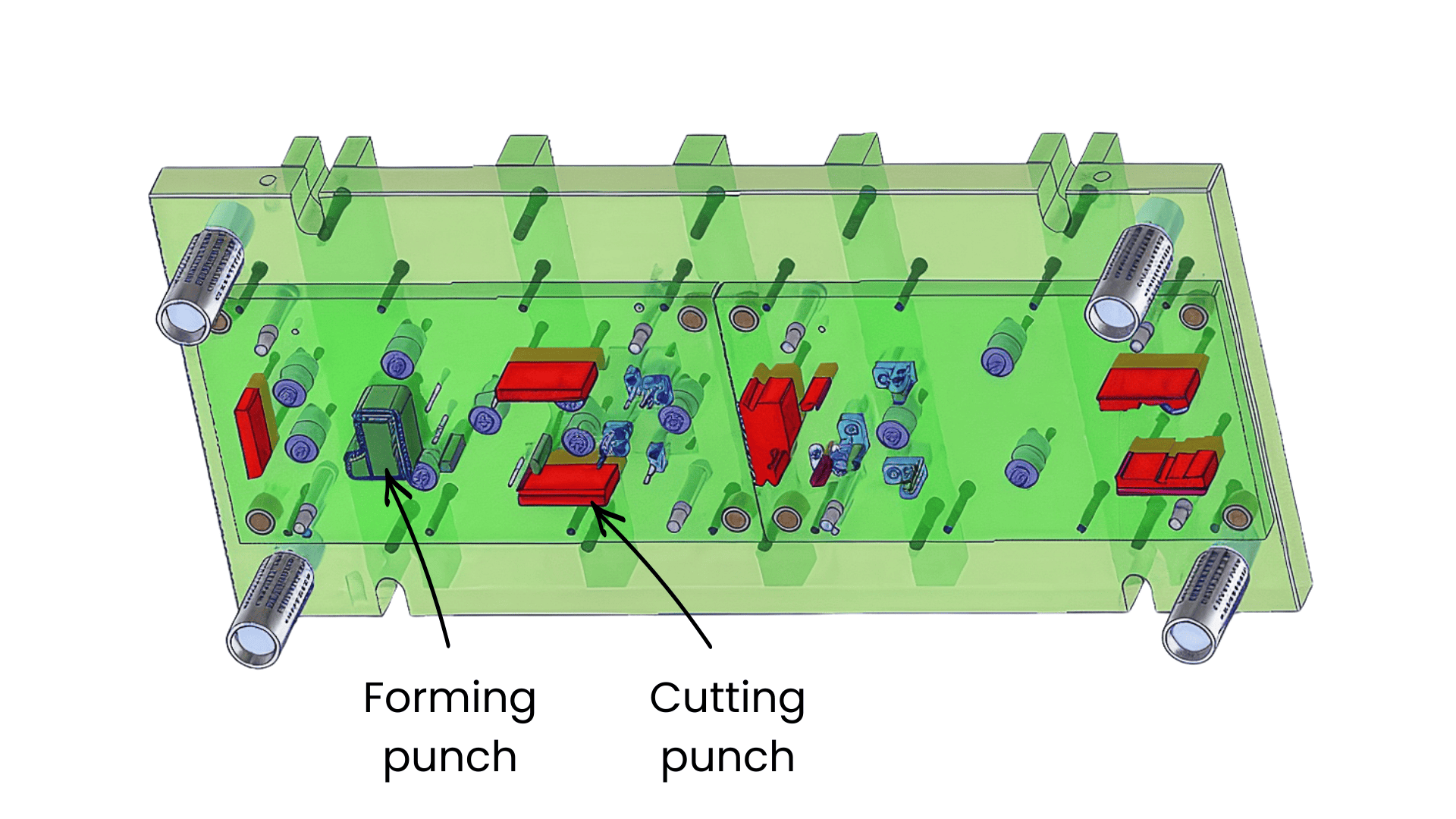
4. Stock Control & Stripping Components
Stripper plates and pressure pads hold the strip flat, control material flow, and strip the stock off the punches on the upstroke. Stock lifters, rails, and stops help guide and support the material as it feeds from station to station, reducing friction, preventing misfeeds, and improving strip tracking.
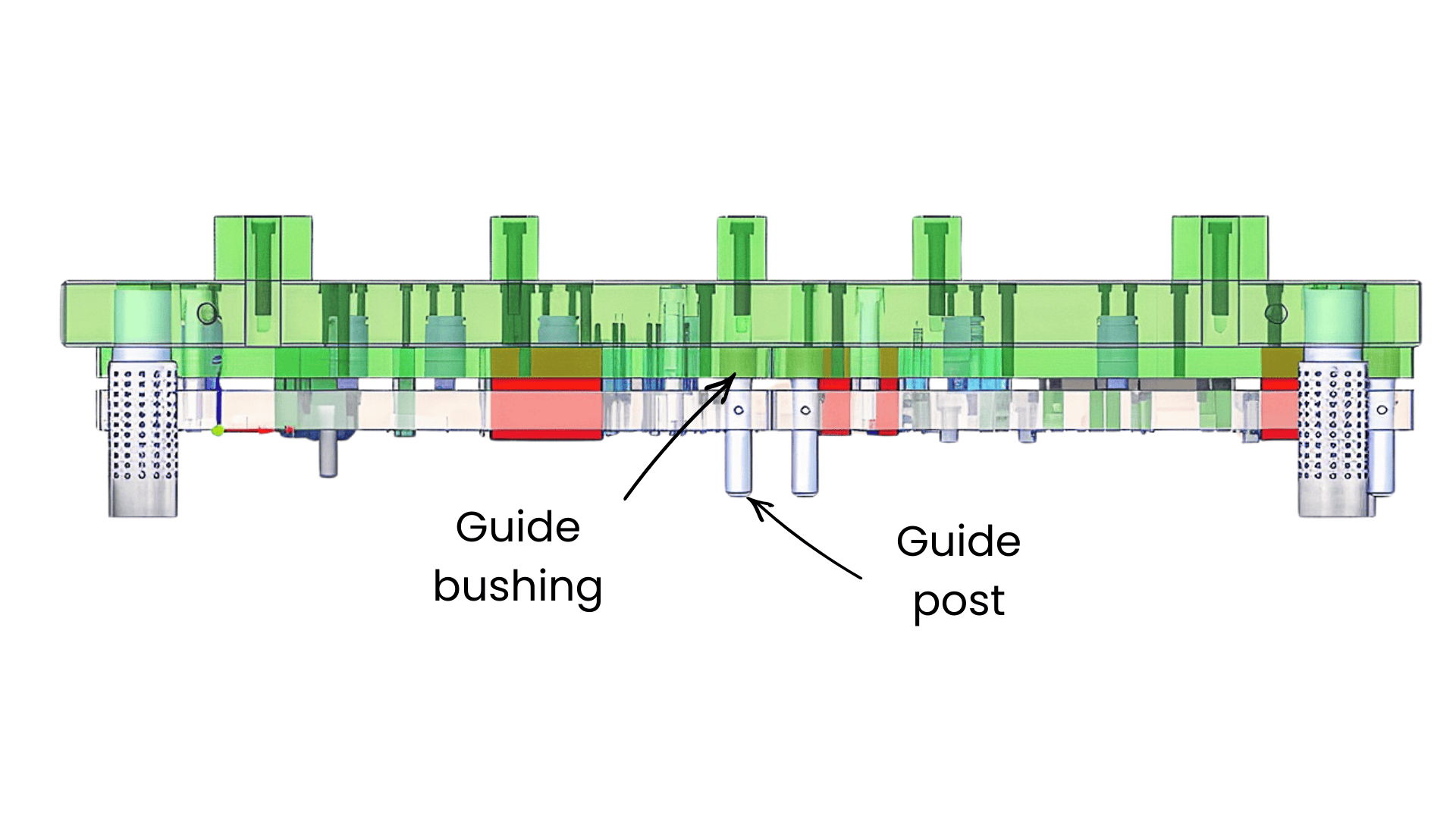
5. Retention & Support Components
Punch retainers, backup plates, and die insert pockets securely hold high-wear components in place while providing critical support under load. This design makes it easier to service and replace individual punches or inserts, reducing downtime and extending the overall life of the die.
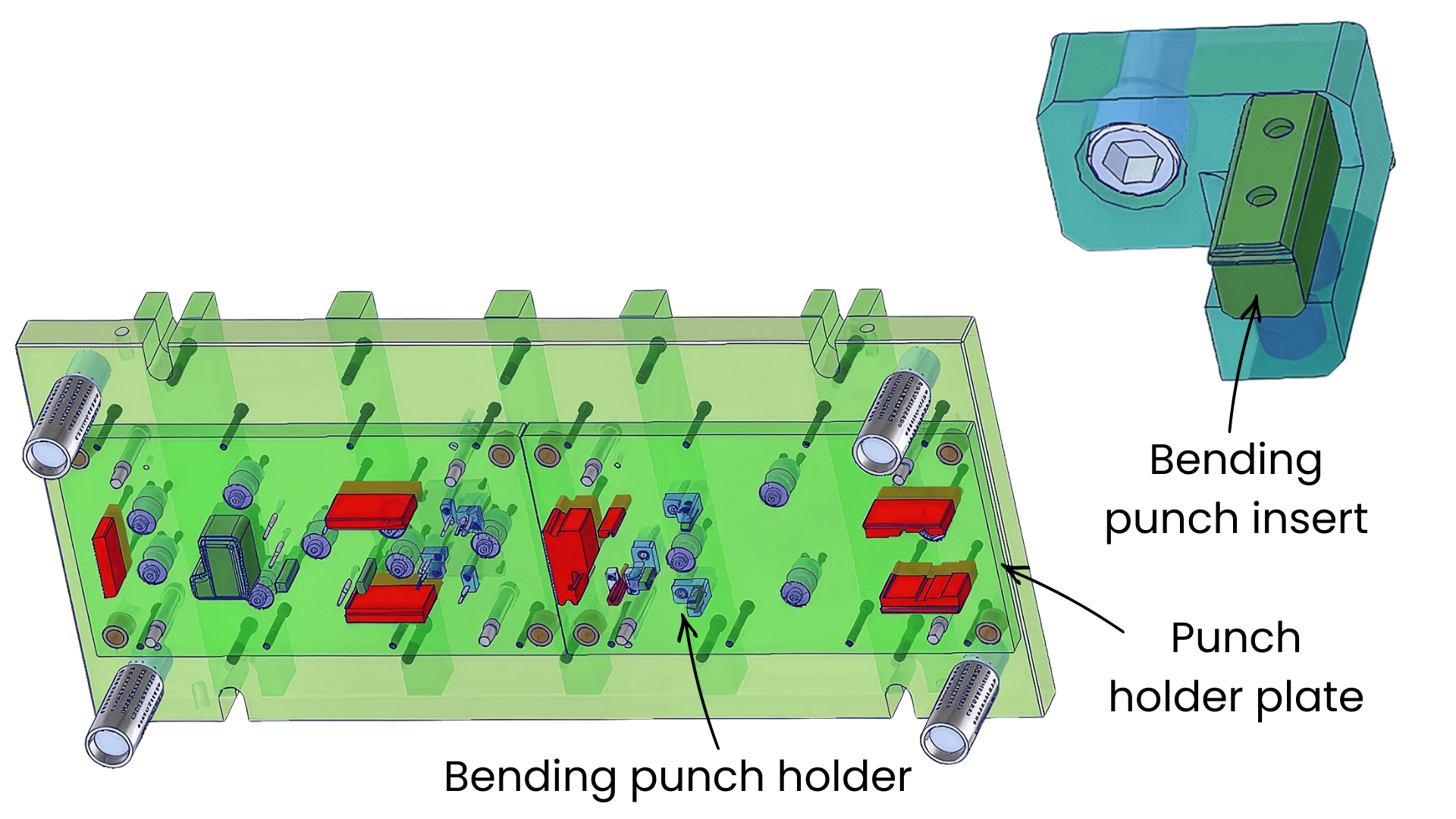
6. Springs & Force-Generating Elements
Coil springs, urethane springs, and nitrogen gas cylinders supply controlled forces to operate stripper plates, pressure pads, and lifters. Choosing the right combination of springs ensures consistent contact pressure, stable forming conditions, and reliable return of moving die components.
7. Scrap & Part Management
Slug reliefs, scrap pockets, and chutes direct punched slugs and scrap material away from critical cutting areas and out of the die. The carrier strip supports the part as it moves through each station, until a final cutoff operation separates the finished component for collection or downstream automation.
8. Fastening & Adjustment Components
Dowels, screws, clamps, and keys are used to accurately locate and secure every component within the die set. Shims and fine adjustments allow toolmakers to dial in clearances, shut heights, and forming pressures, helping maintain part quality over long production runs.
9. Optional Modern Enhancements
Modern progressive dies often include sensors to monitor strip feed, detect slug buildup or broken punches, and prevent catastrophic crashes. Integrated lubrication systems can also be added to deliver precise amounts of lubricant to the strip and tooling, reducing wear and improving surface finish.
When all of these components are properly designed, built, and maintained, a progressive stamping die becomes a reliable production asset that can run millions of cycles with minimal intervention. This level of integration is what allows stampers like Keats to deliver consistent quality, reduce unplanned downtime, and keep total cost per part competitive.
Conclusion
Dies are the central, critical tools that enable the precision and high-volume efficiency of modern manufacturing. Successful manufacturing relies on partnering with experts who invest in superior, custom tooling. This investment maximizes efficiency in the use of raw material, which promotes higher savings on material cost. Choosing the right partner protects quality, ensures part consistency, and minimizes production risks, establishing high-quality tooling as the heart and soul of a successful operation.
Keats Manufacturing has been providing high-quality custom metal stampings and assemblies for over 60 years, serving nearly every global market. Request a quote today to partner with Keats Manufacturing on your next project and leverage our comprehensive expertise acquired since 1958 in tooling design and fabrication. We offer solutions that provide quality metal parts quickly and at a fair, economical price.
What is the Die Clearance of Metal Stamping?
Comments Off on What is the Die Clearance of Metal Stamping?
In the sector of precision metal stamping, understanding the concept of die clearance is critical for achieving high-quality components. Die clearance refers to the gap between the cutting edge of the punch and the die during the stamping process. Getting this clearance right is essential because it directly influences the cleanliness of the cut, the force required for stamping, and the longevity of the tooling. In this article, we will explore die clearance, its significance, and how it impacts the overall quality of stamped parts.
What is die clearance in metal stamping?
Die clearance is the distance between the punch and die at the point where the material shears. This gap is critical for several reasons:
- ✔Ensuring Dimensional Accuracy and Preventing Failure: The precise configuration of the die, including the gap or space where the material is cut or formed, is necessary to achieve the demanding requirements of modern parts.
- ✔Preventing Material Defects and Contamination: A properly designed and functioning tooling gap ensures a clean cut and prevents material issues (high contact resistance, which can lead to overheating, contact welding, and high erosion).
- ✔Maximizing Efficiency and Reducing Costs: The initial precision designed into the die and tool ensures cost-effective production over time.
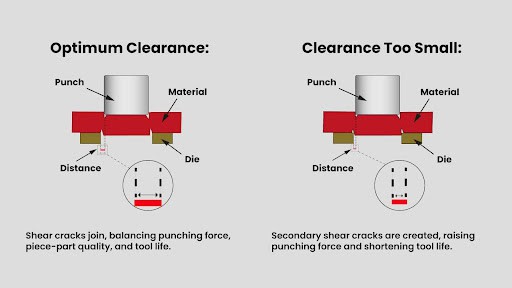
Why it matters
Improper die clearance engineering leads to recurring defects in high-volume production. Our blog Common Defects Found in High Volume Runs & How to Prevent Them examines how tooling decisions directly impact part quality at scale.
What affects the required clearance
- Material thickness: Thinner materials generally require tighter clearance, while thicker materials need more.
- Material type and hardness: Different alloys and hardness levels often necessitate varying clearances.
- Part requirements: High-precision edges may demand a tighter gap, while a larger clearance can enhance tool life if edge quality is less critical.
- Die design and condition: The geometry and wear of the tooling can also affect optimal clearance.
How clearance is determined
This process ensures the tooling is precisely configured for dimensional accuracy and optimal manufacturing efficiency:
What is a die in metal stamping?
A die is a specialized tool used in the metal stamping process to shape and cut material. The metal stamping die design plays a pivotal role in determining the quality and precision of stamped parts.
Types of dies used in metal stamping
- Single-Stage Dies: Perform one operation at a time.
- Progressive Dies: Allow multiple operations in a single pass, enhancing efficiency.
- Compound Dies: Execute two operations simultaneously, such as cutting and bending.
The importance of die clearance in achieving precision cannot be overstated. It ensures that the die performs optimally, producing parts that meet stringent specifications.
What gauge metal for stamping?
Gauge metal refers to the thickness of the metal sheet, which is meaningful in determining how the material will behave during stamping.
Common gauges used in metal stamping applications
The appropriate thickness is determined by several critical factors related to the final product’s design, material properties, and specific application.
- Thickness is a Key Design Consideration: The thickness of the metal sheet is defined during the early phases of product development and design.
- Capabilities Exist for Diverse Thicknesses: Manufacturers have the capability to work with a broad range of material thicknesses, including extremely thin materials, depending on the alloy.
- Thickness Impacts Manufacturing Decisions: The required thickness influences cost and process selection.
Specialized processes like four-slide stamping can work with material that is already at the desired width of the final part, potentially requiring less excess material compared to other direct stamping methods
The relationship between gauge and die clearance is critical; as the gauge increases, the required clearance may also need to be adjusted. For example, the question What metal is best for stamping often arises, with answers varying based on the application and material properties.
What is the tolerance for sheet metal stamping?
Tolerance in the context of sheet metal stamping refers to the allowable deviation from specified dimensions.
| Application Type | Standard Tolerance |
|---|---|
| General Applications | ±0.005 inches |
| High-Precision Applications | ±0.001 inches |
Understanding how tolerance affects the overall quality and fit of stamped parts is essential. High-tolerance components are critical in industries such as aerospace and medical devices, where precision is non-negotiable.
How many types of stamping are there?
There are several types of metal stamping processes, each with its own applications and advantages.
Progressive Die Tooling (or Progressive Die Stamping)
This is a manufacturing process that carries a workpiece through several different stations to create a final product. It involves the use of successive forming or stamping operations on a single stock metal strip. The workpiece remains attached to its stock strip until the final station, where it is cut away. This methodology is commonly used to achieve high-volume production at reduced costs.
Four-Slide/Multi-Slide Tooling (or Four-Slide Stamping)
This is a sophisticated alternative to conventional stamping, using mechanically actuated or servo driven slides that can stamp, bend, and form metal workpieces from four orthogonal directions. The tooling can form complex shapes simultaneously from multiple directions. It often requires less material input because, unlike progressive die stamping, it often does not require a carrier strip to guide the component through the tooling. This method is well-suited for creating intricate shapes, curves, and bends greater than 90°. The equipment used for this includes four-slide and multi-slide machines.
Metal Stamping (General Power Press Tooling)
This is a general term for the process. It generally consists of a power press that forms a flat sheet or coil of metal into a desired shape or pattern. This includes Traditional Press Stampings, which primarily use vertical stamping motions to shear, form, or punch workpieces. The stamping press technologies are housed at Keats facilities alongside four-slide/multi-slide technologies.
Each method has its efficiencies and is suited for specific applications. Understanding what types of metal stamping does offer can help engineers and procurement professionals make informed decisions.
Can you stamp stainless steel?
Yes, stamping stainless steel is feasible, but it comes with its challenges.
Challenges and considerations
- Material hardness: Stainless steel is generally harder than other metals, requiring specialized tooling.
- Burr formation: Increased risk of burrs necessitates careful clearance management.
Common Applications
Applications where stainless steel stamping is used include automotive components, medical devices, and kitchen appliances, showcasing its versatility and durability. The question Can you stamp stainless steel is often raised, and the answer is a resounding yes, provided that the right techniques and tools are employed.