

What is Precision Metal Stamping?
Comments Off on What is Precision Metal Stamping?
In the fast-paced world of manufacturing, precision is paramount. Precision metal stamping is a critical process that ensures the production of high-quality metal components with exact specifications. This article delves into the nuances of precision metal stamping, exploring its significance, processes, applications, and market dynamics. By understanding this essential manufacturing technique, engineering and procurement professionals can make informed decisions that enhance efficiency and product quality in their respective industries.
Precision metal stamping refers to a manufacturing process that involves shaping and cutting metal sheets into specific forms using specialized dies and presses. This technique is significant in manufacturing because it allows for the mass production of complex parts with high accuracy and repeatability. Precision metal stamping allows for the manufacturing of components with tight tolerances and intricate designs, which are critical for high-precision industries such as automotive, aerospace, and medical devices.
What are the Characteristics of Precision Metal Stamping?
The concept of precision metal stamping encompasses several key characteristics that distinguish it from traditional metal stamping methods. These include:
High Precision
Achieving tolerances of ±0.0002 inches
Complex Geometries
The ability to create intricate shapes and designs that meet specific engineering requirements.
Material Versatility
Compatibility with a wide range of materials, including stainless steel, aluminum, and copper.
High Volume Production
Capable of producing millions of parts with consistent quality.

Achieving these characteristics consistently depends heavily on the capabilities and experience of the stamping partner you choose. Our blog Key Considerations When Choosing a Metal Stamping Partner, outlines the critical factors to evaluate before selecting a supplier.
The importance of precision in the stamping process cannot be overstated; it directly impacts the performance and reliability of the final products. Keats Manufacturing, with its ownership of one of the largest fleets of four-slide machines in North America, excels in delivering these high-precision components with a commitment to quality and efficiency.
What is Precision Metal Stamping Process?
A metal stamping company basically takes flat metal and turns it into precision parts you can actually build things with—reliably, at scale, and at a competitive cost.
Here’s what that really means in practice (and what Keats does all day):
1. Help turn a print into something manufacturable
- • Review customer drawings, 3D models, and specs.
- • Suggest DFM changes (radius changes, reliefs, material tweaks, tolerance adjustments) so the part can be stamped repeatably.
- • Recommend the right process: progressive die, four-slide/multi-slide, high-speed reel-to-reel, etc.
2. Engineer and build the tooling
- • Design the strip layout (how the part “walks” through the die).
- • Engineer progressive dies or four-slide tools that pierce, form, coin, and cut the part in sequence.
- • Manufacture, heat treat, assemble, and try-out the tools in-house (Keats style) so you’re not dealing with random outside tool shops.
3. Source and manage the metal
- • Buy coil/strip in the right alloy, thickness, width, and temper (copper, brass, stainless, low carbon steel, high carbon steel, aluminum, etc.).
- • Set up stocking programs or material commitments so you’re not held hostage by mill lead times or border delays.
- • Manage heat/lot traceability from raw material all the way to finished parts.
4. Stamp the parts at scale
- • Run the tools in presses or four-slide/multi-slide machines at the right tonnage and speed.
- • Hold tight tolerances and control burr, flatness, and surface condition.
- • Adjust feeds, lubrication, and sensors to keep the process stable over millions of hits.
5. Add secondary services
Depending on the part, a stamping company will also:
- • Deburr / tumble / clean
- • Plate (tin, nickel, zinc, etc., reel-to-reel or loose piece)
- • Heat treat / stress relieve
- • Do simple assembly or kitting (add screws, clips, contacts, etc.)
- • Engineer custom packaging (reels, trays, tubes, bags in box, pallets)
6. Own quality, documentation, and delivery
A stamping company is also responsible for:
- • PPAP / FAI / capability studies
- • Ongoing in-process inspection and SPC
- • Maintaining and rebuilding tooling for long program life
- • Shipping on time, with the right paperwork, to keep your lines running
At Keats, this is how you get from “coil of copper/brass/steel” to ready-to-use terminals, connectors, busbars, brackets, clips, and springs that drop straight into your assembly lines.
What are Some Practical Applications of Metal Stamping in Various Industries?
Precision metal stamping finds applications across a multitude of industries. Some notable examples include:
| Industry | Applications / Significance |
|---|---|
| Automotive | Production of brackets, clips, and electrical terminals. |
| Appliance | Manufacturing of large quantities of parts at the most competitive price possible. |
| Medical Devices | Creation of intricate parts for surgical instruments and diagnostic equipment. |
| Electrical Distribution | Fabrication of connectors and terminals that require high reliability. |
These applications highlight the versatility and critical role of precision metal stamping in meeting the demands of various sectors. Keats Manufacturing’s expertise in producing custom small metal stampings and wire forms ensures precision and adaptability to meet the unique needs of each industry.
How Big is the Metal Stamping Market?
The metal stamping market has shown robust growth in recent years driven by:
- Increased Demand: Growth in automotive and electrical distribution industries.
- Technological Advancements: Innovations in stamping technology enhancing efficiency and capabilities have driven industry growth.
- Sustainability Trends: A shift towards more sustainable manufacturing practices has helped the industy retain its foothold.
Factors influencing market growth include the rising demand for precision components and the ongoing push for cost-effective manufacturing solutions. Keats Manufacturing’s commitment to ISO 9001, ISO 14001, and IATF 16949 certifications ensures that we meet the highest industry standards, further solidifying our position in this growing market.
What is Precision Metal Stamping Cost?
Understanding the cost of precision metal stamping involves several factors, including:
Material Costs: The type of metal and its thickness can significantly affect pricing. As material is the primary cost driver for every part, selection of the correct material plays a critical role in the cost of every part.
Complexity of Design: Intricate designs require more advanced tooling and longer production times. To put it frankly, the more cuts and bends the part has, the more the tooling will cost to develop.
Volume: Higher production volumes can lower the per-unit cost. Economies of scale help to drive down the cost of parts when raw materials can be purchased at scale.
Secondary Services: Additional processes like plating or heat-treating will also impact overall costs substantially. Precious metal plating can drive part cost up by as much as 200%
When evaluating precision metal stamping costs, it’s essential to consider factors such as material type, design complexity, and production volume relative to application-specific requirements. Our just-in-time delivery model further enhances cost efficiency, allowing clients to optimize their inventory management.
What is Metal Stamping Die Design?
Metal stamping die design is a crucial aspect of the metal stamping process. The design of the die directly influences the quality and precision of the stamped parts. Different types of dies include:
- Progressive Dies: Used for high-volume production, allowing multiple operations in a single press stroke.
- Single Operation Dies: Suitable for simpler parts, executing one operation per stroke. Sometimes a part may require multiple single operation dies to be completed.
Proper die design is crucial to achieving consistent part quality, accuracy, and repeatability in precision stamping, especially for high-volume production. Keats Manufacturing’s in-house toolmaking capabilities ensure that our die designs are tailored to meet specific client needs, enhancing both performance and cost-effectiveness.
Ready to explore the world of metal stamping?
Discover how our custom metal stamping solutions can transform your production capabilities.
Discuss your specific requirements with us today.
What does a stamping company do?
Comments Off on What does a stamping company do?
In the world of manufacturing, stamping companies play a crucial role in transforming raw materials into precise components that are essential for various industries. A stamping company begins its process by receiving a coil of material, which is then fed through a die in a press machine to form precise, repeatable components. This intricate process culminates in the production of finished parts that are often integral to larger assembly products. In this article, we will delve into the essential functions of a stamping company, exploring the processes involved and the value they bring to manufacturing.
One of the Largest Fleets of Multi-Slide Machines
Max Part Volume Production Capability
Of Parts Produced Per Minute
What is metal stamping?
Metal stamping is a manufacturing process that involves shaping and cutting metal sheets or coils into specific forms using dies and presses. This technique is essential in manufacturing because it enables high-volume production with consistent precision and repeatability.
For a more detailed look at how metal stamping works and why it’s widely used across industries, see our blog What Is Metal Stamping?
Stamping companies offer a variety of services, including:
- •Tooling Design & DevelopmentIn-house engineers design progressive dies, four-slide tools, and custom fixtures to meet each part’s functional and cost targets. Early DFM input helps optimize geometry, tolerances, and material usage before steel is cut.
- •Prototyping & Pilot RunsWe collaborate with customers to produce prototype and pilot quantities—using soft tools, modified existing tools, or early-stage production tooling—to prove out the design, material, and assembly concept before full ramp-up.
- •Production StampingUsing advanced progressive presses and one of the largest fleets of four-slide/multi-slide machines in North America, Keats produces complex parts at scale with high repeatability and competitive cycle times.
- •Quality Assurance & TraceabilityRigorous inspection, in-process monitoring, and documented control plans ensure every lot meets print and industry requirements, with full lot traceability from raw material through final packaging.
To maintain high standards, stamping companies often adhere to quality management certifications such as ISO 9001 and IATF 16949. These certifications demonstrate a commitment to quality control and continuous improvement, ensuring that products meet the stringent requirements of various industries.
What does the stamping process do?
The metal stamping process consists of several key steps that transform raw materials into finished products. Here’s a breakdown of the process:
| Step | Description |
|---|---|
| Material Preparation | The process begins with the selection of the appropriate raw material which meets the needs of the specific application of the part. |
| Die Creation | Custom die(s) are engineered and manufactured to shape the metal precisely, supported by robust in-house tool and die capabilities. |
| Stamping | The metal coil is fed into a stamping press, where the die shapes the metal through various techniques such as blanking, bending, and punching. |
| Finishing | After stamping, parts may undergo additional processes such as heat treatment, plating, or deburring to enhance their properties and finish. |

The machinery used in stamping includes:
- Press machines: These are the backbone of the stamping process, applying force to shape the metal.
- Four-slide and multi-slide machines: Specialized equipment that allows for complex shapes and high-volume production.
What does stamping do?
The stamping process is essential for shaping and cutting metal into precise components. The key outcomes of the stamping process include:
Shaped Components
Complex parts are formed and cut to match the exact dimensions, features, and functional requirements called out on the print.
Cost Efficiency
Once the tooling is in place, stamping supports very high-volume production, spreading tooling cost over millions of pieces and driving down the per-part price.
Precision
High-precision progressive dies and four-slide tooling are engineered to hold tight tolerances on critical features, making stamping ideal for demanding applications in automotive, electrical distribution, appliance, and industrial markets.
The advantages of using stamping in manufacturing are substantial:
- Speed: High-speed presses and four-slide machines produce parts in rapid cycles—often hundreds of parts per minute—supporting just-in-time and high-demand production environments.
- Scalability: Once a process is dialed in, capacity can be scaled across multiple presses and facilities, allowing Keats to respond to changing demand while maintaining consistent quality and repeatability.
What are some practical applications of metal stamping in various industries?
Metal stamping shows up in almost every industry that relies on precise, repeatable metal components. At Keats Manufacturing Co., our stamped parts support applications such as:
- Automotive & EV: Terminals, connectors, and lead frames for wiring and control modules. Copper busbars for EV batteries, inverters, and power distribution. Brackets, clips, clamps, and shields for sensors, braking systems, steering, and interior assemblies
- Electrical Distribution & Power Management: Terminals and sub-components for circuit breakers, switchgear, and panelboards. Rigid and flexible busbars for power distribution and grounding. Contact springs, clips, and mounting hardware for electrical enclosures and MCCs
- Appliance & Consumer Products: Brackets, hinges, springs, and clips for washers, dryers, refrigerators, ranges, and small appliances. Grounding and power connection terminals used in motors, controls, and interfaces
- Industrial, Machinery & Control Systems: Mounting brackets, clips, and clamps for sensors, valves, and control panels. Precision springs and retainers are used in motion systems and automation equipment
- HVAC, Refrigeration & Building Systems: Brackets and supports for blowers, compressors, and ductwork. Electrical terminals and connectors for thermostats, controls, and power feeds.
- Telecom, Electronics & Data: Fine-pitch terminals, contacts, and lead frames for connectors and electronic modules. EMI/RFI shields and small formed brackets for communication and networking equipment
- Medical & Specialized Devices: Small precision terminals, springs, and brackets for diagnostic equipment, monitoring devices, and specialty assemblies (often with strict material and cleanliness requirements).
Across these industries, stamped parts often play critical roles in power distribution, signal integrity, mechanical support, grounding, and safety—making reliable stamping processes and robust tooling essential to overall product performance.
What does a stamping company do for metal?
A metal stamping company takes raw metal—typically in coil or strip form—and transforms it into precise, repeatable components using engineered tooling and high-speed presses. Through operations like blanking, piercing, forming, bending, and coining, stamping companies turn flat material into functional parts such as terminals, connectors, busbars, brackets, clips, and springs.
To do this, a stamping company works with a variety of metals, selected to match the performance requirements of the application:
Understanding what a stamping company does for metal is crucial for clients seeking to manufacture components that meet specific performance requirements. By selecting the appropriate materials and processes, stamping companies can deliver high-quality products tailored to their clients’ needs.
What are the typical lead times for receiving custom metal stamping parts?
Comments Off on What are the typical lead times for receiving custom metal stamping parts?
In the evolving manufacturing industry, understanding lead times for custom metal stamping parts is vital for engineers and procurement professionals. Efficient project planning hinges on knowing how long it will take to receive essential components. This article examines the various factors influencing lead times, from the creation of stamping tools to the specific services offered by metal stamping companies. By the end, you’ll have a clearer picture of what to expect when working with a custom metal stamping manufacturer and how to manage timelines successfully.
What is the lead time for stamping tools?
Lead time for stamping tools is one of the most important drivers of any new stamping project. At Keats Manufacturing Co., every progressive die, four-slide tool, and custom fixture is engineered and built in-house, allowing us to control quality, timing, and cost from day one.
The Stamping Tool Lifecycle:
Concept and strip layout → Detailed 3D design → Component manufacturing → Heat treat → Assembly → Press try-out
The timeline for that work is shaped by several key factors:
- Part & Tool Complexity: Intricate geometries, tight tolerances, multiple forming stations, or in-die features (tapping, coining, in-die sensors, etc.) require more engineering and build time.
- Part Size & Material Thickness: Larger parts and heavier gauges demand more robust tool construction, larger die sets, and higher-tonnage presses, which can extend design and fabrication time.
- Material Type & Application Requirements: High-strength steels, spring steels, and heavy copper alloys (like those used in EV busbars and terminals) often require special clearances, coatings, and tool steels, influencing both design and try-out.
- Required Validation Level (PPAP / Qualification): Programs that require extensive dimensional studies, capability runs, or multiple PPAP iterations can add time to the overall launch, especially when combined with customer-specific documentation.
- Customer Response & Design Freeze: Quick feedback on DFM recommendations, print changes, and approvals helps keep the schedule on track. Frequent late changes to part geometry or tolerances can extend tooling lead time.
- Secondary Operations & Gauging: If the tool is integrated with secondary features (in-die forming, threading, staking) or requires custom checking fixtures and gauges, these items must be designed and built in parallel, which can influence timing.
- Capacity & Toolroom Loading: Even with in-house toolrooms, overall lead time depends on how many tools are in process and how a new project fits into the build schedule. Early engagement lets us reserve capacity and plan more efficiently.
8 – 24 Weeks
In general, tooling lead times at Keats commonly fall in the 8–24 week range, depending on part complexity, tool size, and current capacity. Because we design and build tooling in our own toolrooms—rather than outsourcing—we can often shorten timelines, parallel-path activities, and react quickly if a customer needs to pull in a launch or make a late design change. This in-house control helps customers plan more accurately and get from RFQ to SOP with fewer surprises.
Beyond understanding standard tooling timelines, there are proven strategies manufacturers use to shorten overall program schedules. Our blog 3 Ways to Reduce Turnaround Time and Stamping Costs outlines practical approaches to accelerate launches while controlling costs.
What are the typical lead times for receiving custom metal stamping parts?
Once tooling is approved, the lead time for stamped parts is driven mainly by raw material availability and secondary services like plating and heat treatment. For many programs at Keats, these two elements matter more than actual press time.
Material Lead Time Factors
| Factor | Timeline Influence |
|---|---|
| Alloy & Grade | Common copper, brass, low carbon steel, and basic stainless grades are often available quickly. Speciality alloys or niche tempers typically have longer mill lead times. |
| Thickness, Width & Temper | Standard gauges move faster. Unusual thicknesses or tight gauge tolerances may require mill runs, adding weeks. |
| Finish / Coating | Pre-plated strip can shorten downstream processing but may have a longer initial lead time. Bare material is faster to source but relies on post-stamping capacity. |
| Supply Chain | Import vs. domestic sourcing, tariff impacts, and logistics delays can influence arrival speed at our plants. |
On top of material availability, secondary services also play a major role in finished-part lead times:
- Plating (Tin, Nickel, Zinc, etc.): Rack vs. barrel and specific automotive/electrical specs affect queue times at the plater.
- Heat Treatment: Scheduling through ovens, sometimes with specific lot sizes or quench media, limits throughput.
- Deburring, Cleaning & Surface Prep: Vibratory deburr, tumbling, and washing must be slotted into production for high cleanliness standards.
- Special Packaging & Kitting: Custom trays, layered packaging, or bagging with hardware adds handling and planning time.

By aligning on material strategy (alloys, tempers, stock programs) and secondary-service requirements early in the project, Keats can help set realistic lead times and often shorten them—keeping material on the floor, reserving capacity at platers and heat treaters, and reducing surprises once production ramps up.
What types of metal stamping services do these companies typically offer?
For custom metal stampings, the press is only part of the story. The services around material and secondary operations are often what really drive lead time, cost, and overall program success.
At Keats Manufacturing Co., our stamping programs are supported by a full ecosystem of services, including:
Material Sourcing & Stocking Programs
We work with a wide range of copper, brass, bronze, stainless, low carbon steel, high carbon steel, and aluminium alloys. For ongoing programs, we can set up stocking strategies to reduce risk.
Pre-Plated & Bare Strip Options
Depending on the application, we can run pre-plated strip or bare material with post-stamping plating for maximum flexibility. The choice here has a direct impact on both lead time and total landed cost.
Plating & Surface Finishes
Parts can be plated in tin, nickel, zinc, and other finishes, reel-to-reel or loose piece. Complex plating delivers the reliability automotive, electrical, and industrial applications require.
Heat Treat & Stress Relieving
For parts in spring steels or specific alloys, we incorporate heat treatment to hit required mechanical properties, scheduled into the overall lead time.
Deburring, Cleaning & Surface Prep
Vibratory deburr, tumbling, and cleanliness-critical processes are available to meet cosmetic, electrical, and assembly requirements.
Automated Assembly, Hardware & Kitting
We can integrate simple assemblies, add hardware, and kit parts with screws or other components at very high throughputs while still controlling quality.
Custom Packaging & Handling
Engineered packaging—trays, tubes, reels, separators—protects parts and supports your assembly process, preventing damage and delays.
Selecting the right combination of material strategy and secondary services for each program is just as important as choosing the press type. Understanding how these elements fit into the overall custom metal stamping process flow helps engineers make better decisions on cost, lead time, and long-term reliability.
Can you explain the different techniques involved in the metal stamping process?
Comments Off on Can you explain the different techniques involved in the metal stamping process?
Metal stamping is a vital manufacturing process that underpins many high-precision industries, from automotive to aerospace and beyond. Understanding the various techniques involved can significantly improve production efficiency, product quality, and overall manufacturing outcomes. In this article, we will delve into the metal stamping process flow chart, explore the role of dies, compare different types of stamping, and discuss gauge measurement—all essential components for engineering and procurement professionals seeking reliable custom metal stamping solutions.
What is the process of metal stamping?
The metal stamping process flow chart outlines the systematic approach to transforming raw metal into high-precision components. Here’s a step-by-step breakdown of the stamping process:
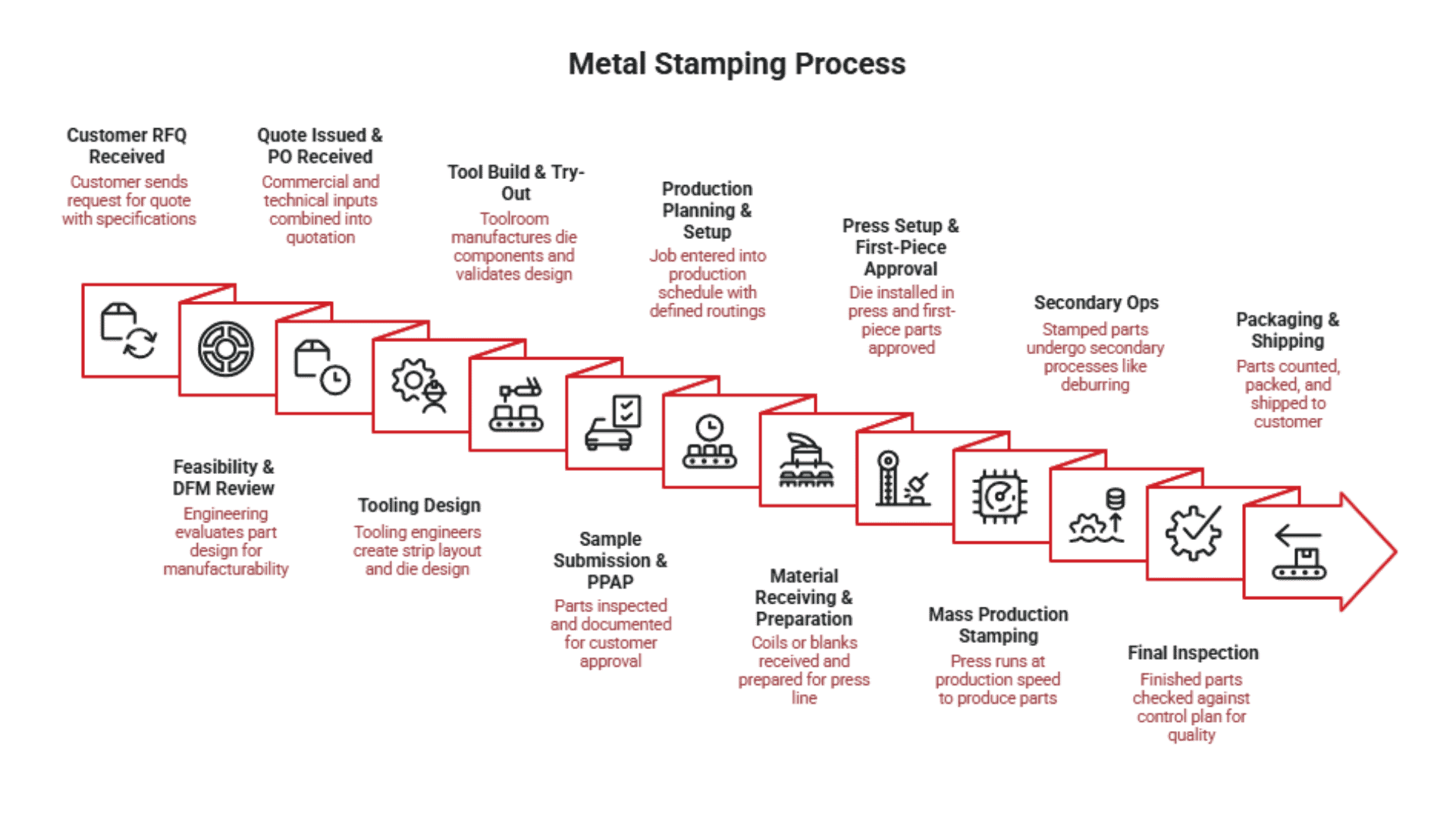
Precision and efficiency are critical in stamping, as each stage directly affects dimensional accuracy and part consistency. Each step in the stamping process step by step is designed to ensure that the final product meets stringent quality standards while minimizing waste and maximizing throughput. At Keats Manufacturing, we leverage one of the largest fleets of four-slide machines in North America to efficiently produce complex forms and bends for high-volume applications, enabling us to produce complex shapes and bends efficiently, particularly for high-volume applications.
What is a die in metal stamping?
In the context of metal stamping, a die serves as a critical tool that shapes the metal into the desired form. The function of a die is to cut, shape, and form metal through various processes. There are different types of dies used in metal stamping, including:
- •Progressive Dies: These allow multiple operations to be performed in a single press cycle, increasing efficiency.
- •Single-Operation Dies: These perform one operation at a time, often used for simpler shapes.
- •Compound Dies: These can perform multiple operations but are designed for specific parts.
The role of dies in ensuring accuracy and repeatability is paramount. A well-designed die enhances final product quality while minimizing scrap, rework, and long-term production costs. At Keats, our in-house tool & die development ensures that each die is crafted to meet the highest standards, backed by a lifetime guarantee.
What are the different types of metal stamping?
Metal stamping encompasses a variety of techniques, each tailored to specific applications. Here’s an overview of the types of stamping process:
Progressive Die Stamping (High Volume, High Precision)
Progressive die stamping is one of Keats’ core strengths. A continuous strip of material feeds through multiple stations in a single die, where it is punched, formed, and cut off as a finished part. This method is ideal for high-volume programs such as terminals, connectors, busbars, and reel-to-reel products, where we routinely run into the tens of millions of parts with very tight tolerances (down to the ten-thousandths of an inch on critical features) and highly repeatable quality.
When comparing high-volume progressive stamping to other die configurations, understanding how compound and transfer dies differ can clarify which approach best fits a given application. Our blog Compound vs. Progressive vs. Transfer Die breaks down these differences in detail.
Four-Slide / Multi-Slide Stamping (Complex Forms, Minimal Scrap)
Keats is particularly known for its four-slide and multi-slide capabilities. In these machines, multiple slides form the part from different directions, making them perfect for small, intricate components with multiple bends, hooks, and locking features—like clips, clamps, and specialty springs. This process often uses less material and reduces secondary operations, giving customers a very cost-efficient solution for complex geometries.
High-Speed Reel-to-Reel Stamping (Terminals, Lead Frames & Connectors)
For electrical terminals, lead frames, and connector pins, Keats uses high-speed progressive dies running on a carrier strip (reel-to-reel). It’s ideal for automotive, appliance, telecom, and industrial electronics applications where you need high volumes, reliable strip control, and plating-ready products.
What gauge metal for stamping?
Gauge measurement is a critical factor in the metal stamping process. It refers to the thickness of the metal and is significant because it influences the strength, weight, and overall performance of the final product. Understanding how gauge works is essential for selecting the right material for your application.
Factors influencing choice:
Choosing the appropriate gauge is crucial for ensuring that the stamped components meet the required specifications and performance standards. At Keats, we ensure full compliance with ISO 9001, ISO 14001, and IATF 16949, guaranteeing that our processes meet rigorous quality and compliance standards.
Ready to explore the world of metal stamping?
Dive deeper into our blog for expert insights, industry trends, and tips on choosing the right custom metal stamping manufacturer for your needs. Discover how our high-volume production capabilities can transform your projects.
What are the main advantages of using sheet metal stamping in manufacturing?
Comments Off on What are the main advantages of using sheet metal stamping in manufacturing?
In the fast-paced world of manufacturing, efficiency and precision are paramount. Sheet metal stamping has emerged as a critical process that not only enhances production capabilities but also ensures high-quality outputs across various industries. This article explores the advantages of sheet metal stamping—its role in manufacturing, its cost benefits, and its wide range of practical applications. By understanding these benefits, engineering and procurement professionals can make informed decisions that align with their production needs.
What is the primary purpose of sheet metal in the manufacturing process?
Sheet metal serves as a foundational material in numerous manufacturing applications. Its versatility allows it to be shaped, cut, and formed into various components essential for a wide range of products. The primary purposes of sheet metal in manufacturing include:
Understanding sheet metal design guidelines is crucial for maximizing manufacturability, reducing waste, and improving production efficiency. These guidelines ensure that the designs are not only functional but also manufacturable, reducing waste and optimizing production efficiency.
What are the benefits of metal stamping?
The metal stamping process offers several advantages that significantly improve production efficiency and reduce costs. Here are some key benefits:
- High Efficiency: Metal stamping supports rapid, repeatable production, making it ideal for high-volume manufacturing. The automated processes can produce thousands of parts in a short time frame.
- Precision: This method consistently achieves tight tolerances—often within ±0.0005 inches, which is critical for industries requiring high accuracy. Keats Manufacturing maintains these tolerances through its advanced capabilities, including the operation of one of the largest fleets of four-slide machines in North America.
- Cost-Effectiveness: The initial setup costs can be offset by the high volume of parts produced, leading to lower per-unit costs over time. With high-volume production capabilities of up to 50 million parts, Keats Manufacturing ensures that clients benefit from economies of scale.
Beyond efficiency and per-part cost savings, custom metal stamping offers strategic advantages that impact long-term production performance. Our blog Benefits of Custom Metal Stamping explores these advantages in greater depth.

The metal stamping process step by step involves:
What are some practical applications of metal stamping in various industries?
Metal stamping is utilized across a multitude of industries, demonstrating its adaptability and effectiveness. Here are some notable examples:
- AutomotiveComponents like brackets, clips, and electrical terminals are commonly produced through stamping. The stamping process in car manufacturing ensures that parts meet stringent safety and performance standards in the automotive industry.
- ElectronicsMetal stamping is used for creating enclosures, connectors, and circuit components.
- Medical DevicesPrecision parts are essential for medical instruments and devices, requiring high-quality metal stamping. Keats Manufacturing’s extensive compliance with ISO 9001, ISO 14001, and IATF 16949 certifications further ensures that components meet the rigorous standards of the medical industry.
These applications highlight the versatility of metal stamping, allowing manufacturers to produce a wide array of products efficiently.
What are the advantages and disadvantages of sheet metal?
The strengths of sheet metal make it a popular choice in manufacturing, but it also has some limitations. Here’s a closer look:
Advantages
- Durability: Sheet metal components are robust and can withstand various environmental conditions.
- Versatility: It can be easily formed into complex shapes and sizes.
- Cost-Effectiveness: High-volume production significantly reduces per-unit cost and material waste.
Disadvantages
- Design Limitations: Certain intricate designs may be challenging to achieve with sheet metal.
- Material Costs: Depending on the type of metal used, costs can vary, impacting overall project budgets.
Understanding these advantages and disadvantages is crucial for making informed decisions in the manufacturing process.
Metal Stamping Die
The role of metal stamping dies is pivotal in the manufacturing process. These dies are custom-made tools that shape the sheet metal into the desired form. Their quality and design of the die directly impact production efficiency, part consistency, and long-term manufacturing cost. Key points to consider include:
- Precision: High-quality dies ensure accurate part production, which is crucial for industries with tight tolerances.
- Durability: Well-designed dies can withstand the rigors of high-volume production, reducing downtime and maintenance costs.
- Cost-Effectiveness: Investing in quality dies can lead to lower overall production costs due to fewer defects and less waste. Keats Manufacturing’s in-house tool and die development ensures that clients receive reliable and precise tooling solutions.
In summary, the importance of die quality cannot be overstated; it is fundamental to achieving profitability and efficiency in metal stamping operations.
How Keats Differs: Coil-Fed Progressive Stamping vs. Traditional Sheet Metal Stamping
While sheet metal stamping is often performed one blank at a time, Keats Manufacturing specializes in progressive metal stamping from continuously fed coil stock. In many traditional sheet metal stamping operations, individual blanks are loaded and formed in single-hit presses. This approach can be effective for larger parts or lower-volume programs, but it is typically slower and more labor-intensive than automated progressive stamping.
In a progressive stamping setup, strip material is fed automatically from a coil through a series of stations within a single die. At each station, a different feature is formed—piercing, bending, coining, embossing, and more—until a finished part is produced with every press stroke. This continuous, coil-fed process dramatically increases throughput compared to handling one blank at a time.
Advantages of Coil-Fed Progressive Stamping at Keats
Keats focuses on coil-fed progressive stamping because it offers several key advantages for customers who need high-volume, high-precision components:
- Speed and Throughput: Automatically feeding material from a coil allows presses to run at high strokes per minute. Instead of loading and unloading individual blanks, parts are produced continuously, which significantly reduces cycle time per piece.
- Consistency and Repeatability: Because all operations occur in a single progressive die, dimensional consistency and part-to-part repeatability are extremely high—ideal for tight-tolerance components such as terminals, connectors, clips, and brackets.
- Lower Labor and Handling Costs: Reduced manual handling translates into fewer opportunities for damage, misloads, or variation. This also helps lower the total cost of ownership over the life of the program.
- Optimized Material Utilization: Progressive dies are designed to nest parts efficiently in the strip, often improving material yield compared to cutting individual blanks.
For projects where volumes are high, geometry is repeatable, and precision is critical, coil-fed progressive stamping is often the most efficient and cost-effective approach.
When Sheet Metal Stamping Still Makes Sense
There are still many situations where more traditional sheet metal stamping from blanks is the right choice—particularly for larger parts, lower volumes, or when changeovers and design iterations are frequent. In those cases, running one blank at a time can offer greater flexibility in setup and tooling strategy.
At Keats, our engineering team works with customers to determine whether coil-fed progressive stamping or a more traditional sheet metal approach best fits the part, the volumes, and the long-term cost targets. In many cases, a program might begin with a simpler sheet-based approach for prototyping, then transition into progressive stamping once the design is frozen and volumes ramp up.
Ready to explore the world of metal stamping?
Discover how our custom metal stampings and assemblies can transform your manufacturing needs.
Or contact our engineering team to discuss your specific requirements.