


Precision metal stamping is a critical process in the manufacturing landscape, known for its ability to create high-quality components with exceptional accuracy. This method is pivotal for industries that demand tight tolerances and high-volume production. In this article, we will examine the intricacies of precision metal stamping, its applications, types, and best practices for ensuring quality in the parts you order.
1958
±0.0001″
50M Parts
3 Locations
What is Precision Stamping?
Precision stamping refers to the process of shaping and cutting metal sheets into specific forms using specialised equipment. It is meaningful in manufacturing due to its efficiency and ability to produce parts with high precision and repeatability. As a leading precision stamping company, Keats specialises in delivering high-quality components tailored to the specific needs of various industries.
Industries that utilise precision metal stamping include:
- ✔Automotive: For components such as brackets, clips, and electrical terminals.
- ✔Appliance: Producing cost-effective clips and brackets at high volumes.
- ✔Medical Devices: Creating intricate components that require strict adherence to quality regulations.
- ✔Electrical Distribution: Manufacturing parts like connectors and terminals that are essential for reliable electrical systems.
- ✔Renewable Energy: Crafting components for solar panels and wind turbines that need to withstand extreme conditions.
Understanding the role of precision stamping in these sectors highlights its importance in delivering reliable and efficient solutions. Keats Manufacturing Co. has been at the forefront of this industry since 1958, leveraging one of the largest fleets of four-slide machines in North America, including unique Wünsch multi-slide machines, which enhance our capability to produce complex geometries with high precision.
What are the Types of Metal Stamping?
The main types of metal stamping processes include:
Progressive Die Stamping
This method involves a series of processes that occur in a single machine. It is ideal for high-volume production and allows for complex shapes to be formed efficiently.
Applications: Used for producing parts like connectors and brackets.
Advantages: High efficiency and reduced waste.
Four-Slide Stamping
Utilising multiple slides, this method allows for intricate parts to be formed in one operation.
Applications: Commonly used for electrical terminals and clips.
Advantages: Flexibility in design and high-speed production. Keats Manufacturing specialises in this area, offering high-precision tolerances of ±0.0002 inches for stamping, ensuring that every component meets stringent specifications. As one of the leading aluminium stamping companies, we also specialise in creating high-quality aluminium components that cater to various applications.
While these methods deliver exceptional accuracy, not every application requires this level of precision. Our blog: Is Precision Metal Stamping Right for Your Application? walks through the key factors to help determine when precision stamping is the best fit.
Single-Stage Stamping
This process involves a single operation to create a part from a sheet of metal.
Applications: Suitable for simple shapes and low-volume production.
Advantages: Cost-efficient for smaller runs.
Deep Draw Stamping
This method is used to create deep, hollow parts from flat metal sheets.
Applications: Often used in the manufacturing of automotive parts and containers.
Advantages: Ability to create complex shapes with minimal seams.
Each type of precision metal fabrication offers unique advantages tailored to specific applications, making it essential for manufacturers to choose the right process for their needs. At Keats Manufacturing, we design and build our tools in-house. We back them with a lifetime guarantee, ensuring that our customers only invest once in tooling. The tooling we construct is of the highest quality and reliability.
How Can I Ensure the Quality and Precision of the Stamped Parts I Order?
Selecting a reliable precision stamping company is essential for ensuring that the parts meet your specifications. Here are some best practices:
Check Quality Certifications
Look for companies that hold certifications like ISO 9001, ISO 14001, and IATF quality certification 16949. These certifications indicate a commitment to quality management systems. Keats Manufacturing is fully compliant with these standards, ensuring that our processes meet international quality benchmarks.
Experience Matters
Choose suppliers with a proven track record in your industry. Their experience can lead to a better understanding and execution of your requirements. Since 1958, we have been delivering custom small metal stampings, wire forms, and assemblies tailored to various industries, establishing a legacy of excellence.
Beyond supplier experience, it’s also important to evaluate whether precision stamping is truly the right approach for your specific part requirements. Our blog: Is Precision Metal Stamping Right for Your Application?, outlines the key considerations that help guide that decision.
Quality Control Measures
Inquire about the quality control processes in place, including inspection methods and testing protocols. At Keats, we utilize advanced quality control measures, including DCC programmable CMM inspections, to verify tolerances of ±0.0001 inches, ensuring that every part produced meets the highest standards of precision.
Precision Metal Stamping Locations
When searching for precision metal stamping near me, ensure that the company you consider has strategically located facilities. Our locations in Illinois, Texas, and Mexico allow us to provide just-in-time delivery for high-volume production, with the capability of producing up to 50 million parts efficiently.
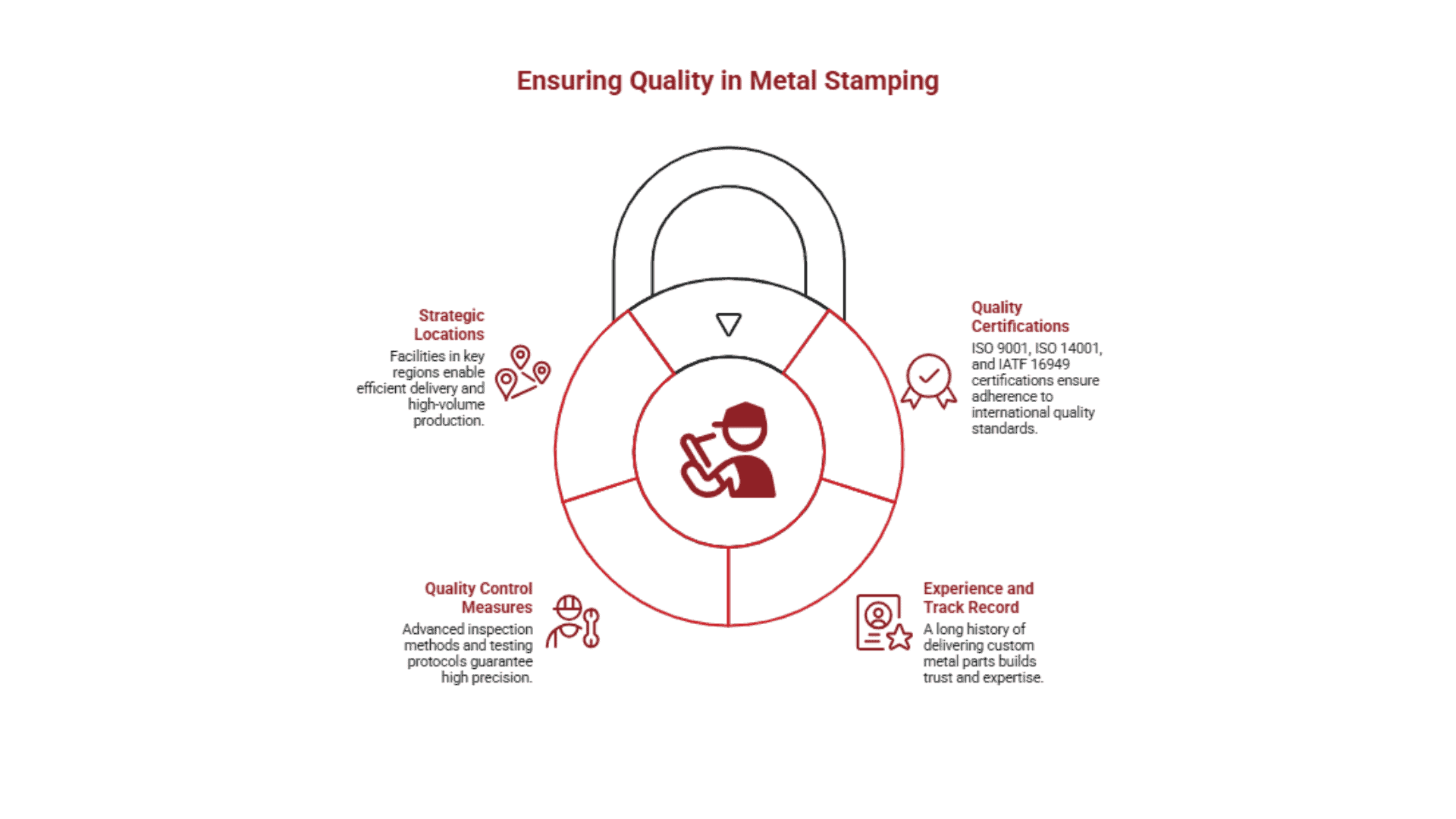
Understanding the intricacies of precision metal stamping and selecting the right partner can meaningfully impact the quality and reliability of your components. By prioritising quality certifications, experience, and robust quality control measures, you can ensure that your manufacturing needs are met with precision and excellence.
What is the Best Metal for Metal Stamping?
The choice of metal meaningfully impacts the precision metal stamping process and the final product. Common metals used include:
| Metal Type | Key Properties & Applications |
|---|---|
| Aluminium | Lightweight and corrosion-resistant, ideal for automotive and aerospace applications. Explore more about Aluminum Alloys for Metal Stamping. |
| Steel | Offers strength and durability, commonly used in heavy-duty applications. See our guide on Steel Alloys Used in Custom Metal Stamping Process. |
| Brass | Known for its excellent conductivity, often used for electrical components. |
| Stainless Steel | Resistant to corrosion, making it suitable for medical and food applications. |
The properties of each metal affect how easily it can be stamped. For instance, softer metals like aluminium are generally easier to stamp than harder metals like stainless steel. This choice influences not only the stamping process but also the overall performance of the final product. If you’re wondering, what is the easiest metal to stamp? Aluminium often ranks at the top due to its malleability.
How Much Does It Cost to Get a Die Made?
The cost of die-making can vary widely based on several factors:
- Complexity of the part Design: More intricate designs require more time and resources to create.
- Material Selection: The type of material used for the die can affect costs.
- Production Volume: Higher volumes can lead to lower per-unit costs, but initial die costs may be higher.
Generally, the price range for getting a die made can start from a few thousand dollars and can go up to tens of thousands, depending on the above factors. Understanding the stamping die process can help in budgeting and planning for your future projects.
How Thick Can You Stamp Metal?
The maximum thickness you can stamp depends on the material, part geometry, press tonnage, and tooling design, but most precision metal stamping falls in a fairly predictable range. For fine terminals, connectors, and small springs, stampers often work with thin strips in the 0.003–0.060 in (0.08–1.5 mm) range. For heavier parts like brackets and copper busbars, Keats can stamp material up to roughly 0.125–0.250 in (3–6 mm), provided the press and tooling are sized correctly.
Key factors that affect how thick you can stamp include:
- Material type and strength – High-strength steels and hard tempers require more tonnage than soft copper or aluminium at the same thickness.
- Part design – Deep forms, tight radii, and complex pierce patterns may require thinner material or multiple operations.
- Required tolerances and edge quality – The tighter the tolerance, the more carefully thickness, clearances, and tooling wear must be controlled.

In practice, the best way to answer “Can this thickness be stamped?” is to review the print, material spec, and thickness together so the stamping engineer can confirm what’s practical and recommend the right process. If you’re considering whether is metal stamping expensive? It’s essential to weigh the costs against the quality and precision that can be achieved.
The Role of Precision in Metal Stamping
At Keats Manufacturing Co., our commitment to precision is evident in our extensive capabilities. We operate one of the largest fleets of four-slide machines in North America which allows us to achieve high-volume production with tight tolerances of ±0.0002 inches. This precision is critical, especially in industries such as automotive and aerospace, where components must meet stringent specifications.
Our in-house tool and die development ensures that we can create custom dies tailored to specific project requirements, backed by a lifetime guarantee. This capability not only enhances the quality of the stamped products but also streamlines the production process, reducing lead times and costs.
Common Applications of Metal Stamping
Metal stamping is widely used across various industries, each requiring specific materials and tolerances. For instance, in the automotive sector, bronze terminal stampings are critical for ensuring reliable electrical connections in steering systems. Our Automotive Steering Position Sensor Terminal, made from 0.0238-inch thick phosphor bronze with a tight tolerance of ±0.0002 inches, exemplifies our dedication to quality and precision.
In the Custom metal stamping appliance industry, our brass terminal screw assemblies are designed for optimal conductivity and durability, making them ideal for electrical components. The choice of materials and the precision of our stamping processes ensure that these components perform reliably under various conditions.
Conclusion
By understanding the nuances of precision metal stamping, you can make informed decisions that enhance your manufacturing capabilities and ensure the delivery of high-quality components. The choice of metal, the cost of die-making, and the thickness limitations are all critical factors that influence the overall success of your projects.
Ready to discover how metal stamping can elevate your manufacturing process?
Connect with our engineering team to discuss your specific requirements and see how we can meet your needs with high-volume production capabilities.
Frequently Asked Questions
What materials can Keats Manufacturing Co. work with for precision metal stamping?
At Keats Manufacturing Co., we work with a variety of materials suitable for precision metal stamping, including:
- High-strength steel for durability and performance in precision metal stamping applications
- Lightweight aluminum for reduced weight applications
- Copper and brass for excellent conductivity
- Custom alloys designed to meet specific engineering requirements
How does Keats ensure high precision in metal stamping?
Keats Manufacturing Co. ensures high precision in metal stamping by:
- Implementing advanced computer-aided design (CAD) technology tailored for our unique Wünsch multi-slide machines, which allows for precise tooling in metal stamping.
- Employing skilled technicians with extensive training in precision manufacturing, specifically in high-precision tolerances of ±0.0005 in. for stamping.
- Conducting regular audits and continuous improvement processes to enhance production accuracy, ensuring compliance with ISO 9001 and IATF 16949 standards.
What industries benefit from Keats' precision metal stamping services?
Our precision metal stamping services support a diverse array of industries, including:
- Automotive applications that demand robust and reliable components through precision metal stamping techniques
- Renewable energy sectors focusing on efficient and sustainable parts
- Consumer goods manufacturing where design flexibility and precision are essential
- Electrical Distribution where Keats is a leading supplier of components for circuit breakers found in every home and business worldwide.
Can Keats Manufacturing Co. handle large volume production runs?
Yes, Keats Manufacturing Co. specializes in high-volume industrial applications, offering:
- Advanced automation techniques to enhance production speed in precision metal stamping
- Capability to manage diverse order sizes efficiently, from small batches to extensive runs
- Proven track record of meeting tight deadlines while maintaining stringent quality standards
- 3 Shifts working 24 hours per day.
How does the in-house tool and die development work at Keats?
Our in-house tool and die development at Keats Manufacturing Co. emphasizes precision and adaptability:
- We utilize advanced CAD software to design custom tools specifically for our unique Wünsch multi-slide machines, ensuring they meet your exact specifications
- Our experienced team conducts rigorous testing on each tool to ensure optimal performance in high-volume production
- We prioritize fast prototyping, often delivering initial samples within two weeks, to facilitate your project timelines and enhance production efficiency.
What certifications does Keats Manufacturing Co. hold?
Keats Manufacturing Co. prides itself on maintaining high industry standards, including:
- Certification in ISO:9001 for quality management systems
- ISO:14001 for environmental management
- IATF:16949 for automotive quality standards, ensuring compliance and consistency in every project related to precision metal stamping.
How does Keats handle design support for precision metal stamping?
Keats provides comprehensive design support for precision metal stamping by:
- Collaborating closely with clients to understand specific requirements
- Utilizing advanced CAD software for precise design modeling
- Offering prototyping services to test and refine designs
- Ensuring manufacturability with expert engineering analysis
- Providing feedback to optimize cost-efficiency and performance. This approach ensures high-quality, tailored solutions that meet client needs effectively.
What makes Keats Manufacturing Co. stand out in precision metal stamping?
Keats Manufacturing Co. stands out due to:
- Ownership of one of the largest fleets of four-slide machines in North America, including unique Wünsch multi-slide machines for enhanced precision
- In-house tool & die development with a lifetime guarantee, ensuring high-quality production
- Extensive high-precision tolerances (±0.0005 in. for stamping) that cater to diverse industrial applications.