

The industry of manufacturing is vast and intricate, with precision at its core. Among the key players in this field are metal stamping companies, which play an essential role in producing components that are foundational to various industries. This article serves as a comprehensive guide to understanding the stamping industry, its processes, and the key players driving innovation. By exploring the intricacies of metal stamping, you’ll gain insights that can help you select the right partners for your manufacturing needs.
What is the stamping industry?
What is metal stamping? Metal stamping is a manufacturing process that involves converting flat metal sheets into specific shapes and designs through a series of operations, including bending, punching, and cutting. The stamping industry is meaningful as it provides essential components for many sectors, including automotive, aerospace, and electronics.
The market dynamics of this industry are shaped by factors such as technological advancements, demand for precision, and the need for cost-efficient solutions. As industries evolve, metal stamping companies must adapt to meet the changing requirements of their clients, ensuring high-quality, reliable products. At Keats Manufacturing Co., we have established ourselves as leaders in this space by offering tolerances as tight as ±0.0002 in., which is essential for applications in high-precision industries such as aerospace and medical devices.
To better understand the fundamentals of this process, read our blog What Is Metal Stamping and How It Works.
Precision Tolerance Capabilities
How is stamping done?
The metal stamping process can be broken down into several steps:
Using the latest developments in CAD/CAM software, engineers create detailed designs of the parts to be manufactured.
In-house tooling is developed to create the necessary dies for stamping. At Keats, dies and tooling are engineered and built in-house, ensuring a high level of quality control and customization for our clients.
The metal sheets are fed into stamping presses where various operations are performed, such as blanking, bending, and piercing. With over 150–175 stamping and wire-forming machines across three facilities, Keats can accommodate a wide range of production volumes, from prototypes to high-volume runs of up to 50 million parts.
After stamping, parts may undergo secondary processes like heat treatment, degreasing, deburring and/or plating to enhance their quality. Our assembly services allow for just-in-time (JIT) delivery, ensuring that components are produced efficiently and delivered exactly when needed.
Different techniques are employed in metal stamping, including progressive die stamping, which allows for high-volume production with tight tolerances. Understanding these techniques is vital for selecting the right metal stampings for your project. Keats also offers secondary services such as heat treating, stress relieving, and powder coating, which further enhance the performance and durability of the stamping parts.
The precision and reliability of the stamping process are further supported by Keats’ commitment to sustainability. Our operations are designed to minimize waste and ensure compliance with regulatory standards, which is increasingly necessary in today’s manufacturing landscape. This sustainability-driven approach not only benefits the environment but also translates into cost savings that can be passed on to our clients.
In addition, the tooling provided by Keats comes with a lifetime guarantee, reflecting our confidence in the quality and durability of our products. This assurance is particularly appealing to procurement professionals and engineers who require long-term reliability in their supply chains.
By leveraging advanced manufacturing technologies and a deep understanding of industry needs, metal stamping companies like Keats Manufacturing Co. are positioned to meet the demands of diverse sectors, from automotive to renewable energy. The integration of automated assembly processes, capable of producing up to 200 pieces per minute, further enhances our ability to deliver high-quality components efficiently.
In brief, the metal stamping industry is not just about producing parts; it’s about providing solutions that meet the evolving needs of various industries. By understanding the intricacies of the stamping process and the capabilities of leading manufacturers, you can make informed decisions that drive your projects forward.
What industries commonly use metal stamping?
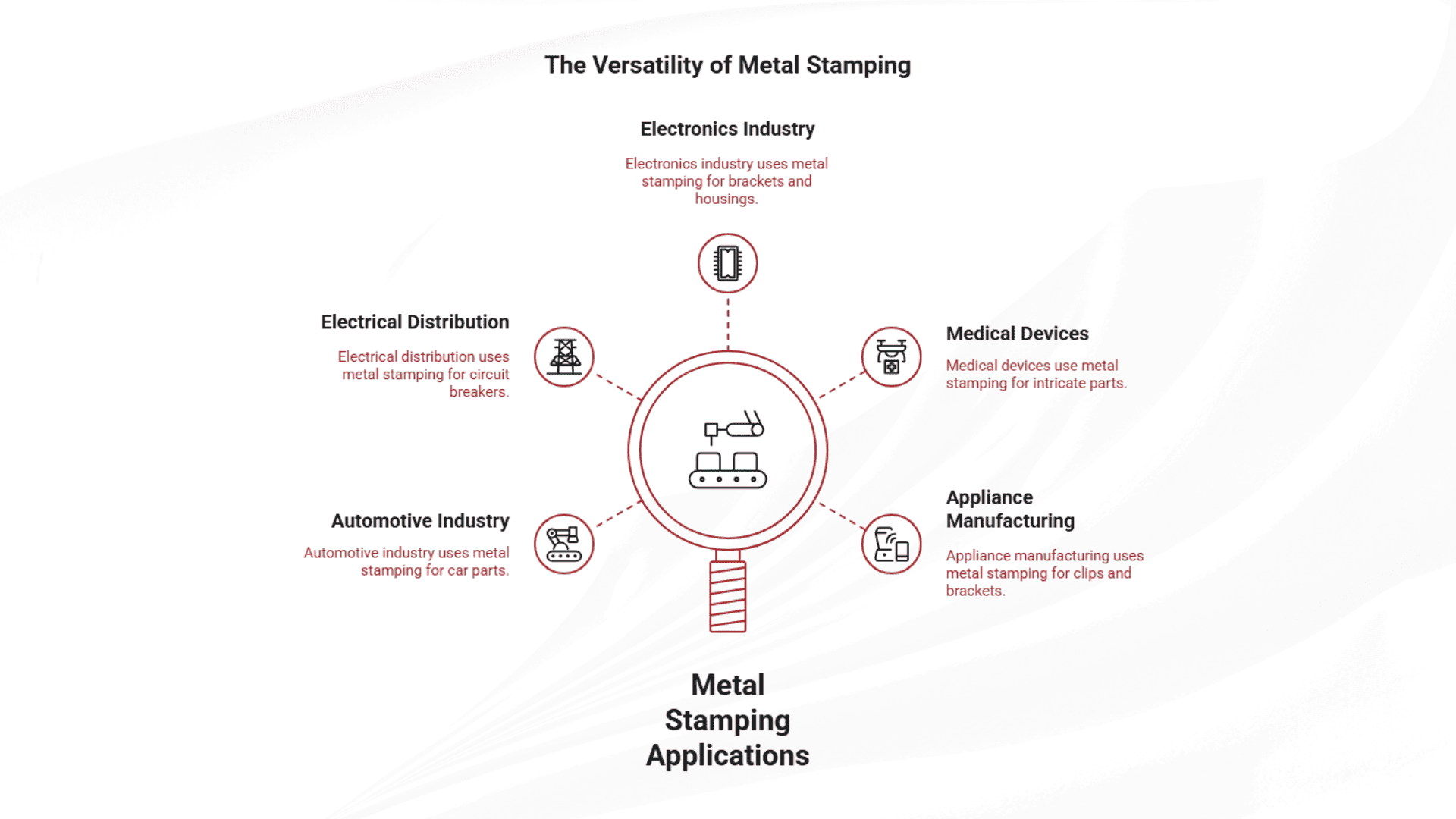
Several industries rely heavily on metal stamping, including:
- ■
Automotive: Nearly every car in North America contains parts produced by top metal stamping companies. - ■
Electrical Distribution: Companies that make circuit breakers and other electrical distribution products use metal stampings in their finished goods extensively. - ■
Electronics: Components such as brackets and housings are often stamped for durability and precision. - ■
Medical Devices: Stamping is used to create intricate parts that meet stringent regulatory standards. - ■
Appliances: Clips, Brackets & Terminals are used in appliances to hold down sub-assemblies and make electrical connections.
The specific needs of each industry affect supplier selection, emphasizing the necessity of quality and reliability in metal stamping companies in the USA. For instance, in the automotive industry, the demand for high-volume production with tight tolerances is essential. At Keats Manufacturing Co., we leverage advanced metal stamping techniques and have over 150–175 stamping and Metalforming machines across three facilities to meet these demands efficiently.
What types of materials are commonly used in metal stamping?
The choice of material substantially impacts the final product, influencing factors such as weight, strength, and cost. Understanding these materials helps in selecting the right metal stamping manufacturer for your needs. Additionally, at Keats Manufacturing Co., we specialize in custom metal stamping across a wide range of materials, ensuring that each project can be tailored to meet specific performance requirements. Leading metal stamp manufacturers like Keats combine material expertise with advanced tooling capabilities to deliver optimal results. Our in-house tooling capabilities allow for precise engineering of dies, which are backed by a lifetime guarantee, further enhancing the reliability of the materials we use.
How can I ensure the quality and precision of the stamped parts I order?
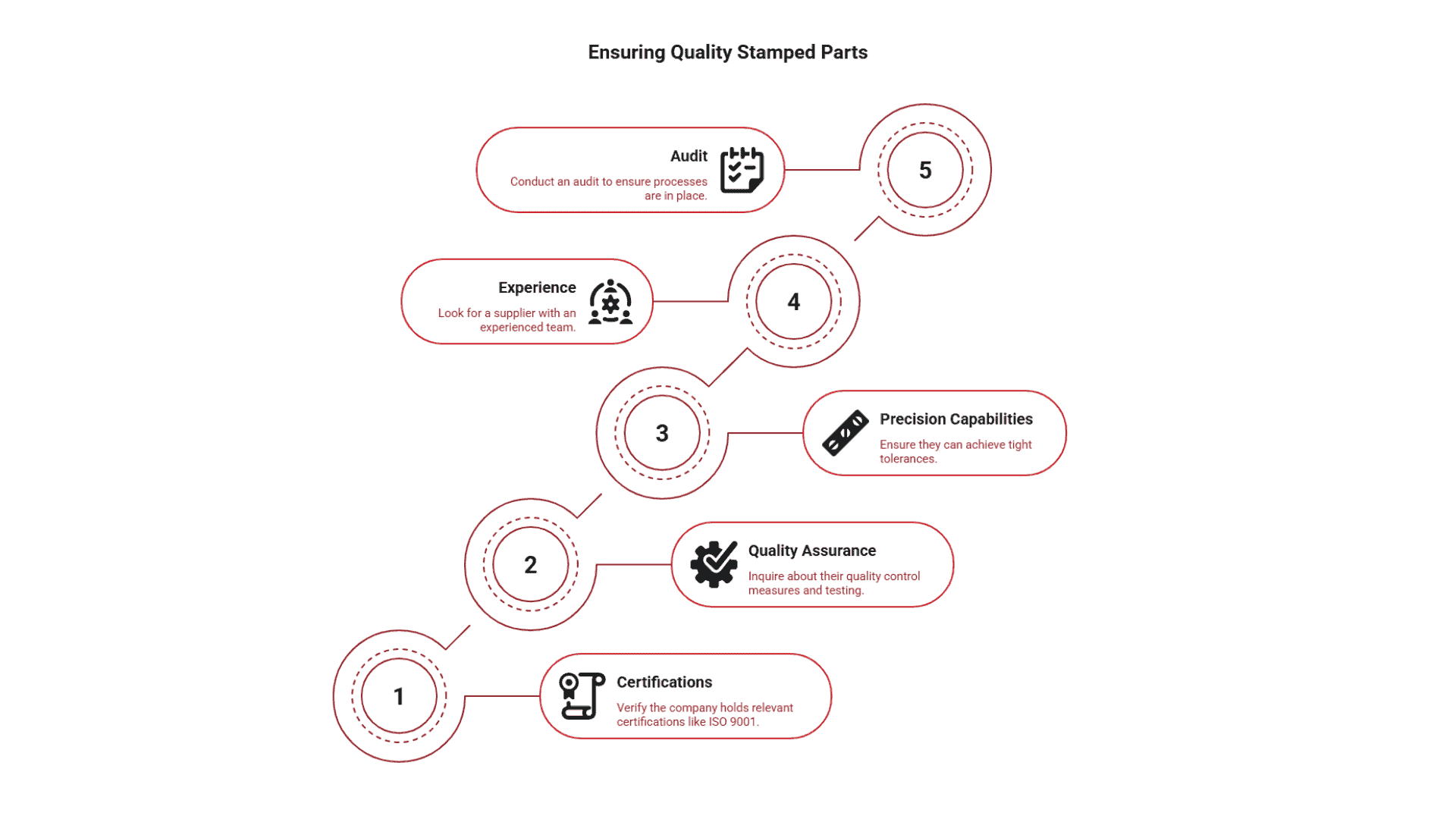
To ensure the quality and precision of stamped parts, consider the following quality control measures:
- Certifications: Look for the largest metal stamping companies that hold relevant certifications, such as ISO 9001 or IATF 16949.
- Quality Assurance Processes: Inquire about their quality assurance measures, including regular inspections and testing.
- Precision Capabilities: Ensure the company can achieve tight tolerances. Ensure the supplier performs a feasibility assessment or a character-based feasibility study (CBFS) on your part prior to awarding any business to them.
- Experience: Metal stamping is a complex process that requires decades to learn and master. Look for a supplier that has an experienced team of engineers with many years experience.
- Audit: Go and audit the process of the supplier you are planning to award business to. Check to make sure they have all the processes in place needed to ensure you get 0 PPM performance.
Choosing metal stamping companies near me that prioritize quality assurance will lead to better outcomes for your projects. At Keats Manufacturing Co., we implement rigorous quality assurance processes at every stage of production. Our commitment to precision is demonstrated through our ability to achieve tolerances as tight as ±0.0005 in. This level of accuracy is essential in industries such as medical devices and aerospace, where even the smallest deviation can have substantial implications.
Beyond that, our Just-in-Time (JIT) delivery capability ensures that parts are produced and delivered as needed, minimizing inventory costs and improving overall efficiency. With automated assembly capabilities that can handle up to 200 pieces per minute, we can meet high-volume demands without sacrificing quality.
In addition, we utilize advanced technologies such as CNC (computer numerical control) and EDM (electrical discharge machining) in our tool and die development. This not only enhances the precision of our tooling but also allows us to adapt quickly to changing project requirements, ensuring that we remain responsive to the needs of our clients.
By partnering with a manufacturer that employs these advanced techniques and adheres to stringent quality standards, you can ensure that the stamped parts you order will meet your specifications and performance expectations.
The global metal stamping market is projected to grow around 4% compound annual growth rate (CAGR). This growth is driven by increasing demand across key sectors such as automotive, aerospace, consumer electronics, and industrial machinery. The automotive industry, in particular, accounts for over 38% of metal stamping demand, driven by rising vehicle production and the need for lightweight components to enhance fuel efficiency.
Technological advancements are also shaping the metal stamping industry. The integration of Industry 4.0 technologies, including smart systems, IoT sensors, AI-driven analytics, and advanced robotics, is transforming stamping operations. These innovations enable precise, real-time monitoring of equipment performance, defect detection, and process optimization, leading to increased productivity and streamlined operations.
Sustainability is another key focus, with manufacturers adopting eco-friendly materials and processes. The use of recycled metals, such as aluminum and steel, is becoming more prevalent to meet environmental regulations and customer demands. Energy-efficient stamping presses and waste-reduction techniques, like precision blanking, are also on the rise, aligning with global sustainability goals.
In the United States, the metal stamping industry has experienced a compound annual growth rate (CAGR) between 1 and 2% over the past five years. This growth is influenced by factors such as fluctuations in input costs, demand from core customer markets like aerospace and manufacturing, and global economic trends.
The Asia-Pacific region holds a substantial share of the global metal stamping market, accounting for over 40% in 2024. This dominance is driven by rapid industrialization and high-volume production capabilities. However, recent U.S. tariffs have indirectly benefited regional players by diverting exports elsewhere.
To summarize, the metal stamping industry is experiencing steady growth, driven by increasing demand across various sectors and technological advancements. Manufacturers are focusing on sustainability, automation, and precision to meet the evolving needs of their customers.
Who Makes Stamping Presses?
The metal stamping industry is characterized by a diverse array of manufacturers, ranging from specialized companies to large conglomerates. Major manufacturers of stamping presses include industry leaders known for their innovative designs and reliability. Some of the largest metal fabricators in the US use presses that are essential to the stamping process, enabling metal stamping companies to produce high-quality parts efficiently. The role of a stamping press in the production process cannot be overstated, as they determine the speed and precision of metal forming operations.
Industry Innovations and Trends:
The metal stamping industry continues to evolve with significant technological advancements. Leading manufacturers are introducing high-speed servo press systems designed to reduce cycle times and enable the production of complex die-based parts for demanding applications.
In the automotive sector, there is a growing focus on lightweight stamped components for next-generation electric vehicle platforms, with manufacturers forming strategic partnerships to co-develop innovative solutions. Additionally, automated welding solutions integrated with stamping lines are becoming increasingly prevalent in automotive body-in-white production.
The connectivity sector is witnessing advancements in high-speed stamping solutions that emphasize precision and material efficiency. Meanwhile, manufacturers across various regions continue to expand their capabilities by investing in heavy-duty stamping equipment, reinforcing their competitive positions in the market. These ongoing developments reflect the industry’s commitment to improving efficiency, precision, and adaptability to meet the evolving demands of modern manufacturing, with this collaborative industry effort playing a pivotal role in advancing stamping press capabilities across various sectors.
Is Stamping Cost-Effective?
Analyzing the cost factors involved in metal stamping reveals several advantages:
- ● High Volume Production: Stamping is often more cost-efficient than other manufacturing processes when producing large quantities.
- ● Reduced Waste: Efficient material use minimizes waste, lowering overall costs.
- ● Just-in-Time (JIT) Delivery: Many metal stamping companies offer JIT delivery, reducing inventory costs.
When compared to other methods, the stamping industry often proves to be a more economical choice for high-volume manufacturing. At Keats Manufacturing Co., we exemplify this cost-efficiency through our just-in-time delivery capability, which not only reduces inventory costs but also ensures that clients receive their parts exactly when needed, enhancing their operational efficiency. Additionally, our in-house tooling and die engineering allow for precise adjustments and optimizations, further driving down costs while maintaining high-quality standards.
Can you provide insights into the technological advancements these companies are using?
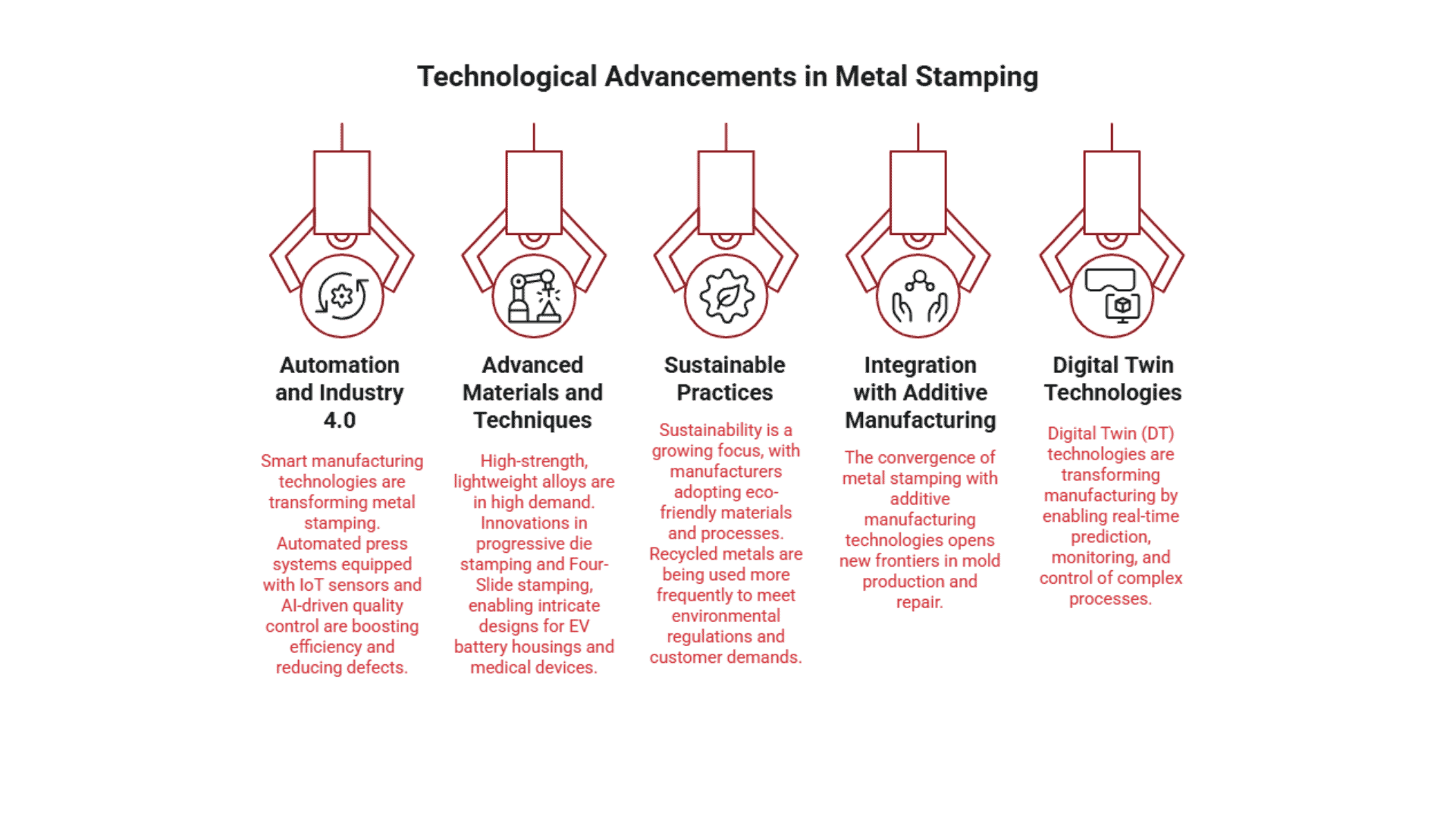
Recent technological innovations in metal stamping include:
- Automation and Industry 4.0 Integration: The adoption of smart manufacturing technologies is transforming metal stamping. Automated press systems equipped with IoT sensors and AI-driven quality control are boosting efficiency and reducing defects.
- Advanced Materials and Techniques: High-strength, lightweight alloys are in high demand, particularly for electric vehicle (EV) components. Innovations in progressive die stamping and Four-slide stamping, enabling intricate designs for EV battery housings and medical devices.
- Sustainable Practices: Sustainability is a growing focus, with manufacturers adopting eco-friendly materials and processes. Recycled metals, such as aluminum and steel, are being used more frequently to meet environmental regulations and customer demands. Energy-efficient stamping presses and waste-reduction techniques, like precision blanking, are also on the rise, aligning with global sustainability goals. Look for a supplier that is certified to ISO:14001
- Integration with Additive Manufacturing: The convergence of metal stamping with additive manufacturing technologies opens new frontiers in mold production and repair.
- Digital Twin Technologies: Digital Twin (DT) technologies are transforming manufacturing by enabling real-time prediction, monitoring, and control of complex processes.
These advancements not only enhance the quality of metal stampings but also position top metal stamping companies. At Keats Manufacturing Co., we leverage CNC (computer numerical control) and EDM (electrical discharge machining) technologies to achieve tight tolerances up to ±0.0005 in. This level of precision is essential for industries such as aerospace and medical devices, where even minor deviations can lead to substantial issues.
Beyond that, our advanced four-slide and multi-slide stamping presses enable us to produce complex shapes and components efficiently, further showcasing our commitment to technological excellence. The integration of these technologies not only streamlines the production process but also enhances the overall quality and reliability of our products.
Conclusion
The industry of metal stamping is shaped by leading manufacturers who invest in innovative technologies and efficient processes. By understanding the key players and advancements in this field, engineers and procurement professionals can make informed decisions that align with their project requirements. Whether you require high-volume production or precision components, the right stamping press can substantially impact your manufacturing outcomes.
Ready to explore the metal stamping industry further?
Discover the top companies, innovative techniques, and industry insights that can elevate your projects.
Frequently Asked Questions
What should I look for when choosing a metal stamping company?
When selecting a metal stamping company, consider the following:
- Assess their production volume capabilities; at Keats Manufacturing Co., we have a proven track record of handling high-volume orders efficiently with one of the largest fleets of four-slide machines in North America.
- Look for advanced technology; our facility is equipped with state-of-the-art CNC machines and unique Wünsch multi-slide machines for precision work.
- Verify their commitment to sustainability; we implement eco-friendly practices to minimize environmental impact while maintaining certification with ISO 9001 and ISO 14001 standards.
What types of materials can Keats Manufacturing Co. work with?
At Keats Manufacturing Co., we work with an extensive array of materials for precision metal stamping, including:
- High carbon steel for parts requiring strength, hardness, and wear resistance.
- Low carbon steel for cost-effective components that need good formability and versatility.
- Stainless steel for applications requiring corrosion resistance, durability, and a clean finished appearance.
- Copper and brass alloys for electrical conductivity, corrosion resistance, and forming performance.
- Aluminum for lightweight components with strong strength-to-weight advantages.
Custom-engineered and specialty alloys selected to meet unique performance, environmental, or application-specific requirements
How does Keats ensure precision in metal stamping?
Keats ensures precision in metal stamping through our ownership of one of the largest fleets of four-slide machines in North America, including unique Wünsch multi-slide machines. We achieve extensive high-precision tolerances of ±0.0002 inches for stamping, backed by in-house tool and die development with a lifetime guarantee.
What industries does Keats Manufacturing Co. serve?
Keats Manufacturing Co. serves a diverse range of industries, including:
- Renewable energy, providing components for solar and wind applications through metal stamping processes.
- Consumer goods, producing parts for household appliances and electronics.
- Industrial machinery, delivering robust components for manufacturing processes.
Can Keats Manufacturing Co. handle high-volume production?
Absolutely! Keats Manufacturing Co. is equipped for high-volume production, with capabilities that include:
- Advanced automation technology to streamline operations and increase throughput, making us a competitive choice among metal stamping companies.
- A dedicated team of engineers focused on optimizing processes for large-scale manufacturing.
- Proven track record of delivering consistent quality across extensive production runs.
- 3 Shifts running 24 hours per day.
What is the lead time for custom metal stamping projects at Keats?
Lead times for custom metal stamping projects at Keats Manufacturing Co. typically range from 8 to 12 weeks, depending on the scale of production and material availability. Our advanced project management system, combined with our ownership of one of the largest fleets of four-slide machines in North America, helps optimize timelines. We prioritize efficient communication to ensure alignment with your deadlines while upholding our quality standards.
Does Keats offer prototyping services for metal stamping?
Yes, Keats Manufacturing Co. provides prototyping services to help you validate your designs before full-scale production:
- Our advanced 3D modeling software allows for precise visualization of your designs.
- We leverage rapid prototyping techniques to reduce lead times and enhance design accuracy.
- This service is essential for identifying potential issues early in the development process, making it a valuable offering among metal stamping companies.
How does Keats Manufacturing Co. support sustainability in its operations?
How does Keats Manufacturing Co. support sustainability in its operations? Sustainability is a priority at Keats Manufacturing Co., reflected in our operations:
- We implement energy-efficient technologies like our advanced four-slide machines to minimize our carbon footprint.
- Our recycling programs ensure that metal scrap is reused, reducing landfill waste.
- We actively seek partnerships with suppliers who prioritize sustainable practices in metal stamping, enhancing our overall environmental responsibility.