


As demand for intricate, reliable metal components grows, manufacturers need processes that combine speed, precision, and flexibility. Four‑Slide Stamping is a metal forming technique that plays a vital role in producing sophisticated parts at scale. Since 1958, Keats Manufacturing Co. has set the standard in custom small metal stampings for high-volume industrial and engineering applications while specializing in this technique.
This comprehensive guide dives into the world of Four-Slide Stamping. Here, you’ll learn what sets four-slide stamping apart from other methods, how the process works, and how to leverage its unique benefits for your most challenging manufacturing projects.
Key Takeaways
- ›Four‑slide stamping enables the rapid, precise production of complex, high-volume metal components with tight tolerances.
- ›This process is distinct from other metal stamping methods due to its unique machine design and simultaneous multi-directional forming.
- ›Material selection and part design significantly impact process efficiency, final product quality, and cost.
- ›Four‑slide technology is ideal for both high-volume industrial runs.
- ›Choosing a reputable four‑slide stamping partner requires evaluating certifications, experience, and secondary service offerings.
What is four-slide stamping?
Four‑Slide Stamping is a specialized metal forming process designed to create intricate parts with multiple bends and forms in a single, highly efficient operation. At its core, the process uses a four-slide stamping machine system with four tool-carrying slides arranged at right angles around the workpiece.
What is a four-slide machine stamping? It is a manufacturing method in which independent slides, each equipped with forming tools, simultaneously work on a metal strip, enabling complex, multi-directional bends, twists, and cutouts in a single continuous cycle. Unlike traditional presses, this setup allows simultaneous forming from multiple directions, enabling the production of complex geometries that would be impractical or cost-prohibitive with other methods.
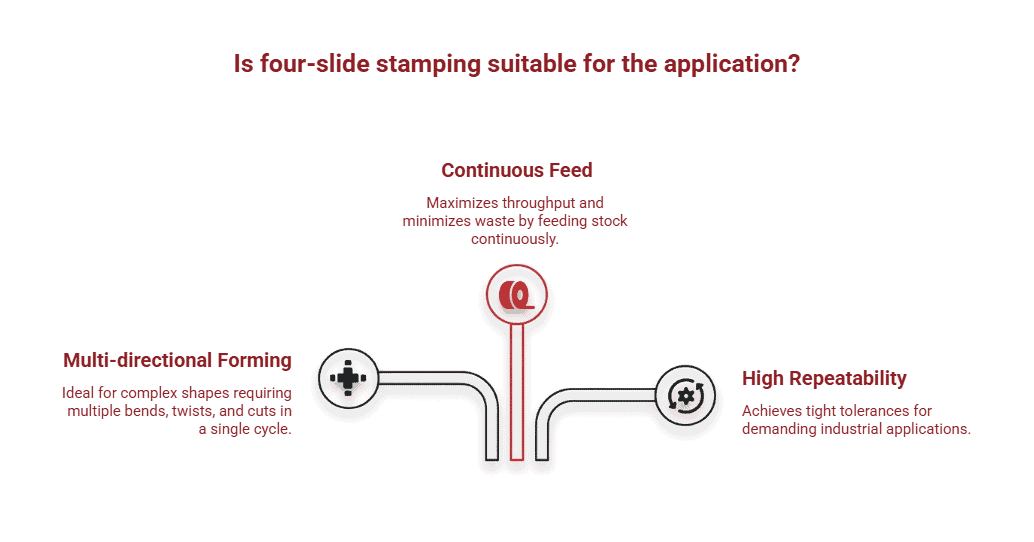
Key features of four-slide stamping include:
- Multi-directional forming: Four slides operate in concert to perform multiple bends, twists, and cuts in a single cycle.
- Continuous feed: Strip or wire stock is fed through the machine, maximizing throughput and minimizing waste.
- High repeatability: The process achieves extremely tight tolerances of up to ±0.0002 in. for stampings, ideal for demanding industrial applications.
Four‑slide stamping excels at producing complex part geometries, such as compound bends, closed loops, and intricate cutouts, across both ferrous and non-ferrous metals. Its ability to perform multiple operations in a single pass accelerates production, reduces handling, and ensures consistent, high-quality results for industries ranging from automotive to medical devices. With production speeds up to 15,000 pieces per hour and in-house tool-and-die development, four-slide technology delivers scalable high-volume manufacturing without compromising precision.
Extreme Precision Metric±0.0002 in.
Maximum tolerances achievable for complex applications.
How does a four-slide stamping machine work?
A four-slide stamping machine operates by driving four horizontal slides with a central camshaft, with each slide carrying a forming tool. The synchronized movement enables the creation of multiple features on a part without transferring the part between stations. This is a key differentiator from traditional vertical stamping presses, which typically only form the part from the punching direction.
Four-Slide Technology offers several advantages for complex parts:
Simultaneous forming from multiple directions reduces the need for secondary operations.
High-speed production supports just-in-time delivery and high-volume capacity of up to 50 million parts.
In-house tool & die development enables rapid prototyping and lifetime tool guarantees, reducing long-term costs.
The four-slide process excels at producing parts with multiple precise bends, ideal for electrical terminals, custom shields, and intricate assemblies. Its unique machine configuration integrates additional tooling, such as punches and cut-off mechanisms, directly into the forming cycle. This streamlines production and minimizes manual intervention.
With over 140 production machines, Keats Manufacturing operates one of North America’s largest four-slide fleets, including exclusive Wünsch multi-slide machines. These advanced systems deliver versatility and precision across diverse materials and part sizes. All Keats plants are certified to ISO:9001, ISO:14001, and IATF:16949 standards.
Production monitoring and quality control are integral to the four-slide stamping process. Advanced inspection technologies, such as programmable CMMs & vision systems, are used to verify part dimensions and tolerances throughout the production run.
The flexibility of four-slide machines also extends to secondary operations. Integrated capabilities such as contact-staking, hole-threading & screw-insertion can be performed in-line or as part of a streamlined workflow, delivering finished parts ready for assembly or end use. This vertical integration reduces lead times, improves cost efficiency, and ensures that every part meets the exacting standards required by high-volume industrial clients.
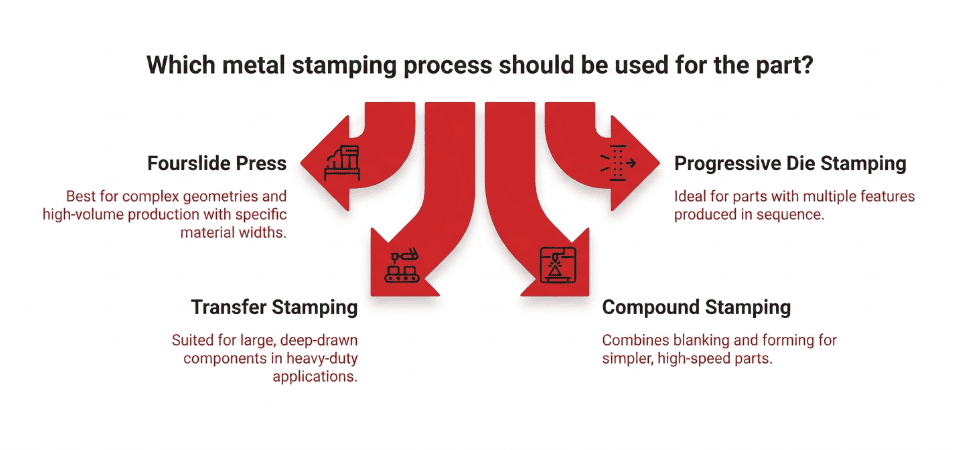
What are the main differences between the four types of metal stamping in terms of their applications?
Metal stamping encompasses several core processes, each with distinct strengths:
Fourslide stamping stands out for its ability to handle intricate designs and frequent design changes with unmatched efficiency.
Another important advantage of four-slide stamping is its ability to reduce gross material usage. In many progressive die stamping applications, the part must remain attached to a carrier strip as it moves from station to station through the die. That carrier strip is necessary for part progression and control, but it ultimately becomes scrap. Four-slide stamping can often eliminate or significantly reduce this extra material requirement because the part is guided through the forming process using stock guides rather than relying on a wide carrier strip to move it through multiple stations.
This can create meaningful cost savings, especially on high-volume programs or parts made from expensive materials such as copper, brass, bronze, stainless steel, or pre-plated strip. By purchasing material closer to the finished part width and reducing unused carrier material, four-slide stamping can lower the gross material content required to produce each part. The result is not just less scrap but also lower total part cost, better material utilization, and a more efficient stamping process for parts well-suited to four-slide production.
When selecting the optimal metal stamping process, it’s essential to consider part complexity, production volume, and required tolerances. Four-slide technology is particularly advantageous for projects demanding high repeatability and the ability to accommodate design modifications without extensive retooling. The process’s inherent flexibility makes it the preferred choice for industries where product innovation and customization are key drivers of competitive advantage.
The strategic location of Keats Manufacturing’s three state-of-the-art campuses in Illinois, Texas, and Mexico further enhances responsiveness and supply chain reliability. By maintaining full control over tool and die design, prototyping, and secondary operations, Keats delivers a seamless experience from initial concept through high-volume production, supporting just-in-time delivery models and reducing total cost of ownership for clients across diverse sectors.
What are some common materials used in metal stamping, and do certain processes work better with specific metals?
Multi-slide machines are compatible with a wide range of metals, each selected for its mechanical properties and suitability for forming:
(including stainless)
copper alloys
Metal stamping high-volume production often favors materials that can withstand repeated forming without cracking or losing dimensional integrity. Four-slide stamping is particularly effective for ductile metals such as copper, brass, and certain steels, which benefit from simultaneous multi-directional forming. The American Society of Mechanical Engineers (ASME) highlights that material selection is a critical step in the metal forming process, as it directly impacts manufacturability, cost, and end-use performance (asme.org).
The extensive compatibility of four-slide and multi-slide stamping with various alloys is a direct result of the process’s unique mechanical configuration. By delivering forming forces from multiple axes, four-slide machines can shape metals with complex geometries and tight radii that would be challenging or impossible to achieve with conventional punch-press methods. For example, electrical terminals and custom shields frequently require intricate bends and precise cutouts. Here, the flexibility of four-slide forming is essential for both quality and cost efficiency.
At Keats Manufacturing, the ability to achieve high-precision tolerances (as tight as ±0.0002 in.) enables the consistent production of parts from even the most challenging materials. This level of precision is particularly valuable when working with specialty alloys such as copper or bronze, which are commonly specified for their electrical conductivity and spring properties in demanding industrial and electronic applications.
For deeper guidance on material selection, explore our dedicated resources on aluminum alloys for metal stamping, steel alloys in custom stamping, and copper alloys for metal stamping.
How does the choice of material, such as high-strength steel versus aluminum, affect the stamping process and final product quality?
Material properties directly influence both the stamping process and end-use performance. For Four‑Slide Stamping, consider:
- High-strength steel: Offers superior durability and load-bearing capacity, ideal for automotive components requiring longevity. However, it may require specialized tooling and lead to slower forming speeds.
- Aluminum: Lightweight and corrosion-resistant, making it suitable for electronics, HVAC, and consumer goods. Its malleability allows for complex forms, but may require additional finishing to prevent surface defects.
In metal stamping high-volume production, balancing the mechanical demands of the application with the material’s formability ensures optimal results.
The choice between high-strength steel and aluminum also has implications for tool wear, production speed, and secondary operations. High-strength steels, while robust, can accelerate tool degradation if not paired with properly engineered dies and lubricants. Keats Manufacturing’s in-house tool & die development addresses these challenges by designing and maintaining tooling specifically for the selected material and part geometry, backed by a lifetime guarantee. This approach not only extends tool life but also preserves part consistency across millions of cycles.
For applications where lightweighting is critical, such as in the automotive or consumer electronics sectors, aluminum’s lower density and corrosion resistance offer clear advantages. However, its tendency to gall or pick up during forming requires careful process control, and, in some cases, the integration of secondary services like e-coating or plating to enhance surface durability. The ability to seamlessly incorporate these finishing steps within the same production workflow is a key differentiator for high-volume manufacturers.
Material selection also impacts achievable tolerances and repeatability. For instance, more ductile metals like copper or brass can be formed at higher speeds without sacrificing dimensional accuracy. This can aid Keats in supporting just-in-time delivery schedules and minimizing lead times. In contrast, harder alloys may require slower cycle rates and more frequent inspection to maintain the tight tolerances demanded by industries such as medical devices or telecommunications.
How do you choose the right material for a metal stamping project?
While not design-responsible for the parts themselves, Keats does offer guidance to help our customers select the ideal material for their specific end use. Choosing the right material involves several key steps:
The material’s compatibility with the selected stamping process is critical for achieving tight tolerances and consistent quality.
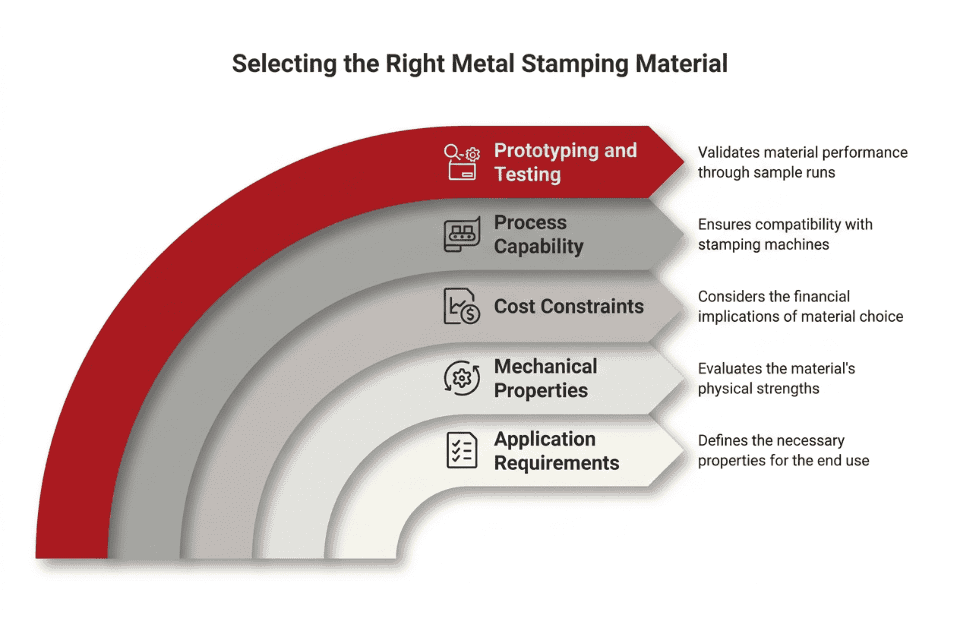
In practice, the material selection process begins with a collaborative engineering review that leverages advanced CAD/CAM and simulation technologies to model the forming behavior of candidate alloys. This digital approach enables early identification of potential challenges such as springback, thinning, or surface defects long before physical tooling is built. By simulating the stamping process, engineers can optimize both material usage and part geometry, reducing scrap and ensuring that the final product meets all functional and regulatory requirements.
The company’s vertically integrated operations, spanning three strategically located, state-of-the-art facilities in Illinois, Texas, and Mexico, enable rapid prototyping and iterative testing across a range of materials and part designs. This infrastructure supports both high-volume production (up to 50 million parts) and low-volume or prototype runs, providing customers with maximum flexibility as their needs evolve.
Keats Manufacturing maintains full certification at all 3 facilities to ISO 9001, ISO 14001, and IATF 16949 standards. These certifications ensure that our manufacturing processes not only meet mechanical and performance criteria but also align with industry-specific quality and traceability mandates.
Can metal stamping be used for producing custom or low-volume parts, or is it only suited for large-scale production?
Metal stamping can support both prototype development and high-volume production, but the optimal process depends heavily on the part’s design, size, material, and expected annual usage. Four-slide stamping is typically best suited for production programs exceeding 100,000 pieces, though this threshold can vary with part size and complexity. Because four-slide tooling is designed for repeatable, high-speed production, it usually does not make economic sense for very low-volume runs unless the part has a clear path to higher-volume production.
When a customer needs prototype parts or a limited production quantity, Keats Manufacturing often uses a different approach. Instead of building full production tooling immediately, the flat blank can be produced using methods such as photo etching, laser cutting, waterjet cutting, or wire EDM. The part can then be individually formed using soft tooling to create prototype samples that closely represent the intended production design. This allows engineers to evaluate fit, form, function, material selection, and design changes before committing to production tooling.
Prototype-First Approach
- Photo etching — ideal for very fine, complex flat patterns
- Laser cutting — versatile for a range of metals and thicknesses
- Waterjet cutting — suitable for heat-sensitive materials
- Wire EDM — precision cutting for hardened steels
This prototype-first approach helps reduce upfront costs and risks while still supporting a smooth transition to full-scale manufacturing. Once the design is validated and volumes justify production tooling, the part can be engineered for the most efficient stamping process, including four-slide stamping when the geometry and volume are a strong fit. In this way, Keats can support customers from early-stage development through high-volume production without forcing a production tooling investment too early in the process.
How do I determine which manufacturers or service providers are most reputable for custom four-slide stamping projects, and what are the advantages of choosing a provider?
To identify the best partner for your custom four-slide stamping near me search, prioritize:
Manufacturers with a reputation for precision and innovation, backed by a lifetime tool guarantee, deliver the reliability your project demands. When evaluating providers, consider those with a proven track record in high-volume industrial and engineering applications, as well as the capability to support complex, multi-step production requirements. The presence of in-house tool & die development, especially with a lifetime guarantee, is a clear indicator of long-term commitment to quality and cost efficiency.
Additionally, companies operating multiple state-of-the-art facilities, particularly those strategically located for just-in-time delivery, offer greater flexibility and responsiveness to changing project demands. The ability to handle a wide range of materials and part geometries, combined with advanced CAD/CAM capabilities, sets the true leaders in the field apart.
Learn more about what to evaluate in our guide: What Should I Consider When Choosing a Custom Metal Stamping Provider?
How do lead times and minimum order quantities usually compare between four-slide stamping providers?
Four-slide stamping is generally best suited for production programs where the annual volume justifies dedicated tooling and machine setup. Minimum order quantities can be relatively high compared with prototype or short-run manufacturing methods, depending on the part’s size, material, and complexity. However, once the tooling is built and the process is running, four-slide stamping can produce parts at very high speeds with a low piece price, making it an excellent option for high-volume components where total cost and repeatability are critical.
Lead times for four-slide stamping are often similar to traditional progressive die stamping because both processes require engineered production tooling. Actual timing depends on tooling complexity, material availability, customer approvals, secondary operations, and production scheduling. For this reason, it is important to discuss expected annual usage, launch timing, prototype requirements, and ramp-up needs early in the quoting process.
While four-slide stamping may not be the right fit for very small production runs, it can be highly cost-effective when the part design and volume align with the process. The combination of high production speed, efficient material usage, and repeatable forming makes four-slide stamping especially valuable for electrical terminals, clips, contacts, shields, springs, wire forms, and other small precision metal components.
When evaluating four-slide stamping providers, customers should ask about realistic tooling lead times, minimum release quantities, production capacity, material sourcing, and secondary service requirements such as plating, heat treating, assembly, tapping, contact staking, packaging, or kitting. A strong supplier will be transparent about when four-slide stamping is the best fit, and when another process may be more appropriate.
Is four slide stamping capable of meeting ultra-tight tolerances?
Is four-slide stamping capable of meeting ultra-tight tolerances? Absolutely. Four-slide stamping is engineered for high-precision applications, routinely achieving tolerances as tight as ±0.0002 in. for stampings. This makes it the process of choice for:
Micro-connectors, terminals
Sensor housings, clips — see our guide on electrical terminals in the auto industry
Precision springs, shields
Industries demanding consistent, repeatable accuracy rely on Four‑Slide Stamping for mission-critical components. The ability to maintain such stringent tolerances is supported by robust quality management systems and real-time inspection technologies, essential for applications where even minor deviations can lead to functional failures. Providers with ISO 9001 and IATF 16949 certifications demonstrate a rigorous approach to process control and continuous improvement, ensuring that every part meets or exceeds customer specifications. Furthermore, integrating machine vision inspection and digital simulation into process engineering enables early detection and correction of potential issues, reducing the need for costly rework and helping maintain high first-pass yield rates. This level of precision is particularly beneficial for industries such as aerospace and medical device manufacturing, where regulatory compliance and traceability are paramount.
Explore how precision metal stamping delivers consistent, reliable results across demanding applications.
Conclusion
Selecting the right four-slide stamping partner is a strategic decision that impacts every stage of your project, from initial design through high-volume production and final assembly. Prioritizing providers with deep technical expertise, vertically integrated operations, and a documented commitment to quality ensures your components meet the highest standards of precision and reliability. The combination of extensive four-slide capacity, in-house tool & die development, and comprehensive secondary services produces superior outcomes, whether you require ultra-tight tolerances, complex geometries, or rapid scalability.
For organizations seeking to optimize both cost and performance, partnering with a manufacturer that offers just-in-time delivery and a lifetime tool guarantee delivers a clear competitive advantage. To discuss your specific requirements or to explore how four-slide stamping can elevate your next project, request a quote today.
Ready to explore four-slide stamping for your next project?
Discover how Keats Manufacturing’s custom four-slide solutions can transform your most challenging components. Visit keatsmfg.com or contact our engineering team to discuss your specific requirements.