

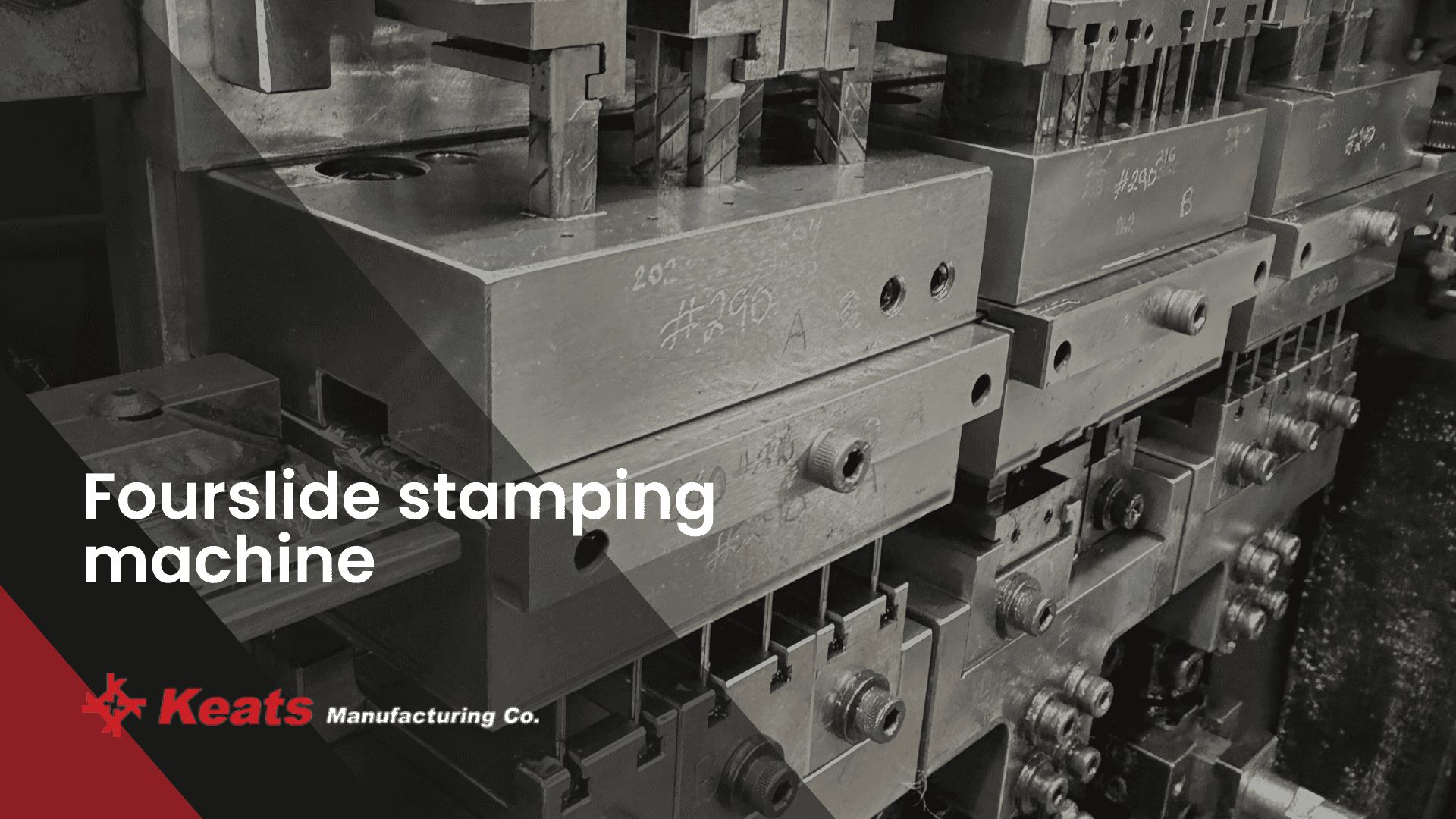
Manufacturers seeking to elevate their capabilities in high-volume, custom metal component production often turn to the four-slide stamping machine process for its transformative approach to precision forming. By combining multi-directional forming with exceptional speed and repeatability, four-slide technology redefines what’s possible in small metal stampings and wire forms.
This article uncovers the mechanics, advantages, and strategic considerations pertaining to four-slide machines, empowering decision-makers to navigate material selection, design complexity, setup efficiency, and quality standards. For a comprehensive overview of the broader process, see our Four-slide stamping page.
Key Takeaways
- ›Four-slide stamping machines deliver unmatched precision and flexibility for high-volume, custom small metal stampings, wire bends, and clips.
- ›These machines accommodate a wide range of metals and thicknesses, making them ideal for complex geometries and intricate part designs.
- ›Compared to traditional stamping, four-slide technology enables reduced tooling costs and greater design freedom.
- ›Selecting the right production machine and certified manufacturing partner ensures optimal quality, tight tolerances, and production efficiency.
- ›ISO 9001, ISO 14001, and IATF 16949 certifications are essential for evaluating if a supplier has consistent quality and compliance in metal stamping manufacturing.
What does stamping mean in manufacturing?
Stamping in manufacturing refers to the process of forming, cutting, or shaping metal sheets or wire into precise components using dies and presses. It is foundational to the production of a wide range of metal parts, from electrical terminals and custom shields to brackets, clips, and intricate electromechanical assemblies. The process typically involves feeding raw metal stock into a press, where a die shapes it under high-speed, high-pressure contact to meet repeatable tolerances across millions of cycles.
Within this landscape, the four-slide stamping machine introduces a fundamentally different approach. Unlike traditional presses that operate solely via vertical motion, four-slide machines use four synchronized slides that move horizontally to form complex parts from strip or wire stock. This multi-directional forming capability enables multiple bends and intricate geometries to be formed in a single pass, significantly reducing the need for secondary operations and material waste.
What are the defects of stamping in metal? A persistent concern across all stamping methods is part quality. Common defects in common parts include burrs, warping, springback, dimensional inaccuracies, and surface imperfections. These issues stem from uncontrolled material flow, improper tooling clearance, and inconsistent press force. Research published in MDPI Manufacturing and Metrology confirms that “uneven distribution of stress during the stamping process is the cause of warping and misalignment,” and that cumulative errors can propagate across subsequent stamping operations.
The four-slide stamping machine addresses these failure modes directly: its cam-driven, synchronized slide motion ensures controlled, repeatable force application from multiple axes, minimizing the stress imbalances that produce defects at scale.
For additional context on how stamping fits within the broader manufacturing landscape, see Can you explain the different types of metal stamping processes used in manufacturing?
What types of materials can be used with a four-slide stamping machine, and are there any limitations?
Four-slide stamping machines are highly versatile, accommodating a broad spectrum of metals and alloys. Commonly processed materials include stainless steel, copper, and copper alloys such as beryllium copper, brass, phosphor bronze, aluminum, low- and high-carbon cold-rolled steels, spring steel, and specialty alloys. As documented in the engineering literature, the most commonly used materials for four-slide operations are selected based on their formability and bending radius rather than solely on machine limitations.
(beryllium, brass, phosphor bronze)
(low & high-carbon)
Specialty Alloys
Material thickness can range from ultra-thin foils to heavier gauges, typically ranging from 0.002 to 0.075 inches (up to ~1.9 mm), depending on machine capacity. Hardness is also a factor; four-slide machines handle spring-tempered and hardened materials effectively, but extremely brittle or unusually thick stock may require specialized tooling or an alternative process such as progressive die stamping.
A prime example of four-slide material capability is the production of Stainless Steel Spring Clips. These components require multiple precise bends, consistent spring-back properties, and reliable dimensional tolerances across high-volume runs. Four-slide technology excels at forming these parts in a single cycle, ensuring repeatable geometry and surface integrity as required for demanding environments in automotive, electronics, and industrial assembly.
Secondary services, plating, heat-treating, and stress-relieving further extend the material and finish options available on a four-slide line, allowing in-line finishing and assembly and reducing downstream handling.
For more on the types of services available in this field, see What types of metal stamping services do these companies typically offer?
How does the four-slide stamping process handle complex part designs compared to traditional stamping methods?
The core mechanical advantage of the four-slide stamping machine is its ability to complete all forming operations required to produce a finished part in a single, continuous cycle. Each of the four slides carries a unique tool that can strike the workpiece either simultaneously or in rapid sequence, enabling the formation of bends, twists, and compound geometries from four orthogonal directions without repositioning the part. This eliminates the need for multiple stations, secondary operations, or extensive die changeovers.
Compared with a progressive die stamping machine, four-slide technology offers superior design flexibility for wire forms and small stampings having multiple bends in proximity or in different planes. Progressive stamping excels at high-volume production of flat or moderately contoured parts where carrier strip continuity and station-to-station consistency are priorities. This is particularly relevant to the automotive and electronics sectors, where part geometry is stable, and volumes are extremely high. However, for parts requiring bends greater than 90°, intricate twists, or multiple forming features in proximity, the four-slide stamping machine can often offer superior efficiency and lower tooling costs.
Design modification is another area where four-slide machines can outperform traditional presses. Adjusting individual slides and cams to accommodate a new geometry requires no new die set; changes are made directly on the machine. Manufacturers who implement quick changeover and setup reduction methodologies achieve increased productivity, reduced lead time, reduced inventory, and faster resolution to quality problems, in direct parallel to the iterative flexibility four-slide enables throughout product development cycles. Production rates of up to 15,000 pieces per hour make this process viable for full-scale volume production.
To explore the specific factors that influence production speed and efficiency in four-slide machines, visit Can you explain the main factors that affect the speed and efficiency of four-slide machines in production?
Can you explain the setup and changeover process for different parts on a four-slide machine?
Setting up a four-slide stamping machine for a new part involves a precise sequence of steps:
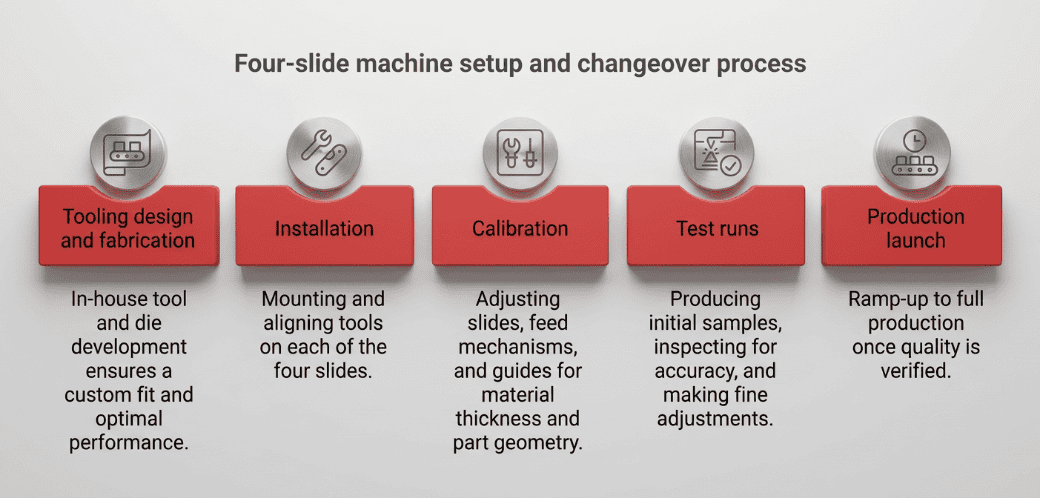
A key operational advantage of the four-slide platform is that minor and major tooling adjustments can be made directly on the machine without removing the tooling for external modification. This reduces both production downtime and tool room labor, enabling rapid response to design changes or in-process quality corrections.
Operator skill is the decisive variable in changeover performance. A well-trained team reduces setup time, maintains dimensional control, and maximizes productive capacity across every shift. This relationship plays out in practice across the manufacturing sector: the National Institute of Standards and Technology’s Manufacturing Extension Partnership (NIST MEP), a public-private network that helps U.S. manufacturers improve productivity and competitiveness, has documented that manufacturers working with its centers report significant cuts in changeover time, freeing up additional production capacity across multiple shifts. In a four-slide environment, that same operator expertise shows up directly: faster part transitions, less idle time, and higher overall equipment utilization.
For companies evaluating options, searching for a ‘four-slide stamping machine near me’ or identifying ‘metal stamping manufacturing companies near me‘ provides access to local engineering expertise to accelerate setup, troubleshooting, and ongoing optimization, critical for just-in-time delivery and high-volume production schedules.
How do I determine the right tonnage or size of stamping machine for my specific project needs?
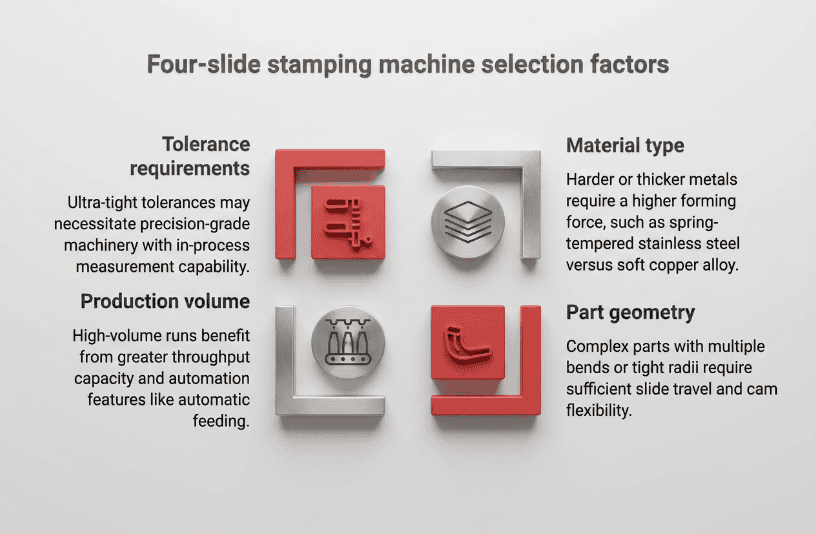
Selecting the optimal four-slide stamping machine size involves evaluating several interconnected factors:
- Material type and thickness. Harder or thicker metals require a higher forming force. Spring-tempered stainless steel demands a different machine capacity than soft copper alloy strip.
- Part geometry and complexity. Parts with multiple bends, tight radii, or forming operations from all four axes require a machine with sufficient slide travel and cam flexibility to execute each motion within the cycle.
- Production volume. High-volume runs benefit from machines with greater throughput capacity and automation features such as automatic feeding and integrated assembly operations.
- Tolerance requirements. Ultra-tight tolerances may necessitate precision-grade machinery with in-process measurement capability.
Consulting with metal stamping manufacturers provides access to engineering teams who can evaluate drawings, assess machine specifications against part requirements, and recommend the most cost-effective configuration. Local partnerships also reduce lead times for tooling modifications and provide hands-on support during ramp-up.
In-house tool and die development is a decisive capability in this selection process. NIST MEP case studies confirm that manufacturers with integrated tool and die shops are positioned to reduce lead times and modify tooling as required for just-in-time production, eliminating the delays and costs associated with outsourced tooling changes. Matching machine capacity to part requirements from the outset rather than retrofitting later is the single most effective strategy for cost-efficient, high-quality production.
What is the average stamping tolerance?
Stamping tolerance defines allowable deviation from specified dimensions and is a direct measure of process capability, tooling quality, and machine precision. In high-precision environments, typical tolerance ranges are:
for stampings
for most features, with tighter control achievable in specialized applications
This directly raises the question: “Is four-slide stamping capable of meeting ultra-tight tolerances?” The answer is yes: when the supplier properly maintains their equipment and develops their tooling in-house using advanced CAD/CAM systems, and rigorous process controls, four-slide technology consistently achieves the tolerances required for critical applications in automotive, medical device, and electrical distribution manufacturing.
Peer-reviewed research published in MDPI Materials confirms that “precise control of forming parameters ensures uniform material flow, minimizes elastic recovery, and reduces defects like thinning, microcracking, and grain boundary separation” — the physical mechanisms that determine whether a stamped part holds its specified dimensions across millions of cycles. ISO 9001:2015 further specifies that certified organizations must “demonstrate the ability to consistently provide products and services that meet customer and applicable statutory and regulatory requirements”, establishing the calibration and documentation framework that makes tolerance compliance auditable and repeatable.
For a deeper dive into the role of precision in metal stamping, see What is Precision Metal Stamping.
What kinds of design limitations or part geometries are difficult to achieve with four-slide stamping?
While the four-slide stamping machine delivers exceptional versatility, certain geometries present real challenges:
In these cases, the progressive die stamping machine is the preferred alternative, offering deeper draw capability, larger forming envelopes, and higher available press tonnage. For parts that fall near the boundary between processes, collaboration with experienced engineers often yields hybrid solutions, such as a four-slide with an integrated press head station, that capture the forming flexibility of four-slide while adding limited deep-draw or blanking capability. Material properties such as hardness, ductility, and temper also influence feasibility. Engineering review at the design stage is the most reliable way to match geometry to the process prior to making a tooling investment.
What are ISO and IATF certificates?
ISO and IATF certifications are internationally recognized frameworks for quality, environmental, and sector-specific process management in manufacturing. Understanding what these certifications require and what they guarantee is essential for selecting metal stamping manufacturing companies near me for mission-critical applications.
The world’s leading quality management standard, helping organizations “deliver consistent products and services, improve efficiency, and meet customer and regulatory expectations.” For a four-slide operation, it means every setup, changeover, calibration, and production run is documented, controlled, and subject to continuous-improvement audit cycles.
Governs environmental management systems, ensuring manufacturing operations minimize environmental impact by controlling the use of materials, energy, and waste streams — an increasingly important requirement for OEM supply chain compliance.
Builds on ISO 9001 with additional requirements specifically designed for automotive supply chains, covering quality management system requirements for design, development, production, and service of automotive-related products, including traceability, risk management, and production part approval processes.
When evaluating ‘metal stamping manufacturing companies near me’, confirming ISO 9001, ISO 14001, and IATF 16949 certification ensures that the four-slide stamping machine operations you’re partnering with meet the most rigorous standards for quality consistency, process documentation, and regulatory compliance. This provides confidence for regulated industries from automotive and aerospace to medical device and electrical distribution.
Conclusion
Selecting the right stamping machine and process is a strategic decision that impacts every stage of your project, from prototyping to high-volume production. Leveraging Keats Manufacturing’s comprehensive fleet of four-slide and multi-slide machines, in-house tool & die expertise, and legacy of precision manufacturing dating back to 1958, achieves optimal results for even the most complex components.
Discover how four-slide stamping can streamline your manufacturing process with greater precision and efficiency. Ready to learn more or see how this technique can benefit your next project? Contact our team today to discuss your requirements or request a personalized quote.
Ready to find the right four-slide stamping solution?
Contact Keats Manufacturing to discuss your requirements or request a personalized quote. Visit keatsmfg.com or reach out to our engineering team directly.