

Metal stamping is an essential process for manufacturing precision components across automotive, medical, electronics, and aerospace industries. Understanding the materials that can be efficiently used in metal stamping is essential for engineers and procurement professionals alike. This article explores the types of materials commonly employed in metal stamping, their properties, and considerations for selecting the best options for your projects.
What form of material is used for metal stamping?
The materials typically used for metal stamping can be categorized into different forms, including sheets, coils, and strips. The choice of material form is essential for achieving the desired specifications and tolerances in stamping parts.
Properties for stamping:
- • Ductility: The ability to deform under tensile stress without breaking.
- • Tensile Strength: The resistance of a material to being pulled apart.
- • Hardness: The ability to withstand deformation and wear.
- • Corrosion Resistance: Essential for parts exposed to harsh environments.
These properties ensure that the stamping parts material can endure the stresses of the manufacturing process while maintaining structural integrity. Additionally, at Keats Manufacturing Co., our in-house tooling capabilities allow us to engineer dies that maximize the performance of these materials, ensuring optimal results in the stamping process.
What metals are best for stamping?
| Material Group | Grades & Applications |
|---|---|
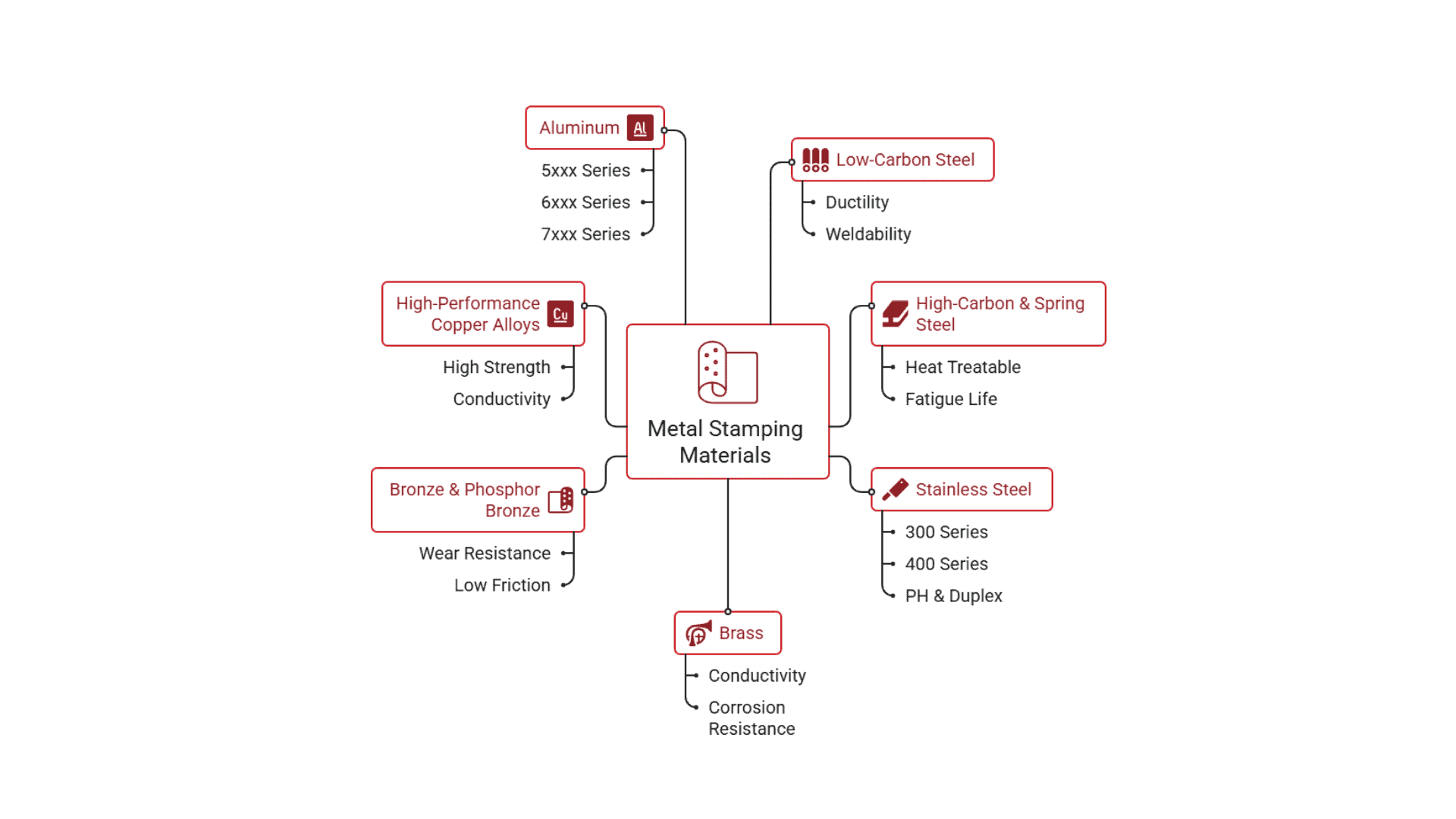
| Low-carbon steel (A1008/A1010, IF, HSLA) | The workhorse for brackets, shields, and housings. Excellent ductility and consistency, great for deep draws and complex forms, readily weldable and paintable. HSLA grades add strength without sacrificing formability—perfect when you want thinner, lighter parts. |
| High-carbon & spring steel (1050–1095) | Chosen for clips, clamps, springs, and retainers. These grades respond well to heat treat for high strength and fatigue life. Expect tighter bend radii post-harden and plan secondary operations (stress-relief, deburr) accordingly. |
| Stainless steel (300/400 series, PH & duplex) | 300 series (301/304/316): Austenitic, very formable with excellent corrosion resistance.
400 series (409/430/434/444): Ferritic, magnetic, good corrosion resistance with better cost stability. PH & duplex (17-4PH, 2205): For high strength, wear, and corrosion resistance with reduced section thickness. |
Selecting the right alloy involves more than corrosion resistance and strength—application demands and cost trade-offs matter just as much. Our blog Material Matters: Choosing the Right Metal for Your Project, breaks down how to evaluate those decisions efficiently.
Selecting the right alloy involves more than corrosion resistance and strength—application demands and cost trade-offs matter just as much. Our blog, Steel Alloys Used in Custom Metal Stamping Process, breaks down how to evaluate those decisions efficiently.
Copper & Alloys
- Copper (Cu: C110, Cu-ETP): 99.9% pure copper. This is one of the most common materials for Terminals, Bubars, and other parts that require high electrical conductivity. Copper is generally easy to form and has little springback.
- Brass (Cu-Zn: C260, C268, C272): Clean edges, stable springback, and superior conductivity make brass a favorite for electrical terminals, contacts, and decorative hardware.
- Bronze & phosphor bronze (C510/C519/C521): Copper-tin alloys renowned for wear resistance, low friction, and fatigue strength.
- High-performance copper alloys (C194/C197/C19210, C7025/C7026): Engineered for today’s electrification requirements. See more on Copper Alloys for Metal Stamping.
Aluminum (5xxx/6xxx/7xxx)
- 5xxx (5052/5083/5754): Non-heat-treatable Mg-bearing alloys—great formability, good strength-to-weight, and strong corrosion resistance.
- 6xxx (6061/6082): Heat-treatable Al-Mg-Si—balanced strength and machinability for structural stampings.
- 7xxx (7005/7075): Very high strength where weight savings are critical. For more info, visit Aluminum Alloys for Metal Stamping.
Why these materials stamp well
- Formability vs. strength trade-off: Low-carbon and 5xxx Al lead for deep draws; spring steels, PH stainless, and Corson coppers deliver strength.
- Electrical/thermal performance: Copper, brass, and advanced Cu alloys offer high conductivity.
- Corrosion performance: Stainless and 5xxx Al excel in harsh environments.
- Finish options: All are compatible with common finishes (tin, nickel, silver, zinc, passivation, anodize).
We routinely hold tight tolerances to ±0.0002 in., enabling intricate features—lances, coined details, fine slots, and precision bends—across all of the materials above. If you share your target environment (load, current, temperature, corrosion, plating), we’ll recommend the optimal alloy and temper for cost, performance, and throughput.
What is the best metal for metal stamping?
Determining what metal is best for stamping depends on the specific application and requirements. Factors influencing the choice of metal include:
Material selection in metal stamping is essential to achieving desired performance, durability, and overall economic viability. Ultimately, the best metal will align with the functional requirements and overall budget of the project. At Keats, we provide The Many Benefits of Just-in-Time Inventory delivery capability, ensuring that the selected materials are available when needed, thereby optimizing project timelines and costs.
What gauge metal for stamping?
The gauge of metal used in stamping is a very important factor that directly impacts the performance and durability of the final product. Guidelines for selecting the appropriate gauge:
- Application Requirements: Heavier parts may require thicker gauges, while lighter applications can utilize thinner gauges.
- Material Type: Different metals have different strengths; for example, aluminum may require a thicker gauge than steel.
- Manufacturing Capabilities: Ensure the chosen gauge aligns with the capabilities of the stamping equipment being used.
Selecting the right gauge is essential for achieving the desired balance between strength, weight, and cost. We operate over 150–175 stamping and wire-forming machines across our three facilities, allowing for flexibility in gauge selection and production scalability.
Can you stamp stainless steel?
Yes, you can stamp stainless steel, but it comes with specific challenges:
- Work Hardening: Stainless steel can harden during the stamping process, making it more challenging to form.
- Tool Wear: The hardness of stainless steel can lead to increased wear on tooling, necessitating more frequent replacements.
- Comparison with Other Metals: While stainless steel offers excellent corrosion resistance, it may require more precise tooling and increased energy.
Understanding these factors is critical for successful stainless steel stamping. Our lifetime guarantee on tooling ensures that the tooling used for stainless steel stamping is built to withstand these challenges, providing peace of mind for our clients.
Aluminum for Progressive Stamping
Advantages:
- Lightweight
- Corrosion Resistance
- Ease of Fabrication
Disadvantages:
- Lower Strength
- Cost (Alloy Dependent)
At Keats Manufacturing Co., we utilize automated assembly capabilities of up to 200 pieces per minute, ensuring that aluminum components can be efficiently processed and assembled for high-volume production.