

Choosing the right custom metal stamping provider is crucial for ensuring consistent precision, quality, and long-term manufacturing success. With the right partner, you can achieve precision, quality, and efficiency in your manufacturing processes. This article will guide you through essential considerations, including types of metal stamping, practical applications across industries, key supplier features, cost factors, and design guidelines. Understanding these elements will empower you to make an informed decision when selecting a custom metal stamping manufacturer.
What are the types of metal stamping?
Metal stamping encompasses various processes, each tailored for specific applications. The four main types of metal stamping include:
Progressive Die Stamping
This process involves feeding a strip of metal through a series of stations in a single die. Each station performs a specific operation, such as cutting or bending, until the final part is produced. It’s ideal for high-volume production and offers excellent precision.
Understanding how progressive die stamping compares to multi-slide methods can help clarify which approach best fits your part design and production volume. For a deeper comparison, see our blog Difference Between Multi-Slide and Progressive Die Stamping.
Four-Slide Stamping
This method uses a machine with four sliding tools that can perform multiple operations simultaneously. It’s well-suited for complex shapes and is commonly used in industries requiring intricate designs, such as electronics.
Deep Draw Stamping
In this process, a flat metal sheet is drawn into a die to create a three-dimensional part. It is particularly useful for producing parts like cans and containers, often utilised in the automotive and appliance sectors.
Blanking and Punching
These processes involve cutting out shapes from a sheet of metal. Blanking creates a flat shape, while punching removes material to create holes or complex designs. These methods are widely used in various industries, including construction and medical devices.
Understanding the different types of metal stamping available helps you select the process best suited to your application. At Keats Manufacturing Co., all dies and tooling are engineered and built in-house, ensuring that we maintain strict quality control throughout the production process.
What are some practical applications of metal stamping in various industries?
Metal stamping is a versatile manufacturing process used across numerous industries. Here are some practical applications:
Automotive
Metal stamping is essential for producing components like brackets, housings, and chassis parts. The precision and durability of stamped parts ensure vehicle safety and performance. Notably, nearly every car in North America contains a Keats part, showcasing our extensive involvement in the automotive sector.
Appliance
In this industry, metal stamping is used for creating critical components such as brackets and structural parts, where precision and weight reduction are paramount. Our tooling is backed by a lifetime guarantee, ensuring reliability in high-stakes applications.
Electronics
Stamped metal parts are used in electronic devices for connectors, housings, and other components, ensuring reliable performance and durability.
Machines
Across three facilities, we can meet high-volume demands efficiently.
Utilizing metal stamping in these applications provides benefits such as reduced production costs, improved efficiency, and consistent part quality.
What are the key features to look for when choosing a stamping supplier?
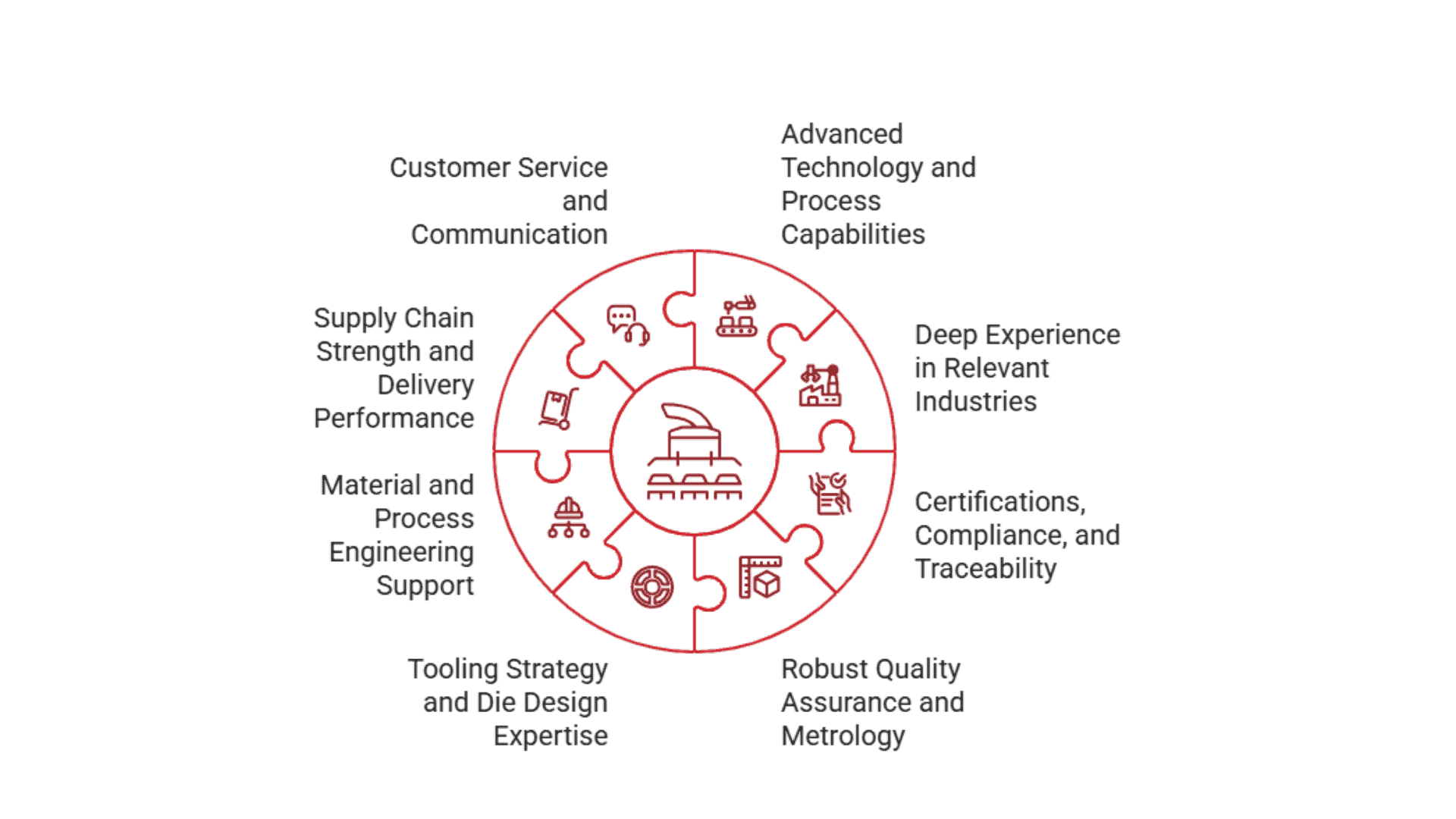
Selecting the right metal stamping partner can make or break a program. Beyond getting a competitive price, you need a supplier who can protect your quality, delivery, and long-term total cost of ownership. Here are the key features to evaluate, and how Keats aligns with each.
1. Advanced Technology and Process Capabilities
A modern stamping supplier should be built around high-speed, highly repeatable processes, not just basic presses.
Look for:
- Progressive, coil-fed stamping: For medium to high volumes, this is the backbone of efficient production. A continuously fed strip runs through a progressive die, forming multiple features at once and delivering a finished part with each stroke. Keats specialises in progressive metal stamping from continuous coil, ideal for terminals, connectors, clips, brackets, and busbars that demand tight tolerances at scale.
- Four-slide / multi-slide capabilities: These machines excel at complex, three-dimensional forms, small parts, and intricate bends. Keats operates one of the largest four-slide fleets in North America, which allows us to shape highly complex geometries that would be difficult or costly with standard presses.
- Precision tooling technology: CNC machining and EDM (wire and sinker) are essential to build and maintain high-precision dies. This is what allows repeatable tolerances like ±0.0005 in. in production, not just in theory.
- In-house tooling and die maintenance: A supplier that designs, builds, and services its own tools has tighter control over uptime, quality, and lead times. Keats’ in-house tool and die team supports everything from new die builds to emergency repairs and engineering changes.
Ask potential suppliers to explain which processes they’ll use for your part and why. If they cannot clearly articulate whether your project belongs in progressive stamping, four-slide, or traditional sheet/blank stamping—and the trade-offs involved—that’s a red flag.
2. Deep Experience in Your Part Types and Industries
Years in business matter, but relevant experience matters more.
Consider:
- Part families: Has the supplier produced parts similar to yours, terminals, contacts, lead frames, brackets, clips, busbars, etc. at the volumes and tolerances you need?
- Industry standards: Do they understand automotive PPAP, medical documentation, or electronics cleanliness and packaging requirements?
- Design for Manufacturability (DFM): Can they recommend small changes to thickness, bend radii, hole sizes, or material choices that improve manufacturability and reduce cost?
Keats brings decades of experience in high-precision stampings and assemblies across automotive, electrical distribution, appliance, industrial, and medical applications. That experience translates directly into faster launches, fewer surprises, and more robust tooling decisions up front.
3. Certifications, Compliance, and Traceability
A serious stamping partner needs a mature quality system, not just a certificate on the wall.
Key items to verify:
- Quality certifications: ISO 9001, IATF 16949 (for automotive), ISO 14001 (environmental), and any industry-specific standards relevant to your product.
- Documented procedures: APQP, FMEA, control plans, PPAP, and structured change-control processes.
- Traceability: Lot-level traceability of raw material, process steps, inspection data, and final shipment.
Keats’ ISO 9001, ISO 14001, and IATF 16949 certifications reflect a systemic approach to quality and compliance, not just a checkbox. This is especially important when you’re dealing with safety-critical or high-liability parts.
4. Robust Quality Assurance and Metrology
The best stamping press in the world cannot save you from poor measurement and control. Look at vision systems, CMMs, and SPC charts. At Keats, our quality assurance team is integrated into the stamping process from tool design through to JIT delivery.
5. Tooling Strategy and Die Design Expertise
The sheet metal stamping dies your supplier uses are the heart of the process. Keats’ in-house tool and die group designs progressive dies específicamente optimized for continuous coil feed and high stroke rates.
6. Material and Process Engineering Support
Look for material expertise in brass, copper, and stainless steel. Keats routinely advises customers on material choices that balance performance, formability, and cost.
7. Supply Chain Strength and Delivery Performance
Beyond the press, you need a partner who can support your schedule. We offer The Many Benefits of Just-in-Time Inventory and operate multiple facilities to reduce logistics risk.
8. Customer Service, Communication, and Program Management
Keats takes a customer-centric approach, with engineering, quality, and sales closely aligned so you have a single, coordinated team throughout the life of the program.
When you combine advanced coil-fed progressive stamping, strong tooling and quality systems, deep materials expertise, and reliable program support, you get more than a part—you get a manufacturing partner. That’s the role Keats aims to play: helping you choose the right stamping process (progressive, four-slide, or traditional sheet/blank stamping) and then executing it with the precision, speed, and consistency your business depends on.
How much does it cost to get a die made?
The cost of getting a die made varies based on several factors:
| Factor | Impact on Cost |
|---|---|
| Complexity | More intricate designs require advanced tooling, increasing costs. |
| Materials | The type and quality of materials used for the die affect pricing. |
| Production Volume | Higher volumes spread die cost over more units, reducing cost per part. |
| Customization | Custom features or modifications influence the final price. |
On average, die-making costs can range from a few thousand to tens of thousands of dollars, depending on these factors. Understanding metal stamping die design can help you plan your budget effectively. At Keats, our in-house tooling capabilities allow us to optimize die design for cost-effectiveness and efficiency.
What are sheet metal design guidelines?
Designing sheet metal parts requires adherence to specific guidelines to ensure manufacturability and cost-effectiveness. Here are some best practices:
- ✔
Minimize Complexity: Simplified designs can reduce production costs and improve manufacturability. - ✔
Consider Tolerances: Specify tolerances that align with the capabilities of the stamping process to avoid issues during production. - ✔
Use Appropriate Materials: Select materials that provide the necessary strength and durability for your application while being suitable for the stamping process. - ✔
Design for Assembly: Incorporate features that facilitate easy assembly and reduce the need for secondary operations.
By following these sheet metal design guidelines, you can optimize your designs for metal stamping, ensuring efficient production and high-quality results. Keats also offers secondary services such as plating and deburring, which can further enhance the manufacturability of your designs.
Ready to explore the world of metal stamping?
Visit Keats Manufacturing Co. to dive deeper into our expert insights, industry trends, and tips on choosing the right Metal Stamping Companies for your needs.
Frequently Asked Questions
What certifications should I look for in a custom metal stamping provider?
When selecting a custom metal stamping provider, it's essential to look for certifications that reflect their commitment to quality and industry standards. At Keats Manufacturing Co., we proudly hold certifications such as ISO:9001 for quality management and ISO:14001 for environmental management. Furthermore, our adherence to IATF:16949 demonstrates our capability in the automotive sector, while other industry-specific certifications underscore our dedication to meeting rigorous safety and performance standards, which are critical factors to consider when choosing a custom metal stamping provider.
How important is in-house tool and die development for metal stamping?
In-house tool and die development is essential for optimizing both precision and production timelines. By managing the tooling process internally, we can swiftly adapt to design changes and enhance quality control, which is a key consideration when choosing a custom metal stamping provider. This approach not only fosters innovation but also leads to significant cost savings, as we minimize reliance on external suppliers and streamline the entire manufacturing workflow.
What types of metal can be used for custom stamping?
A wide variety of metals can be used for custom stamping at Keats Manufacturing, each offering unique benefits:
- Steel - Known for its strength and durability, ideal for heavy-duty applications.
- Aluminum - Lightweight and corrosion-resistant, perfect for automotive and aerospace industries.
- Copper - Excellent electrical conductivity, used in electrical components.
- Brass - Offers good machinability and corrosion resistance, suitable for decorative and functional parts.
- Stainless Steel - Combines strength with corrosion resistance, great for medical and food processing applications.
Why is precision important in metal stamping?
Precision in metal stamping is essential for ensuring that components fit together seamlessly and perform as intended. At Keats Manufacturing Co., we utilize advanced technology and rigorous quality control measures to maintain tight tolerances, which enhances the performance and longevity of your products in demanding applications. When choosing a custom metal stamping provider, consider their commitment to precision as a key factor in ensuring quality outcomes.
How does the location of a metal stamping provider affect my project?
Proximity reduces shipping costs and lead times, enhancing project efficiency.
- Local providers offer easier coordination for site visits and quality checks.
- Working within the same time zone simplifies communication and project management.
- Regional suppliers may better understand local regulations and standards, ensuring compliance.
- Nearby providers can quickly address issues, minimizing downtime and production delays.
What is the benefit of using a provider with advanced machinery?
Utilizing advanced machinery, such as our unique Wünsch multi-slide machines, allows Keats Manufacturing Co. to achieve intricate designs with remarkable accuracy and speed. This technology enhances our capability to produce large quantities while maintaining stringent quality control measures, including extensive high-precision tolerances of ±0.0005 in. for stamping, which is crucial when choosing a custom metal stamping provider.
How can I assess the experience of a metal stamping provider?
To evaluate the experience of a metal stamping provider like Keats Manufacturing Co., consider their industry certifications, such as ISO:9001 and IATF:16949, which reflect their commitment to quality. Additionally, inquire about their project portfolio, showcasing diverse applications and innovations, including the use of their unique Wünsch multi-slide machines. Engaging in discussions with their team can reveal their expertise and problem-solving approach in custom precision metal stamping, particularly regarding their extensive high-precision tolerances.
What role does quality control play in custom metal stamping?
Quality control is crucial in custom metal stamping due to its impact on product reliability and performance.
- Ensures precision and adherence to specifications, reducing errors and rework.
- Enhances product consistency, leading to improved customer satisfaction.
- Involves rigorous inspections and testing, ensuring compliance with industry standards.
- Helps maintain cost efficiency by minimizing waste and optimizing production processes. A robust quality control system signifies a provider's commitment to excellence and dependability.