

How does a 4-slide machine work?
Comments Off on How does a 4-slide machine work?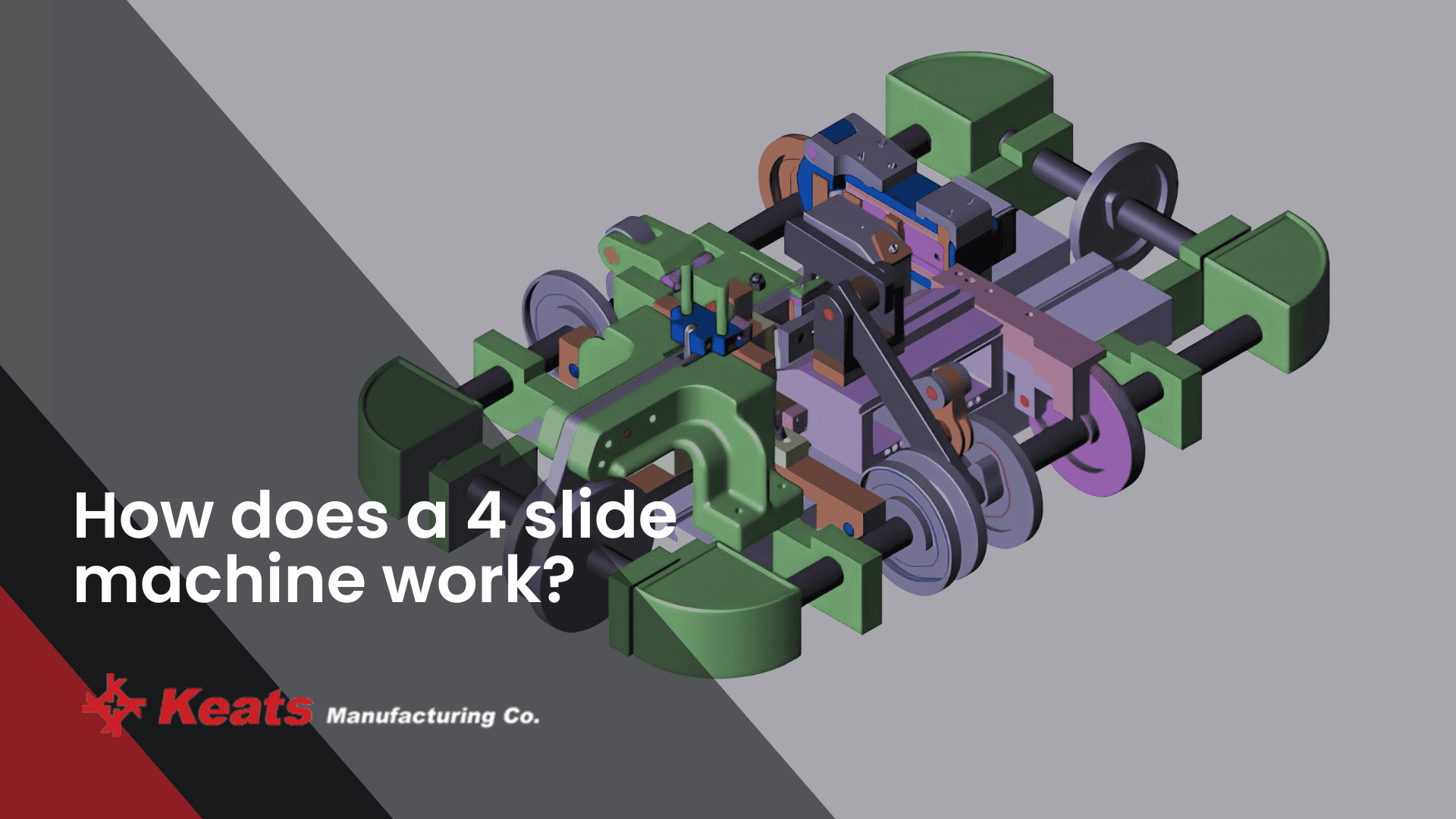
Precision and speed are at the heart of modern metal component manufacturing. The four-slide machine stands out as the preferred platform for companies needing intricate, high-volume parts. Since 1958, Keats Manufacturing Co. has harnessed the power of advanced four-slide technology to deliver custom solutions with exceptional accuracy and efficiency.
This article answers the essential question: “How does a 4-slide machine work?” For a deeper dive, visit our Four-slide stamping machine page or explore our Four‑slide stamping resource.
Key Takeaways
- ›Four-slide machines deliver unmatched efficiency and precision for high-volume custom metal stamping and forming.
- ›Simultaneous multi-directional forming enables complex geometries and tight tolerances that are not achievable with traditional presses.
- ›Four-slide stamping is ideal for producing small, intricate parts such as clips, brackets, and electrical terminals at scale.
- ›Setup and tooling for four-slide machines require specialized expertise but enable rapid, repeatable production with minimal waste.
- ›Material and geometric limitations exist, but four-slide technology remains a cornerstone for industries demanding high-precision, custom solutions.
What is a four-slide machine used for stamping?
A four-slide machine, also known as a multi-slide or four-slide press, is a specialized metalworking platform engineered for high-speed, high-precision forming and stamping of small metal parts. Unlike conventional presses that use a single vertical ram, the four-slide machine features four synchronized slides approaching the workpiece from perpendicular directions simultaneously or in rapid sequence, performing multiple forming, bending, and cutting operations in a single continuous cycle.
Advantages over other methods:
Multiple operations are performed in one pass, reducing cycle times and labor costs.
Capable of achieving tolerances as tight as ±0.0002 in. for stampings components.
Minimal scrap due to precise forming. Raw material can often be purchased to the exact width of the part, resulting in 90%+ material utilization.
Supports a wide range of custom small metal stampings, wire bends, clips, and assemblies.
Keats Manufacturing operates one of the largest fleets of four-slide machines in North America, including unique Wünsch multi-slide machines, expanding the range of achievable part geometries well beyond what standard four-slide platforms offer.
For more information on the advantages of this process, see What are the advantages of stamping.
How does a 4-slide machine work?
The four-slide machine’s efficiency lies in its cam-driven mechanical configuration:
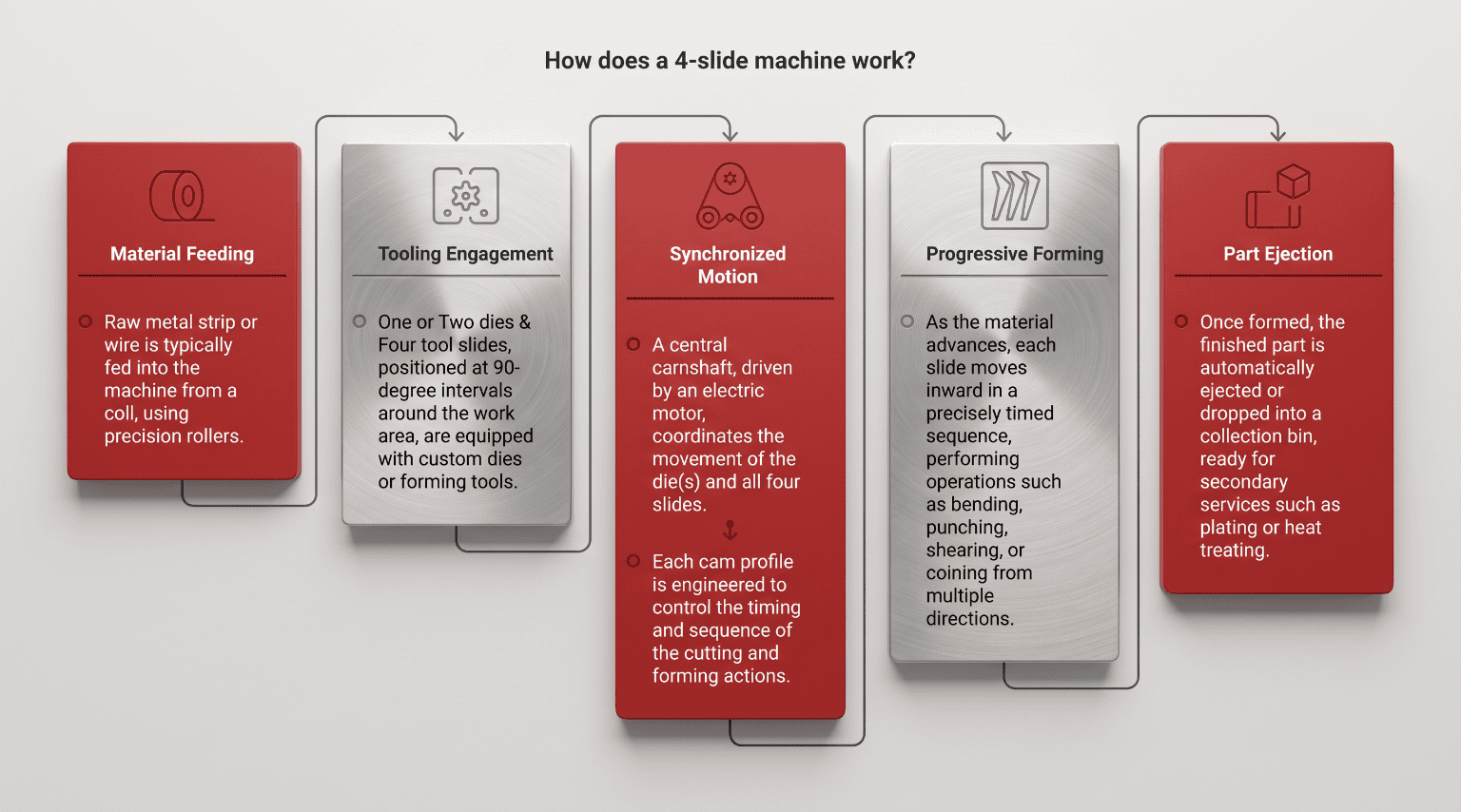
This continuous process can produce up to 15,000 pieces per hour and scale to 50 million parts. At Keats’ campuses in Illinois, Texas, and Mexico, in-house tool-and-die teams using CAD/CAM, EDM, and CNC develop and maintain all tooling, with a lifetime guarantee.
To understand how four-slide stamping compares with other methods, see Can you explain the different types of metal stamping processes used in manufacturing?
What types of parts or products are most commonly made using a 4-slide machine?
The four-slide machine is the preferred platform for the following product categories, serving automotive, electronics, aerospace, medical device, and industrial equipment sectors:
Keats manages the secondary service supply chain to ensure parts receive the proper plating, heat-treating, e-coating, stress-relieving, kitting, and screw insertion. Keats delivers fully finished assemblies ready for direct integration. For companies searching for ‘custom metal four-slide stamping near me’, Keats’ three strategically located campuses provide regional access to engineering consultation and full-scale production.
For more on how precision is achieved in these components, see What is Precision Metal Stamping.
How does the setup process for a 4-slide machine differ from other metalworking machines?
Four-slide setup differs from conventional presses in three key ways:
- Custom in-house toolingEach of the four slides requires custom in-house tooling developed via CAD/CAM, EDM, and CNC. Four-slide tooling often integrates a small progressive die section to pierce or blank the strip before the four horizontal slides execute the final forming around a mandrel.
- Specialized hands-on expertiseWhile tooling is engineered using digital CAD/CAM and precision CNC/EDM, the four-slide machines themselves are mechanically synchronized via custom cam profiles and linkage geometry, requiring specialized hands-on expertise from experienced technicians during setup.
- Verified cam timing and synchronizationPrecise cam timing and slide synchronization must be verified through controlled test runs before production launch. Investing in machine optimization and targeted operator training has been shown to reduce setup times while achieving higher precision on complex parts.
At Keats, full compliance with ISO 9001, ISO 14001, and IATF 16949 ensures every setup is documented, traceable, and repeatable. For a visual reference, consult our metal stamping process flow chart for an overview of the stages and setup considerations unique to four-slide operations.
Are there any limitations to the shapes or materials that a 4-slide machine can handle?
As NIST research on manufacturing processes and material selection confirms, matching the process to the part geometry at the conceptual design stage is the most effective way to control costs and guarantee manufacturability. For buyers searching for ‘custom metal four-slide stamping near me’, Keats’ engineering team provides early-stage design consultation to evaluate feasibility before any tooling investment is made.
Ready to see how four-slide stamping can work for your project?
Discover how four-slide stamping can streamline your manufacturing process and deliver precision results for your next project. Contact us to explore customized solutions and see how four-slide stamping can benefit your business.
Four-slide stamping machine
Comments Off on Four-slide stamping machine
Manufacturers seeking to elevate their capabilities in high-volume, custom metal component production often turn to the four-slide stamping machine process for its transformative approach to precision forming. By combining multi-directional forming with exceptional speed and repeatability, four-slide technology redefines what’s possible in small metal stampings and wire forms.
This article uncovers the mechanics, advantages, and strategic considerations pertaining to four-slide machines, empowering decision-makers to navigate material selection, design complexity, setup efficiency, and quality standards. For a comprehensive overview of the broader process, see our Four-slide stamping page.
Key Takeaways
- ›Four-slide stamping machines deliver unmatched precision and flexibility for high-volume, custom small metal stampings, wire bends, and clips.
- ›These machines accommodate a wide range of metals and thicknesses, making them ideal for complex geometries and intricate part designs.
- ›Compared to traditional stamping, four-slide technology enables reduced tooling costs and greater design freedom.
- ›Selecting the right production machine and certified manufacturing partner ensures optimal quality, tight tolerances, and production efficiency.
- ›ISO 9001, ISO 14001, and IATF 16949 certifications are essential for evaluating if a supplier has consistent quality and compliance in metal stamping manufacturing.
What does stamping mean in manufacturing?
Stamping in manufacturing refers to the process of forming, cutting, or shaping metal sheets or wire into precise components using dies and presses. It is foundational to the production of a wide range of metal parts, from electrical terminals and custom shields to brackets, clips, and intricate electromechanical assemblies. The process typically involves feeding raw metal stock into a press, where a die shapes it under high-speed, high-pressure contact to meet repeatable tolerances across millions of cycles.
Within this landscape, the four-slide stamping machine introduces a fundamentally different approach. Unlike traditional presses that operate solely via vertical motion, four-slide machines use four synchronized slides that move horizontally to form complex parts from strip or wire stock. This multi-directional forming capability enables multiple bends and intricate geometries to be formed in a single pass, significantly reducing the need for secondary operations and material waste.
What are the defects of stamping in metal? A persistent concern across all stamping methods is part quality. Common defects in common parts include burrs, warping, springback, dimensional inaccuracies, and surface imperfections. These issues stem from uncontrolled material flow, improper tooling clearance, and inconsistent press force. Research published in MDPI Manufacturing and Metrology confirms that “uneven distribution of stress during the stamping process is the cause of warping and misalignment,” and that cumulative errors can propagate across subsequent stamping operations.
The four-slide stamping machine addresses these failure modes directly: its cam-driven, synchronized slide motion ensures controlled, repeatable force application from multiple axes, minimizing the stress imbalances that produce defects at scale.
For additional context on how stamping fits within the broader manufacturing landscape, see Can you explain the different types of metal stamping processes used in manufacturing?
What types of materials can be used with a four-slide stamping machine, and are there any limitations?
Four-slide stamping machines are highly versatile, accommodating a broad spectrum of metals and alloys. Commonly processed materials include stainless steel, copper, and copper alloys such as beryllium copper, brass, phosphor bronze, aluminum, low- and high-carbon cold-rolled steels, spring steel, and specialty alloys. As documented in the engineering literature, the most commonly used materials for four-slide operations are selected based on their formability and bending radius rather than solely on machine limitations.
(beryllium, brass, phosphor bronze)
(low & high-carbon)
Specialty Alloys
Material thickness can range from ultra-thin foils to heavier gauges, typically ranging from 0.002 to 0.075 inches (up to ~1.9 mm), depending on machine capacity. Hardness is also a factor; four-slide machines handle spring-tempered and hardened materials effectively, but extremely brittle or unusually thick stock may require specialized tooling or an alternative process such as progressive die stamping.
A prime example of four-slide material capability is the production of Stainless Steel Spring Clips. These components require multiple precise bends, consistent spring-back properties, and reliable dimensional tolerances across high-volume runs. Four-slide technology excels at forming these parts in a single cycle, ensuring repeatable geometry and surface integrity as required for demanding environments in automotive, electronics, and industrial assembly.
Secondary services, plating, heat-treating, and stress-relieving further extend the material and finish options available on a four-slide line, allowing in-line finishing and assembly and reducing downstream handling.
For more on the types of services available in this field, see What types of metal stamping services do these companies typically offer?
How does the four-slide stamping process handle complex part designs compared to traditional stamping methods?
The core mechanical advantage of the four-slide stamping machine is its ability to complete all forming operations required to produce a finished part in a single, continuous cycle. Each of the four slides carries a unique tool that can strike the workpiece either simultaneously or in rapid sequence, enabling the formation of bends, twists, and compound geometries from four orthogonal directions without repositioning the part. This eliminates the need for multiple stations, secondary operations, or extensive die changeovers.
Compared with a progressive die stamping machine, four-slide technology offers superior design flexibility for wire forms and small stampings having multiple bends in proximity or in different planes. Progressive stamping excels at high-volume production of flat or moderately contoured parts where carrier strip continuity and station-to-station consistency are priorities. This is particularly relevant to the automotive and electronics sectors, where part geometry is stable, and volumes are extremely high. However, for parts requiring bends greater than 90°, intricate twists, or multiple forming features in proximity, the four-slide stamping machine can often offer superior efficiency and lower tooling costs.
Design modification is another area where four-slide machines can outperform traditional presses. Adjusting individual slides and cams to accommodate a new geometry requires no new die set; changes are made directly on the machine. Manufacturers who implement quick changeover and setup reduction methodologies achieve increased productivity, reduced lead time, reduced inventory, and faster resolution to quality problems, in direct parallel to the iterative flexibility four-slide enables throughout product development cycles. Production rates of up to 15,000 pieces per hour make this process viable for full-scale volume production.
To explore the specific factors that influence production speed and efficiency in four-slide machines, visit Can you explain the main factors that affect the speed and efficiency of four-slide machines in production?
Can you explain the setup and changeover process for different parts on a four-slide machine?
Setting up a four-slide stamping machine for a new part involves a precise sequence of steps:
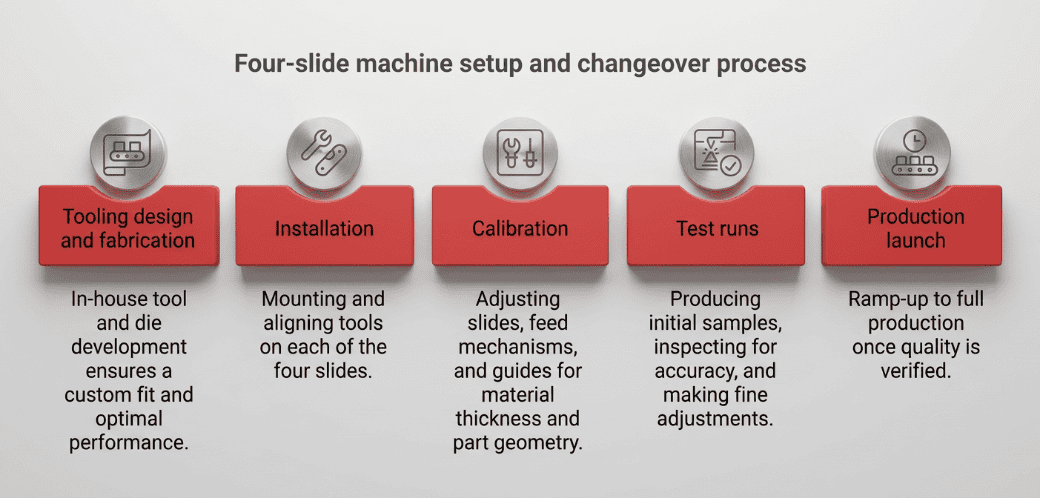
A key operational advantage of the four-slide platform is that minor and major tooling adjustments can be made directly on the machine without removing the tooling for external modification. This reduces both production downtime and tool room labor, enabling rapid response to design changes or in-process quality corrections.
Operator skill is the decisive variable in changeover performance. A well-trained team reduces setup time, maintains dimensional control, and maximizes productive capacity across every shift. This relationship plays out in practice across the manufacturing sector: the National Institute of Standards and Technology’s Manufacturing Extension Partnership (NIST MEP), a public-private network that helps U.S. manufacturers improve productivity and competitiveness, has documented that manufacturers working with its centers report significant cuts in changeover time, freeing up additional production capacity across multiple shifts. In a four-slide environment, that same operator expertise shows up directly: faster part transitions, less idle time, and higher overall equipment utilization.
For companies evaluating options, searching for a ‘four-slide stamping machine near me’ or identifying ‘metal stamping manufacturing companies near me‘ provides access to local engineering expertise to accelerate setup, troubleshooting, and ongoing optimization, critical for just-in-time delivery and high-volume production schedules.
How do I determine the right tonnage or size of stamping machine for my specific project needs?
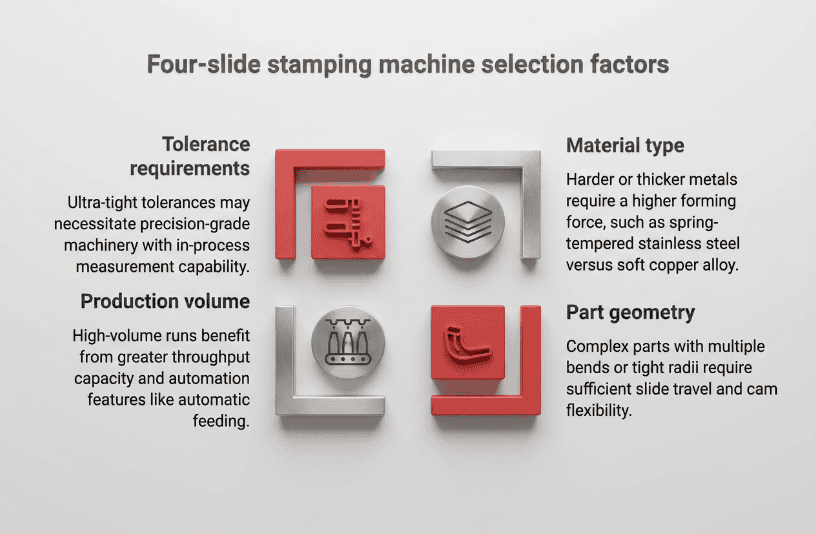
Selecting the optimal four-slide stamping machine size involves evaluating several interconnected factors:
- Material type and thickness. Harder or thicker metals require a higher forming force. Spring-tempered stainless steel demands a different machine capacity than soft copper alloy strip.
- Part geometry and complexity. Parts with multiple bends, tight radii, or forming operations from all four axes require a machine with sufficient slide travel and cam flexibility to execute each motion within the cycle.
- Production volume. High-volume runs benefit from machines with greater throughput capacity and automation features such as automatic feeding and integrated assembly operations.
- Tolerance requirements. Ultra-tight tolerances may necessitate precision-grade machinery with in-process measurement capability.
Consulting with metal stamping manufacturers provides access to engineering teams who can evaluate drawings, assess machine specifications against part requirements, and recommend the most cost-effective configuration. Local partnerships also reduce lead times for tooling modifications and provide hands-on support during ramp-up.
In-house tool and die development is a decisive capability in this selection process. NIST MEP case studies confirm that manufacturers with integrated tool and die shops are positioned to reduce lead times and modify tooling as required for just-in-time production, eliminating the delays and costs associated with outsourced tooling changes. Matching machine capacity to part requirements from the outset rather than retrofitting later is the single most effective strategy for cost-efficient, high-quality production.
What is the average stamping tolerance?
Stamping tolerance defines allowable deviation from specified dimensions and is a direct measure of process capability, tooling quality, and machine precision. In high-precision environments, typical tolerance ranges are:
for stampings
for most features, with tighter control achievable in specialized applications
This directly raises the question: “Is four-slide stamping capable of meeting ultra-tight tolerances?” The answer is yes: when the supplier properly maintains their equipment and develops their tooling in-house using advanced CAD/CAM systems, and rigorous process controls, four-slide technology consistently achieves the tolerances required for critical applications in automotive, medical device, and electrical distribution manufacturing.
Peer-reviewed research published in MDPI Materials confirms that “precise control of forming parameters ensures uniform material flow, minimizes elastic recovery, and reduces defects like thinning, microcracking, and grain boundary separation” — the physical mechanisms that determine whether a stamped part holds its specified dimensions across millions of cycles. ISO 9001:2015 further specifies that certified organizations must “demonstrate the ability to consistently provide products and services that meet customer and applicable statutory and regulatory requirements”, establishing the calibration and documentation framework that makes tolerance compliance auditable and repeatable.
For a deeper dive into the role of precision in metal stamping, see What is Precision Metal Stamping.
What kinds of design limitations or part geometries are difficult to achieve with four-slide stamping?
While the four-slide stamping machine delivers exceptional versatility, certain geometries present real challenges:
In these cases, the progressive die stamping machine is the preferred alternative, offering deeper draw capability, larger forming envelopes, and higher available press tonnage. For parts that fall near the boundary between processes, collaboration with experienced engineers often yields hybrid solutions, such as a four-slide with an integrated press head station, that capture the forming flexibility of four-slide while adding limited deep-draw or blanking capability. Material properties such as hardness, ductility, and temper also influence feasibility. Engineering review at the design stage is the most reliable way to match geometry to the process prior to making a tooling investment.
What are ISO and IATF certificates?
ISO and IATF certifications are internationally recognized frameworks for quality, environmental, and sector-specific process management in manufacturing. Understanding what these certifications require and what they guarantee is essential for selecting metal stamping manufacturing companies near me for mission-critical applications.
The world’s leading quality management standard, helping organizations “deliver consistent products and services, improve efficiency, and meet customer and regulatory expectations.” For a four-slide operation, it means every setup, changeover, calibration, and production run is documented, controlled, and subject to continuous-improvement audit cycles.
Governs environmental management systems, ensuring manufacturing operations minimize environmental impact by controlling the use of materials, energy, and waste streams — an increasingly important requirement for OEM supply chain compliance.
Builds on ISO 9001 with additional requirements specifically designed for automotive supply chains, covering quality management system requirements for design, development, production, and service of automotive-related products, including traceability, risk management, and production part approval processes.
When evaluating ‘metal stamping manufacturing companies near me’, confirming ISO 9001, ISO 14001, and IATF 16949 certification ensures that the four-slide stamping machine operations you’re partnering with meet the most rigorous standards for quality consistency, process documentation, and regulatory compliance. This provides confidence for regulated industries from automotive and aerospace to medical device and electrical distribution.
Conclusion
Selecting the right stamping machine and process is a strategic decision that impacts every stage of your project, from prototyping to high-volume production. Leveraging Keats Manufacturing’s comprehensive fleet of four-slide and multi-slide machines, in-house tool & die expertise, and legacy of precision manufacturing dating back to 1958, achieves optimal results for even the most complex components.
Discover how four-slide stamping can streamline your manufacturing process with greater precision and efficiency. Ready to learn more or see how this technique can benefit your next project? Contact our team today to discuss your requirements or request a personalized quote.
Ready to find the right four-slide stamping solution?
Contact Keats Manufacturing to discuss your requirements or request a personalized quote. Visit keatsmfg.com or reach out to our engineering team directly.
What quality control measures are commonly used during and after the metal stamping process?
Comments Off on What quality control measures are commonly used during and after the metal stamping process?
Achieving flawless metal stamping results requires more than advanced machinery; it demands rigorous, proactive quality control at every stage. For organizations that depend on high-precision components, understanding the quality measures used during and after stamping is essential when selecting a manufacturing partner.
This article details how Keats Manufacturing Co. ensures defect-free custom small metal stampings, wire forms, and assemblies at scale by implementing industry-leading quality protocols. It further outlines the core steps of quality control and examines specialized inspection and finishing strategies.
Key Takeaways
- ›Robust quality control in metal stamping is essential to ensure precision, reliability, and consistent high-volume production, especially for critical industrial applications.
- ›Leading metal stamping companies integrate advanced inspection, testing, and documentation throughout every stage of the stamping process.
- ›Common stamping defects are proactively identified and prevented with sophisticated measurement technologies and in-house tool & die expertise.
- ›Industry-specific requirements, such as those in the automotive or aerospace industries, drive the selection of specialized metal-finishing and quality-control protocols.
- ›Proximity to advanced four-slide stamping capabilities can significantly enhance both process efficiency and quality outcomes.
What is a metal stamping company?
A metal stamping company is a specialized manufacturer that transforms raw metal into precision-engineered components using high-speed presses and dies. These firms serve as critical partners to industries such as automotive, aerospace, electronics, and medical devices, delivering components that meet exacting standards for form, fit, and function.
At the core of every reputable metal stamping company is a commitment to the metal stamping process, which encompasses a series of precise, engineered steps designed to convert raw material into high-performance components. This process is driven by advanced technology, in-house tool-and-die expertise, and rigorous quality control protocols, ensuring that each part meets demanding specifications for critical industrial and engineering applications.
Typical services provided by a metal stamping company include:
- Custom small metal stampings: Engineered parts produced to tight tolerances (as fine as ±0.0002 in. for stampings)
- Wire forms and assemblies: Complex shapes and integrated assemblies, often produced with advanced four-slide and multi-slide equipment.
- In-house tool and die development: Custom tooling designed and maintained for the life of each part, ensuring repeatable accuracy.
- Secondary services: Integrated plating, heat treating, stress relieving, kitting, and screw insertion, for streamlined supply chains.
Quality control is at the core of every reputable metal stamping process. Companies like Keats Manufacturing Co. maintain ISO 9001, ISO 14001, and IATF 16949 certifications, demonstrating a rigorous commitment to quality management and traceability throughout the production lifecycle.
Tolerance Precision Achieved±0.0002 in.
Maintained across high-volume runs of up to 50 million parts, from first to last unit.
A key differentiator is the ownership and operation of one of the largest fleets of four-slide machines in North America, including unique Wünsch multi-slide machines. This extensive equipment base enables manufacturers to execute highly complex forming operations with exceptional repeatability and process control. The ability to maintain high-precision tolerances down to ±0.0002 inches for stampings ensures that even the most demanding applications in electronics, automotive, and aerospace are consistently met.
What are the five steps of quality control?
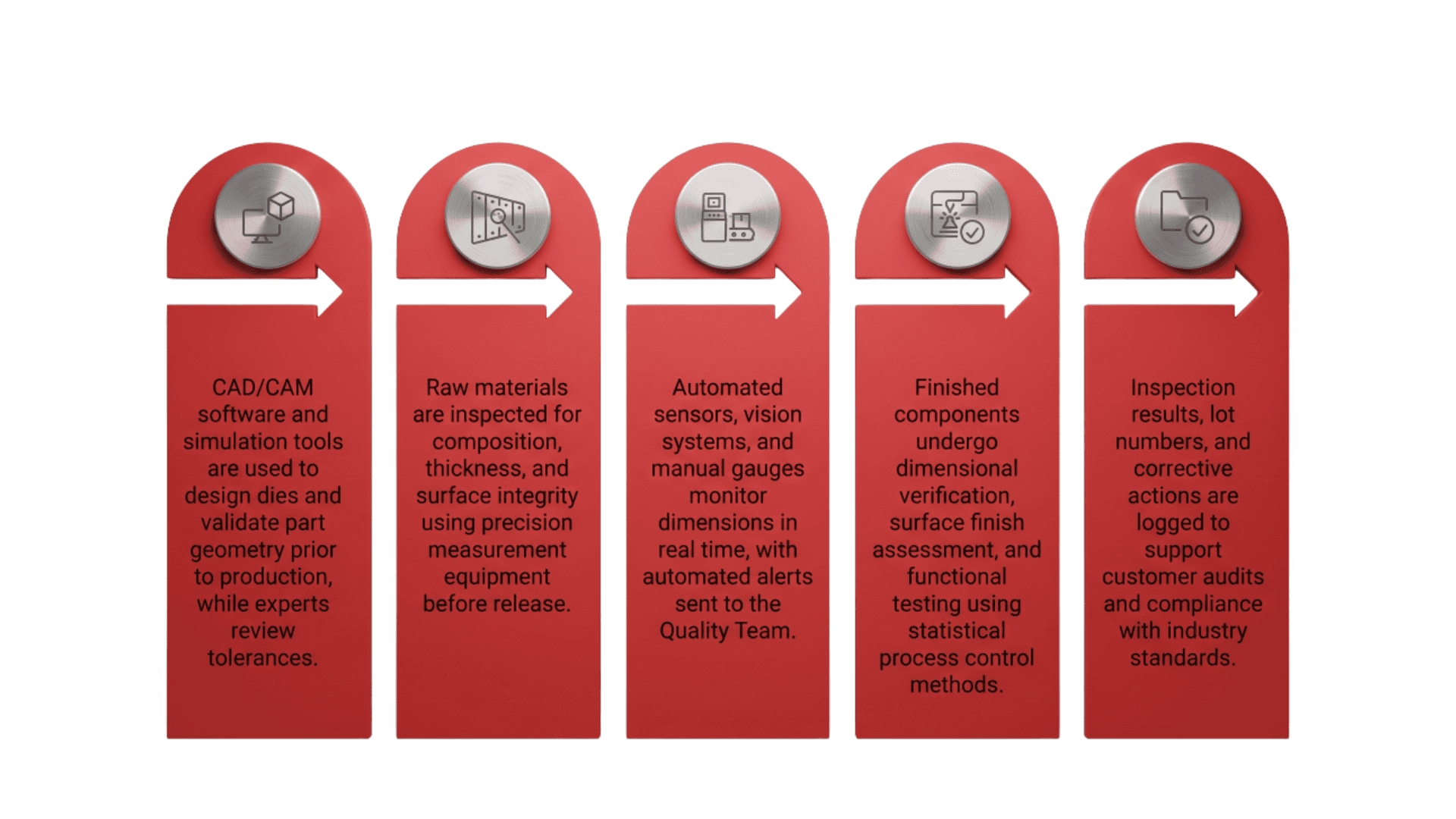
Effective quality control in metal stamping is a structured, stepwise process designed to prevent defects and ensure every part meets specifications. The stamping process, step by step, integrates these key quality control stages:
Design and tool validation
- CAD/CAM software and simulation tools are used to design dies and validate part geometry prior to production.
- In-house tool and die experts review tolerances and performance to ensure tools meet project requirements.
Incoming material inspection
- Raw materials are inspected for composition, thickness, and surface integrity using precision measurement equipment.
- Only materials that meet strict specifications are released to the production floor.
In-process inspection and monitoring
- During the metal stamping process, automated sensors, vision systems, and manual gauges monitor critical dimensions in real time.
- Operators perform regular spot checks to verify part consistency and machine calibration.
- Paper-free inspection process as all inspection gauges are connected to the Inspection Mobile platform.
- Real-time automated emails are sent to the Quality Team and Plant Manager to alert all when a series of points are consistently increasing or decreasing over time, suggesting a gradual change in process conditions.
Post-production inspection
- Finished components undergo dimensional verification, surface finish assessment, and functional testing.
- Statistical process control (SPC) methods are applied to detect trends or deviations before parts reach final packaging.
Documentation and traceability
- All inspection results, lot numbers, and corrective actions are logged for full traceability.
- Quality documentation supports customer audits and compliance with industry standards (ISO, IATF, VDA, Mil-Spec).
By following this structured approach, manufacturers can catch issues early, minimize rework, and maintain a zero-defect culture.
The integration of simulation technology during the design and engineering phases further enhances quality control. By leveraging advanced modeling and virtual compensation strategies, manufacturers can predict and correct potential issues such as springback, thinning, or surface imperfections before production begins. This proactive approach reduces the need for multiple tooling correction cycles and ensures a more consistent match between the engineering model and the final stamped part.
What quality control measures are commonly used during and after the metal stamping process?
A robust quality assurance program is essential to delivering reliable, high-precision stamped components. The most effective measures used during and after the metal stamping process include:
Common stamping defects, such as burrs, warping, incomplete forming, or surface scratches, are systematically identified and prevented through:
- In-house tool and die maintenance (guaranteed for the lifetime of the part)
- Proactive die sharpening and alignment
- Use of advanced multi-slide and four-slide equipment to reduce process variability
For further technical details on defect types and their prevention, consult resources such as the Precision Metalforming Association (PMA) or ASM International’s guidelines on sheet metal forming defects.
The strategic deployment of production monitoring systems at each Keats facility enables real-time adjustments to process parameters, material characteristics, and feed rates. These systems are designed to adapt to day-to-day variations, ensuring that high-volume runs of up to 50 million parts maintain consistent quality from the first to the last unit. Additionally, the presence of three state-of-the-art, company-owned locations in Illinois, Texas, and Mexico enables localized quality oversight and faster responses to customer requirements, further minimizing risk and maximizing reliability.
Are there specific industries or applications where one type of metal finishing is preferred over the others?
Industry requirements often dictate the choice of metal finishing after stamping, directly impacting both performance and quality control. For example:
Demands robust corrosion resistance and durability, favoring zinc plating, e-coating, or heat-treating for safety-critical components.
Requires tight tolerances and lightweight finishes, with a preference for anodizing, chromate conversion coating, or specialized coatings to meet AS9100 and regulatory standards.
Prioritizes conductivity and surface smoothness, making selective plating and stress relief essential for electrical terminals and contacts.
For companies evaluating finishing options, integrating finishing with the metal stamping process is a key differentiator. Tight control of finishing within the same facility enhances traceability, reduces handling risks, and enables immediate post-stamping quality checks. This is particularly valuable for industries where regulatory compliance, part cleanliness, and precise dimensional accuracy are non-negotiable.
Additionally, advanced processes like metal four-slide stamping offer unique advantages for complex geometries and high-volume runs. For procurement professionals and engineers searching for metal four-slide stamping near me, having proximity to a supplier with in-house four-slide capabilities can significantly reduce lead times, improve communication, and enhance quality control through on-site inspection and rapid iteration. The ability to partner locally for both metal stamping and finishing ensures that specifications are met without compromise and that adjustments can be implemented swiftly, critical for industries with tight product launch windows or ongoing engineering changes.
The integration of secondary services, such as plating, heat treating, and stress relieving within the same facility further streamlines the quality assurance process. This vertical integration minimizes the risk of handling damage, ensures better process control, and provides a single point of accountability for the finished product’s performance. For sectors with stringent regulatory or environmental requirements, full compliance with ISO 14001 and IATF 16949 further demonstrates a commitment to both product quality and sustainable manufacturing practices.
To learn more about the advantages of stamping, visit What are the advantages of stamping?
Conclusion
Quality control in metal stamping is not a single checkpoint but a continuous, integrated discipline spanning design, materials, production, and finishing. Partnering with a manufacturer that combines state-of-the-art equipment, in-house expertise, and rigorous process controls secures the precision, reliability, and scalability your applications demand.
Discover how four-slide stamping can streamline your manufacturing process and deliver precision results for your next project. Ready to learn more or discuss your specific needs? Contact us to explore customized solutions and see how four-slide stamping can benefit your business.
Ready to elevate your quality control standards?
Contact Keats Manufacturing to explore customized solutions and see how four-slide stamping can benefit your business. Visit keatsmfg.com or reach out to our engineering team directly.
What is fourslide manufacturing?
Comments Off on What is fourslide manufacturing?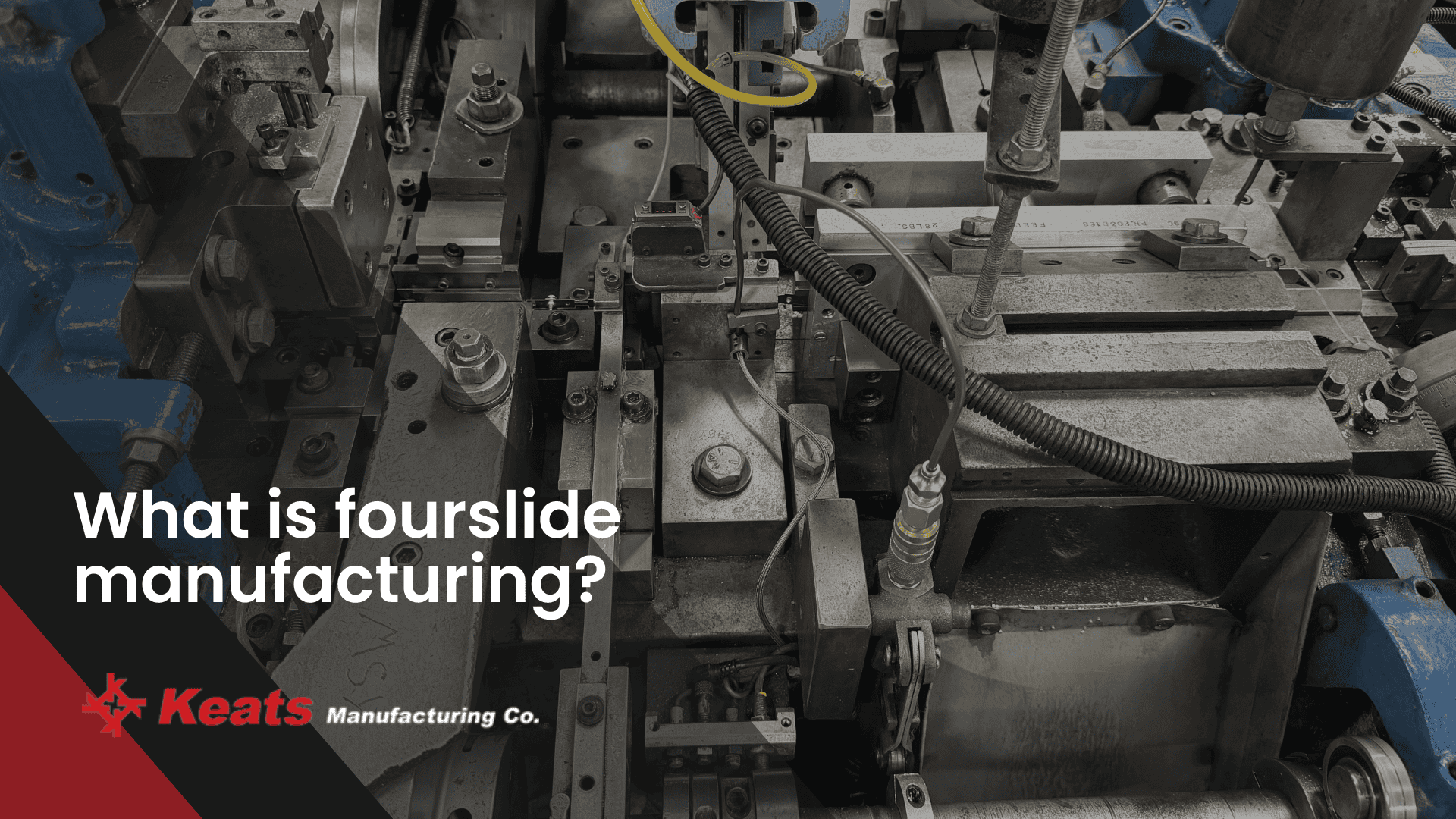
From intricate electrical connectors to custom brackets, manufacturers depend on advanced processes to achieve precision and efficiency at scale. Fourslide manufacturing excels in producing complex geometries and high-volume runs with exceptional accuracy.
For engineers and business leaders, understanding this process reveals new design opportunities and streamlines production. This article outlines the essentials, advantages, and key considerations of utilizing fourslide manufacturing for your next project.
Key Takeaways
- ›Fourslide manufacturing is a precision metal forming process ideal for producing complex, high-volume custom small metal stampings and wire forms.
- ›The fourslide machine uses synchronized slides to perform multiple operations in a single cycle, delivering exceptional accuracy and repeatability.
- ›This process accommodates a wide range of metals and alloys, offering tight tolerances (as precise as ±0.0002 in.) and efficient high-volume production.
- ›Compared to traditional stamping, fourslide manufacturing reduces tooling costs, streamlines secondary operations, and supports just-in-time delivery.
- ›A successful four-slide part design requires careful attention to bend radius and part complexity to maximize efficiency and manufacturability.
What is fourslide manufacturing?
Fourslide manufacturing is a metal forming process designed to produce custom small metal stampings, wire forms, and assemblies with exceptional accuracy and repeatability. At its core, fourslide manufacturing employs a unique machine architecture that uses four synchronized slides, each equipped with its own tooling, to bend, cut, and shape metal stock from multiple directions within a single cycle.
Developed in the early 20th century to streamline complex wire forms and flat stampings, fourslide manufacturing has been in use by Keats Manufacturing Co. since 1958. Operating one of North America’s largest fleets of four‑slide and Wünsch multi‑slide machines, Keats delivers precision solutions for automotive, electrical, aerospace, and consumer electronics applications, including electrical terminals, custom shields, brackets, precision wire forms, and intricate small assemblies.
With locations in Illinois, Texas, and Mexico, Keats Manufacturing Co. delivers rapid, just-in-time production across North America. Our extensive fleet, including Nilson and Wunsch machines, enables flexible, high-volume output of complex custom assemblies with reliable on-schedule delivery.
For a closer look at the equipment behind this process, see the Four-slide stamping machine.
Industry-Leading Tolerance±0.0002 in.
Precision achievable with fourslide manufacturing across a wide range of metals and alloys.
What is the four-slide manufacturing process?
The fourslide machine is engineered for continuous, automated production of intricate metal parts. Its distinctive design sets it apart from conventional stamping presses and progressive die systems.
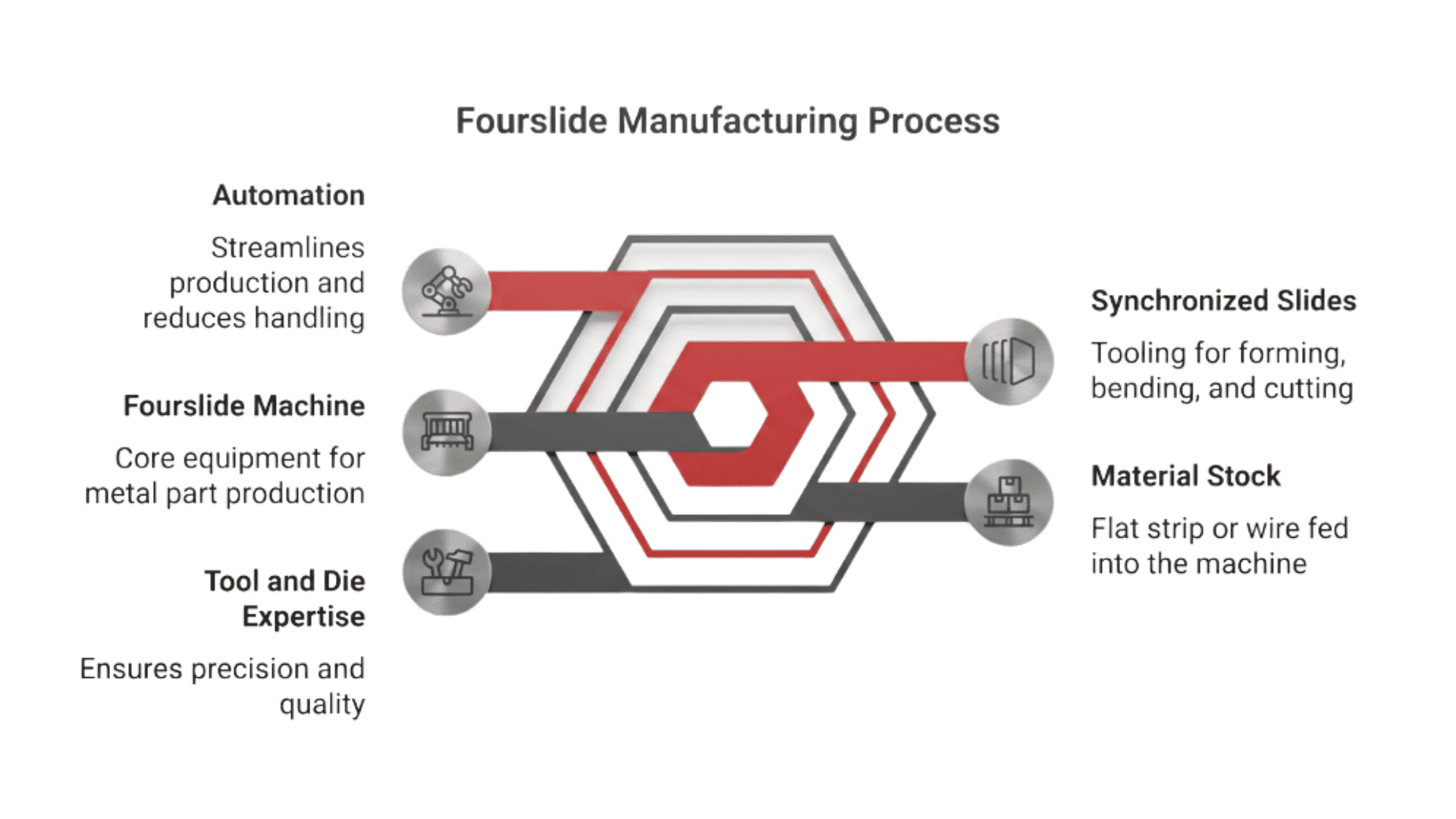
The process relies on synchronized horizontal slides, each fitted with custom tooling, to perform multiple forming, bending, and cutting operations in a single cycle. This precise coordination enables the efficient production of complex geometries with high repeatability and minimal handling. Engineered for speed and precision at scale, fourslide manufacturing integrates automation, in-house tool-and-die expertise, and advanced process controls to deliver consistent, high-quality parts in every run.
Fourslide manufacturing feeds flat strip or wire stock into the machine’s center, where four synchronized slides with custom tooling bend, cut, and shape material from multiple directions in a single pass. Finished parts are ejected automatically for continuous, efficient production.
Bending, punching, and forming completed in one run — no separate setups required.
Rapid prototyping and lifetime-guaranteed tools minimize downtime and accelerate delivery.
Streamlined integration of plating, heat-treating, and more within the production workflow.
Compared to traditional stamping, fourslide manufacturing reduces the need for multiple tools and secondary machine setups, streamlining the entire production workflow. Advanced CAD/CAM systems ensure precise, repeatable results. In-house tool and die development accelerates prototyping and provides lifetime-guaranteed tools, supporting consistent quality and minimizing downtime for demanding, fast-paced industries.
What types of materials can be used with fourslide manufacturing?
Fourslide manufacturing supports a broad spectrum of metals and alloys, allowing engineers to tailor material selection to the application’s demands. Common materials include:
stainless steel
(brass, phosphor bronze)
aluminum alloys
& bronze
demanding environments
Material selection directly impacts part performance, manufacturability, and cost. For example, stainless steel offers corrosion resistance for harsh environments, while copper provides excellent electrical conductivity for terminals and connectors.
Design engineers should consider:
- Ductility and formability of the chosen metal
- Required mechanical and electrical properties
- Surface finish and compatibility with secondary services (e.g., plating or heat-treating)
By leveraging in-house CAD/CAM capabilities, Keats Manufacturing Co. ensures optimal material performance and part integrity from prototype to high-volume production.
The process supports material thicknesses up to 0.090″ and widths up to 3.000″, enabling the production of both delicate and robust components for demanding sectors such as automotive, medical, and aerospace. Secondary services, such as zinc-plating, galvanization, black oxide, and chrome plating, further broaden the range of materials and finishes achievable.
How does the fourslide process impact production speed and efficiency compared to other methods?
Fourslide manufacturing delivers significant speed and efficiency advantages, especially for high-volume and complex parts. The four-slide machine’s ability to perform multiple forming and cutting operations in a single cycle eliminates the need for separate tooling setups and secondary handling.
Key efficiency benefits include:
- Reduced cycle times: Multiple bends and forms are completed simultaneously, not sequentially.
- Lower tooling costs: One set of slides can replace several progressive dies.
- Just-in-time delivery: High-volume capacity (up to 50 million parts) support lean manufacturing and inventory optimization.
In contrast, conventional stamping presses often require multiple dies, additional handling, and longer setup times, making them less efficient for parts with intricate geometries or that require frequent design changes.
Scenarios where fourslide manufacturing excels:
- Complex parts with multiple bends or cutouts
- High-volume production runs demand tight tolerances and repeatability
- Projects requiring quick design iterations
With production rates up to 10,000 pieces per hour, fourslide technology enables manufacturers to scale efficiently without compromising quality or delivery. Full compliance with ISO 9001, ISO 14001, and IATF 16949 ensures rigorous quality management and traceability, both of which are critical for regulated industries that require consistent documentation and process control. The International Organization for Standardization (ISO) notes that “adherence to ISO 9001 and related standards is a critical factor in ensuring product consistency and customer satisfaction in precision manufacturing.”
Are there any limitations or challenges associated with designing parts for fourslide manufacturing?
While four-slide manufacturing offers excellent speed, precision, and flexibility for many small metal components, it is not the best fit for every part design. Four-slide machines are typically best suited for smaller parts made from strip or wire stock that can be formed efficiently through a sequence of bends, cuts, and forms. Large parts, especially those made from material thicker than approximately 0.090″ or wider than approximately 3″, are often better suited for traditional progressive die stamping or other metal forming processes.
Common design constraints include:
Optimize the four-slide part design by engaging your manufacturing partner early to gather input on bend radii, material selection, and feature feasibility. Leverage CAD/CAM simulation to validate manufacturability and plan for integrated secondary operations like plating for maximum efficiency.
Keats Manufacturing Co. delivers in-house tool and die development with lifetime guarantees, optimizing your designs for quality, efficiency, and cost from the start. Early collaboration with our process engineers and use of digital modeling ensure challenges are addressed prior to tooling, supporting consistent quality and streamlined production.
Final Insights
Fourslide manufacturing is a proven solution for producing high-precision, high-volume custom small metal stampings, wire forms, and assemblies. By leveraging the unique capabilities of the fourslide machine, manufacturers can achieve complex geometries, tight tolerances, and rapid production speeds, all while maintaining strict quality and compliance standards.
Discover how four-slide stamping can streamline your manufacturing process and deliver precision results for your next project. Ready to learn more or discuss your specific needs? Contact us to explore customized solutions and see how four-slide stamping can benefit your business.
Ready to explore fourslide manufacturing for your next project?
Contact Keats Manufacturing to explore customized solutions and see how fourslide stamping can benefit your business. Visit keatsmfg.com or reach out to our engineering team directly.
Can you explain the main factors that affect the speed and efficiency of four-slide machines in production?
Comments Off on Can you explain the main factors that affect the speed and efficiency of four-slide machines in production?
From intricate electrical terminals to robust spring clips, four-slide stamping enables manufacturers to produce complex metal components at remarkable speed and precision. For companies aiming to streamline their production lines and maintain a competitive edge, recognizing the variables that influence four-slide machine performance is vital.
This article examines the essential factors – ranging from material selection and tooling to finishing techniques and process optimization – that shape the speed and efficiency of four-slide stamping, to aid in making strategic decisions for your manufacturing needs.
Key Takeaways
- ›Four-slide stamping offers unmatched speed and flexibility for producing complex, high-volume precision metal components.
- ›Material selection, tooling design, and machine maintenance are primary drivers of production speed and efficiency.
- ›Four-slide stamping often offers lower costs and faster turnaround than progressive die stamping for suitable part geometries.
- ›Strategic process optimization and manufacturer expertise are essential for maximizing four-slide machine throughput and quality.
What is four-slide stamping, and how does the process work?
Four-slide stamping is a highly specialized metal stamping process that utilizes a unique machine design to produce complex, small metal stampings and wire forms with exceptional precision and repeatability. Unlike traditional punch presses, four-slide machines (sometimes referred to as “multi-slide” machines) feature synchronized slides arranged at right angles around the workpiece. Each slide is equipped with tooling that can bend, cut, punch, or form the material from multiple directions in a single cycle.
Basic operation of four-slide machines:
- Coiled or strip metal is automatically fed into the machine.
- Four independent slides, driven by a central camshaft, move tooling horizontally to form the part.
- Multiple operations (bending, forming, shearing) occur simultaneously or in rapid sequence.
- Finished parts are ejected, and the cycle repeats at high speed.
Unique features of four-slide stamping compared to other metal forming processes:
- High production speeds (thousands of parts per hour)
- Ability to perform multiple operations in one setup
- Exceptional precision (tolerances up to ±0.0002 in.)
- Cost-effective for high-volume, complex geometries
- In-house tool and die development, as practiced by Keats Manufacturing Co., ensures lifetime tooling guarantees and rapid prototyping
State-of-the-art four-slide machines, including Keats’ Nilson and US Baird models, are engineered for both speed and flexibility. These machines accommodate a range of raw material sizes, with feed lengths up to 15.000″, supporting both prototyping and high-volume runs exceeding 50 million parts. The unique Wünsch multi-slide machines further extend the range of part complexity and throughput, enabling simultaneous forming operations across multiple axes.
What are the main uses or applications for each type of metal?
Four-slide stamping is highly versatile, enabling the production of a wide range of precision metal components across industries. The following are the key product applications where this process excels, each matched to the metals best suited for its performance requirements.
Brackets
Custom metal brackets are among the most common four-slide stampings, used in automotive systems (ABS brakes, airbag assemblies, instrument panels), appliances, and electrical distribution equipment. They are typically produced from steel, aluminum, or stainless steel, with material choice driven by the required strength, weight, and corrosion resistance. Keats Manufacturing handles bracket orders of up to 50 million parts and offers barrel and rack plating to ensure long-term durability.
Electrical Terminals
Terminals require precise geometries and reliable conductivity, making four-slide stamping the ideal process. Phosphor-bronze is widely used for high-reliability automotive terminals (steering position sensors and lighting systems), while General Copper alloys are used in appliance timer controls. Beryllium Copper (C17200) is reserved for high-precision spring contacts in hearing aids, medical devices, and aerospace applications. Keats produces terminals to tolerances of ±0.0002 in., meeting IATF 16949 and ISO 9001 standards.
Metal Bushings
Bushings are cylindrical components that reduce friction, limit torque and support rotational or sliding motion in mechanical assemblies. Four-slide stamping produces bushings with tight tolerances and full material traceability. Aluminum & Cold Rolled steel are the most common materials used for bushings. Stainless steel variants are used where corrosion resistance is critical. Industries served include automotive, medical, and precision mechanical systems.
Metal Clips
Spring clips and retaining clips benefit from the high-speed, material-efficient nature of four-slide stamping. Stainless steel (301/302) with “½ hard” temper is the standard choice for flat spring clips, providing the spring-back force needed for secure retention. Four-slide technology eliminates the need for a carrier strip, reducing material costs by up to 35% compared to progressive die stamping, a significant advantage for high-volume clip production across appliance, automotive, and electronics applications.
Bus Bars
Bus bars are conductive components used in power distribution units to distribute electrical current across circuits. C110 Copper is the material of choice due to its excellent electrical conductivity and suitability for high-current applications. These include power distribution units for electric vehicles (EVs), construction equipment, and industrial electrical systems. While most busbars are made from traditional progressive die stamping, Four-slide stamping allows busbars to be formed with complex geometries while maintaining tight tolerances on conductivity and dimensions.
Lead Frames
Lead frames are structural elements in electronic packages that connect semiconductor chips to external circuits. They demand extreme dimensional accuracy and consistent surface quality. General Copper alloys are commonly used for standard lead frames in consumer electronics and appliance controls, while Phosphor Bronze or specialty copper alloys may be selected when spring properties or higher fatigue resistance are required. In-house CAD/CAM tooling at Keats ensures the precision required for high-volume lead frame production.
Shields
Metal shields protect sensitive electronic components from electromagnetic interference (EMI) and heat. Cold Rolled Steel (1008/1010) is widely used for fuel-injection shields in automotive engines, while Galvanized Steel provides corrosion protection for carbon-steel pins and light-gauge components. Four-slide and multi-slide technology (including Wunsch machines) enables shields to be formed through simultaneous operations across multiple axes, meeting complex geometry and tight-fit requirements for automotive, electronics, and industrial applications.
Across all these applications, material selection must align with the required mechanical properties, desired finish, tolerance requirements, and application-specific standards (ISO 9001, IATF 16949, Mil-Spec). Keats Manufacturing’s in-house CAD/CAM engineering, toolmaking, and advanced simulation tools ensure optimal part accuracy and manufacturability across every product type.
How do the different metal finishing techniques affect the durability and lifespan of the finished product?
Metal finishing and material selection enhance a product’s lifespan by protecting it against environmental and mechanical stress:
Coatings such as zinc plating, galvanization, and black oxide are applied to carbon steel to provide essential rust protection. Alternatively, using 304 or 316 stainless steel provides inherent corrosion resistance in high-moisture environments.
Components such as custom bushings are designed to cushion movement and reduce friction, extending the service life of mechanical assemblies. Chrome plating is also utilized to improve the surface durability of wireforms.
Tin plating is often used on copper, brass, and other conductive materials to improve corrosion resistance, solderability, and long-term electrical performance. It is especially valuable for electrical terminals, contacts, and connectors where consistent conductivity and protection from oxidation are important. Tin plating can also help reduce contact resistance and improve the reliability of components used in automotive, electronics, and power distribution applications.
Replacing plastic components with metal clips helps prevent parts from failing under high heat. Additionally, super-tight tolerance manufacturing prevents minor defects that could lead to catastrophic failure in critical aerospace or medical applications.
Precious metal plating, such as silver, gold, palladium, or nickel underplating, is often used when parts require superior conductivity, corrosion resistance, solderability, or long-term contact reliability. These finishes are especially important for electrical contacts, battery components, medical devices, and high-performance connector applications where even small increases in resistance or surface oxidation can affect performance. While precious metal plating adds cost, it can significantly improve durability and reliability in demanding environments.
The choice and sequence of finishing techniques directly influence product durability, corrosion resistance, and service life, especially in demanding applications such as automotive, aerospace, and medical devices. Keat’s practice of integrating these secondary services in-house streamlines production and ensures quality control at every stage.
Secondary services, including plating, heat treating, stress relieving, and e-coating, are outsourced and managed by Keats. All of Keats’ approved suppliers meet stringent ISO 9001 and IATF 16949 quality standards. The result is a finished product with enhanced durability and consistent performance, even in the most challenging operating environments.
Can you explain the main factors that affect the speed and efficiency of four-slide machines in production?
This is a critical question for manufacturers seeking to optimize throughput and reduce costs. The primary factors include:
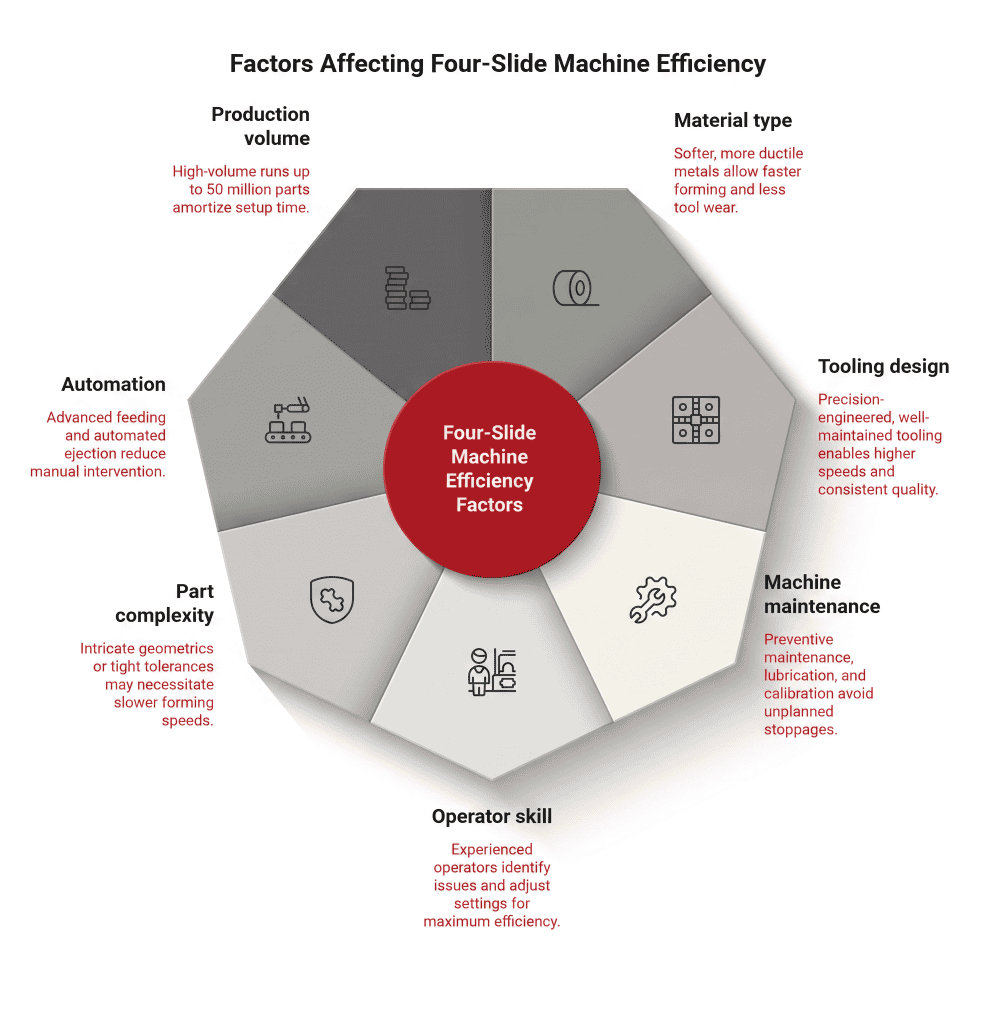
It’s important to note that four-slide stamping technology inherently supports rapid, multi-directional forming, allowing for simultaneous operations that drastically reduce cycle times compared to conventional stamping. In combination with in-house tool-and-die expertise and rigorous preventive maintenance, manufacturers can achieve both high throughput and consistent quality across large production runs. Strategic investments in operator training and automation further amplify these benefits, ensuring each run is optimized for both speed and precision.
Adhering to strict sheet metal stamping design guidelines during the engineering phase further enhances manufacturability, reduces tool wear, and supports just-in-time delivery strategies.
Keats Manufacturing operates one of North America’s largest fleets of four-slide and proprietary Wünsch multi-slide machines, enabling precise, high-speed forming with minimal changeover and maximum throughput. Industry 4.0 technologies, real-time monitoring, and simulation-driven engineering enhance efficiency through predictive maintenance and rapid troubleshooting. With three strategically located campuses (IL, TX, Mexico), Keats delivers distributed production, optimized logistics, and just-in-time delivery, all under full compliance with ISO 9001, ISO 14001, and IATF 16949.
How does the cost and speed of four-slide stamping compare to other metal-forming methods like progressive die stamping?
When evaluating metal forming technologies, decision-makers often compare four-slide stamping to progressive die stamping.
Cost Comparison
Four-slide stamping is often considered one of the most cost-efficient options for high-volume production due to several factors:
- Lower Tooling Investment: Compared to traditional metalworking methods, fourslide stamping typically requires a lower initial tooling investment. In contrast, traditional power presses require expensive, specialized tooling to achieve intricate cuts and sharp bends.
- Material Efficiency: The fourslide process uses material more efficiently and generates less waste than traditional processes. This is particularly beneficial when working with expensive metals, as the reduction in scrap translates directly to lower material costs.
- Elimination of Secondary Operations: Because fourslide machines are “start-to-finish” operations that perform multiple forming and stamping tasks in a single run, they often eliminate the need for one or more secondary operations, reducing the total cost per part.
- Inexpensive Design Changes: Modifying a part design in traditional press operations can be expensive and time-consuming, often requiring a new die. Fourslide machines can accommodate design changes with simple adjustments to individual sliding tools.
Speed and Turnaround
The unique mechanics of the fourslide machine allow for high-speed manufacturing and faster project completion:
- High Production Rates: Fourslide machines can achieve production rates of nearly 10,000 pieces per hour, depending on part complexity.
- Faster Turnaround: The ability to perform multiple operations in a single run, accessing the metal from four orthogonal directions simultaneously or sequentially, results in a much faster turnaround than traditional methods that might require multiple machine setups.
While progressive die stamping is often cited as a “solid fit” for high-volume runs (such as 250,000+ pieces annually) that require precision hole placement and consistent tolerances, fourslide stamping remains the preferred choice for designs that require complex twists, curves, or multiple bends that a single-direction vertical press cannot easily achieve. For further analysis, refer to our metal stamping process and four-slide stamping techniques resources.
Ultimately, the choice depends on part geometry, volume, and project requirements. Keats Manufacturing Co. offers both four-slide and progressive die stamping, providing objective guidance to ensure optimal results for your application.
Conclusion
Four-slide stamping stands out as a premier solution for high-speed, high-precision metal component manufacturing, driven by factors such as material selection, advanced tooling, integrated finishing, and expert operation. By understanding the main drivers of speed and efficiency, you can make informed decisions that maximize productivity and product quality.
Discover how four-slide stamping can streamline your manufacturing process and deliver precision results for your next project. Ready to learn more or discuss your specific needs? Contact us to explore customized solutions and see how four-slide stamping can benefit your business.
Ready to optimize your four-slide stamping production?
Contact Keats Manufacturing to explore customized solutions and see how four-slide stamping can benefit your business. Visit keatsmfg.com or reach out to our engineering team directly.