

What are some examples of the most common stamping defects, and how can they be identified during production?
Comments Off on What are some examples of the most common stamping defects, and how can they be identified during production?
Quality control in metal forming is a proactive engineering discipline; every component passing through a press represents a measurable data point to isolate variables before they escalate. In high-volume manufacturing environments, undetected structural deviations can compound rapidly, impacting downstream assembly steps, structural performance, and total cost of ownership.
This article explores the root causes of common fabrication errors, outlines advanced detection methods used on the factory floor, and examines how component reliability affects industrial applications. To understand the underlying multi-axis equipment driving these quality frameworks, read What is a four-slide machine used for or reference our comprehensive Four‑slide Stamping resource hub.
Key Takeaways
- ›Stamping defects are a primary source of material waste and production downtime, making early in-line identification essential for high-volume efficiency.
- ›Typical forming anomalies such as cracks, wrinkles, and burrs can be systematically captured using automated vision systems and precise in-process sensors.
- ›Defect-free components are non-negotiable for critical fastening assemblies, directly dictating the long-term safety and performance of industrial machinery.
What are the types of defects?
In industrial metalworking, defects occur during the mechanical deformation and cold-forming of raw stock. These issues are typically driven by progressive tooling wear, misaligned clearances, or material thickness inconsistencies. Effectively managing sheet metal stamping defects requires a focus on mechanical press precision and die optimization to reduce process variation.
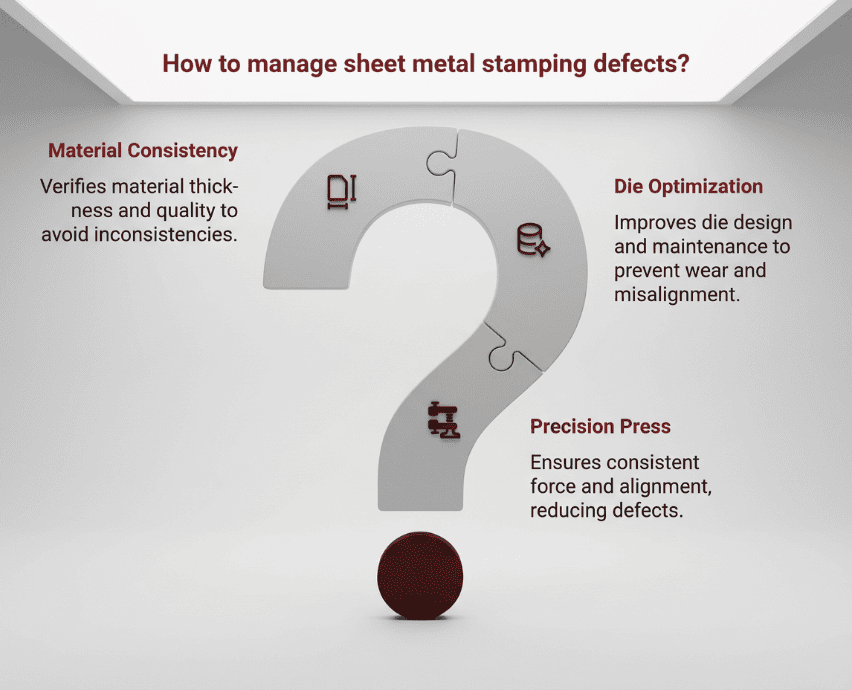
Modern simulation technology allows engineers to pre-visualize tooling designs, providing a thorough analysis that predicts specific formability issues such as wrinkles, thickening, splits, and springback. By identifying these flaws early in the engineering stage, teams can implement virtual compensation strategies to ensure the final part matches the engineering model and maintains consistent dimensions. Beyond structural failures, visual and surface defects are a significant concern, particularly for pre-plated components.
High-quality tooling is considered the “heart and soul” of preventing these failures, especially in high-volume production. Precision dies, often utilizing A2 or carbide tool steel, are designed to maintain tight dimensional tolerances measured in microns. This precision prevents issues such as under-performance and system damage. Furthermore, secondary operations such as coining are often integrated into the process to apply high force to the workpiece, causing it to conform to the die and reduce or remove burrs.
Pinpointing whether a failure stems from a thermal variable, a high-speed mechanical strike, or day-to-day variations in coil thickness or material characteristics dictates whether engineering teams must rebuild a die set or alter raw material. Utilizing Design for Manufacturability (DFM) services as soon as a design print is available is vital for catching these engineering flaws before production begins, as addressing issues that cannot be completed to spec after manufacturing starts is extremely expensive.
For a broader overview of how different stamping processes, such as fourslide stamping, which offers high accuracy from four orthogonal directions, or traditional progressive die stamping, can influence defect types and precision levels, see the Types of stamping processes section.
What are some examples of the most common stamping defects and how can they be identified during production?
Within automated production environments, certain stamping defects require continuous monitoring due to their frequency:
Occur when localized tensile stresses exceed the material’s ultimate tensile strength, often caused by inadequate die radii or poor alloy ductility.
Wavy undulations triggered by excessive compressive stresses or insufficient blank-holder pressure during drawing operations.
Sharp, raised protrusions along sheared edges that develop as punch-to-die clearances widen due to normal tool wear.
Geometric thinnings, structural distortions, or volumetric variations that drift beyond specified print tolerances.
To capture these anomalies before parts reach shipping bays, modern manufacturing facilities utilize a combination of automated vision systems, multi-axis in-line metrology, and dynamic acoustic emission sensors. Automated cameras scan part surfaces at maximum throughput speed to isolate cracks, while automated force sensors monitor real-time tonnage spikes to flag premature tool breakage.
The U.S. Department of Energy’s Advanced Materials and Manufacturing Technologies Office reports that integrating smart manufacturing frameworks, such as advanced embedded sensors and real-time process controls, directly increases manufacturing throughput and improves overall product quality by mitigating errors at the point of fabrication. Utilizing specialized multi-slide configurations further enhances this control.
To further understand how material selection affects defect rates, refer to: How does the choice of material impact the likelihood of defects occurring in the stamping process?
Isolating fabrication anomalies during active production is necessary to maintain strict engineering compliance and reduce material waste. By leveraging advanced in-line inspection tools and multi-axis forming equipment, manufacturers can eliminate the structural variables that cause component failure.
Ready to eliminate stamping defects from your production process?
Discover how four-slide stamping can streamline your manufacturing process and deliver precision results for your next project. Contact us to explore customized solutions and see how four-slide stamping can benefit your business.
How does the tooling design process for four-slide stamping differ from traditional stamping methods?
Comments Off on How does the tooling design process for four-slide stamping differ from traditional stamping methods?
Choosing the right tooling architecture is a pivotal decision in custom precision manufacturing, directly influencing production quality, lead times, and total cost of ownership. As the demand for intricate, high-volume components grows, engineering teams must evaluate how different forming mechanisms impact part execution.
This article breaks down the foundational differences in tool engineering, providing actionable insights for optimizing your production approach. For core technical context, explore What is a four-slide machine used for or visit our comprehensive Four‑slide Stamping pillar page.
Key Takeaways
- ›Four-slide tooling enables simultaneous multi-directional forming, offering unmatched flexibility for complex geometries compared to traditional vertical stamping dies.
- ›Conventional stamping relies on sequential press operations, which often require more material handling and higher tooling investments for intricate designs.
- ›Component requirements, such as specialized bushings with bearings or high-tensile clips, dictate whether multi-slide or progressive stamping is optimal.
- ›Digital in-house tool design optimization consolidates multiple manufacturing steps into a single, high-speed automated pass.
What is the difference between stamping and machining?
Stamping and machining represent two fundamentally different mechanical approaches to component fabrication:
A high-speed, structural forming process that uses custom-engineered die sets and mechanical presses to shape flat sheet metal. It is designed for rapid cycle times, high volume repeatability, and extreme cost-efficiency at scale.
A subtractive manufacturing process that removes material from a solid workpiece using CNC mills, lathes, or cutting tools. It is preferred for low-volume production runs or extreme three-dimensional geometries that require heavy-gauge materials.
Material specifications and application architecture drive this selection. For example, producing high-volume bushings with bearings requires exceptional surface finishes and precise dimensional control. When manufactured at scale, stamping is the optimal process due to its velocity. Compared to the extensive cycle times required by alternative machining workflows, stamping achieves significantly higher throughput and lower manufacturing costs than subtractive methods because the entire forming operation completes in a matter of seconds. For more on how materials affect stamping outcomes, see How does the choice of material impact the likelihood of defects occurring in the stamping process?
What are the different types of stamping machines?
Industrial metal forming utilizes diverse press configurations engineered for specific material behaviors and geometries:
The traditional workhorses of the industry. Mechanical systems use a flywheel-driven ram for high-speed, flat blanking, while hydraulic presses deliver variable force profiles for deeper material draws.
Advance raw coil stock through sequential internal stations, completing separate cuts or bends at each stage of the stroke.
Engineered with high tonnage capacities to process thick-gauge alloys for structural automotive and industrial sub-assemblies.
Utilize four or more independent, synchronized slides driven by a unified camshaft network.
Patent literature on multi-slide forming technology confirms that four-slide machines arrange tool slides in opposing pairs, each perpendicular to the other, and reciprocating toward a common center to execute forming operations from multiple directions simultaneously. This unique mechanical configuration allows multi-slide systems to efficiently produce specialized round metal spring clips and various aluminum wire clip sizes without requiring complex multi-station dies or separate secondary operations.
For a deeper dive into the machinery, see our Four-slide stamping machine page.
What are the methods of stamping?
Selecting a manufacturing methodology depends on balancing part complexity, production volume, and throughput requirements:
At Keats Manufacturing Co., the ability to deliver high-volume production up to 50 million parts, while meeting demanding tolerances (as tight as ±0.0002 in. for stampings) is supported by advanced process engineering and comprehensive quality management. Full compliance with ISO 9001, ISO 14001, and IATF 16949 ensures that every stamped part meets rigorous industrial and engineering standards.
Industry documentation from the Society of Manufacturing Engineers (SME) confirms that while progressive dies require a continuous carrier strip to advance components through separate stations, four-slide processing utilizes synchronous slides acting on a single focal point. For components like variable aluminum wire clip sizes, this minimizes raw material scrap and eliminates the need for downstream handling.
For an overview of the main types of stamping processes, see our specialized page.
How does the tooling design process for four-slide stamping differ from traditional stamping methods?
The core distinction between these processes lies in how forming forces are delivered to the material. Traditional vertical stamping relies on upper and lower halves of a single die set moving exclusively along a vertical axis. For complex parts, this layout requires long, intricate progressive tracks.
Cams strike the workpiece from four different directions in a single pass. This multi-directional capability provides distinct advantages for components such as high-tensile round metal spring clips or cylindrical bushings with bearings, which require complex, multi-plane bends around a central mandrel.
Our engineering team optimizes tool development by integrating CAD/CAM modeling, CNC machining, and Electrical Discharge Machining (EDM) across our strategic production network. Transitioning from traditional toolmaker methods to digital CAD/CAM workflows yields more predictable and repeatable stamping results, reducing prototype cycles and improving dimensional stability across high-volume runs. This digital engineering foundation allows for rapid prototyping, lower initial tooling costs, and exceptional dimensional stability across high-volume production runs of up to 50 million parts.
Conclusion
Selecting the optimal tooling design directly dictates part quality, process efficiency, and total cost of ownership. Four-slide stamping, with its advanced multi-directional forming and rapid tooling adaptability, offers significant advantages for complex, high-volume components.
Discover how four-slide stamping can streamline your manufacturing process and deliver precision results for your next project. Ready to learn more or discuss your specific needs? Contact us to explore customized solutions and see how four-slide stamping can benefit your business.
Ready to optimize your tooling design for precision and efficiency?
Contact Keats Manufacturing to explore customized solutions. Visit keatsmfg.com or reach out to our engineering team directly.
How does the choice of material impact the likelihood of defects occurring in the stamping process?
Comments Off on How does the choice of material impact the likelihood of defects occurring in the stamping process?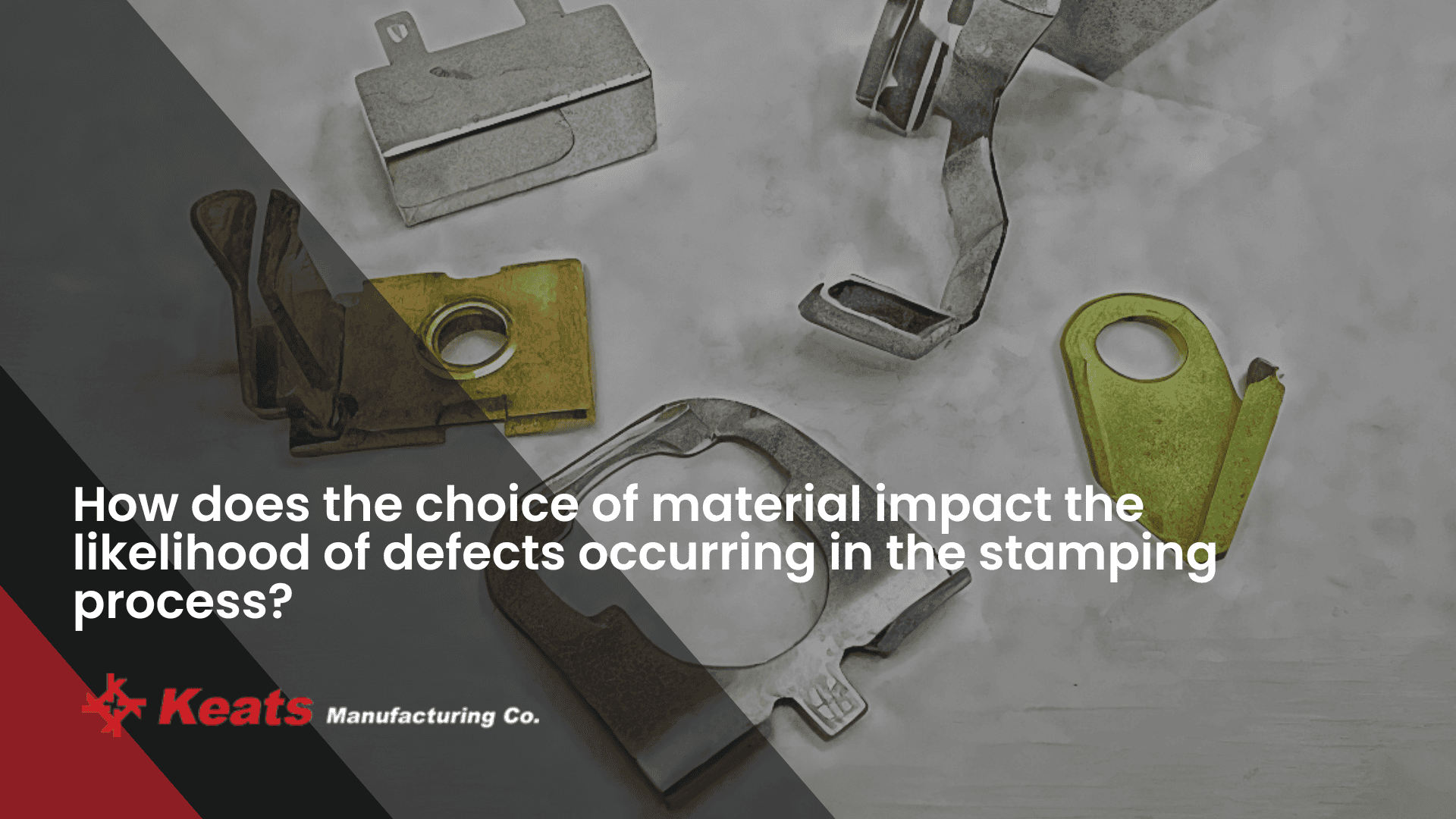
Every stamped metal component begins its journey with a critical decision: the selection of raw material. In precision manufacturing, where tolerances can be measured in ten-thousandths of an inch, the link between material properties and stamping defects is profound.
This article delves into how the characteristics of your chosen material can shape the outcome of four-slide stamping operations, affecting everything from defect rates to overall part performance. For foundational concepts, see What is fourslide manufacturing? and Four‑Slide Stamping. Below, we examine the technical factors that engineers must weigh to prevent defects and optimize production.
Key Takeaways
- ›Material selection is a primary determinant of defect rates in four-slide stamping, directly influencing part quality, process stability, and yield.
- ›The unique capabilities of four-slide stamping machines enable high-precision, high-volume production, but only when materials are matched to both design and machine parameters.
- ›Engineers must evaluate properties such as ductility, hardness, and thickness to ensure optimal material compatibility and minimize stamping defects.
- ›Poor material choices can lead to more frequent burrs, fractures, and dimensional inconsistencies, especially in complex geometries or high-tolerance applications.
- ›Strategic material selection, combined with advanced in-house tool & die development, is essential for achieving just-in-time delivery and consistent quality in custom precision metal stampings.
What is a fourslide stamping machine and how does it work?
What is a fourslide stamping machine? It is an advanced metal forming system engineered for the efficient production of complex, high-precision components. Unlike traditional punch presses, the fourslide (or multi-slide) machine utilizes four synchronized slides, each equipped with forming tools, that approach the workpiece from multiple angles. This enables simultaneous bending, forming, and cutting operations, all within a single cycle.
Key advantages of fourslide stamping machines include:
- Multi-directional forming for intricate geometries
- Rapid tool changes and high throughput, supporting just-in-time manufacturing
- Exceptional repeatability and tolerance control (as tight as ±0.0005 in. for stampings)
- Reduced secondary operations due to integrated forming capabilities
The best four slide stamping machine configurations, such as those operated by Keats Manufacturing Co., leverage proprietary Wünsch multi-slide technology and in-house tool & die development. This combination supports both prototyping and full-scale production up to 50 million parts, while maintaining rigorous quality standards (ISO 9001, ISO 14001, IATF 16949).
The use of advanced simulation and process modeling during the engineering phase further enhances defect prevention. By digitally validating material behavior, thickness variation, and forming parameters before production, manufacturers can proactively identify and address potential sources of defects. This practice is especially critical when working with high-hardness or specialty alloys, where even minor deviations in material properties can result in wrinkling, splits, or excessive springback.
Why is material selection important in engineering design?
Material selection is a cornerstone of engineering design, directly impacting product performance, manufacturability, and lifecycle cost. The right material ensures that components meet application-specific requirements for strength, conductivity, corrosion resistance, and dimensional stability.
For instance, when producing Aluminum Bushing spacers, engineers must consider:
The material’s modulus of elasticity and yield strength to prevent deformation under load.
Longevity in harsh environments is directly dependent on material selection.
Compatibility with downstream processes such as plating or heat-treating.
Selecting an inappropriate alloy or temper can compromise not only the part’s mechanical integrity but also the efficiency and yield of the stamping process. In high-volume applications, even minor material inconsistencies can lead to significant defect rates, resulting in increased scrap, rework, and cost overruns.
Material guidelines established by Keats Manufacturing emphasize the importance of matching the inside bend radius at least to the material thickness, particularly for less ductile metals. This design principle reduces the risk of cracking and ensures smoother bends, directly lowering the likelihood of defects. Additionally, maintaining proper hole spacing and sizing — keeping hole diameters at least equal to the material thickness and spacing them at least twice the thickness from the edges — helps prevent deformation and burr formation during stamping.
For a broader overview of how different stamping processes interact with various materials, see Types of stamping process.
How do engineers choose the right material for a product or system?
Engineers employ a systematic approach to material selection, balancing technical requirements, economic constraints, and process compatibility. The following criteria are paramount:
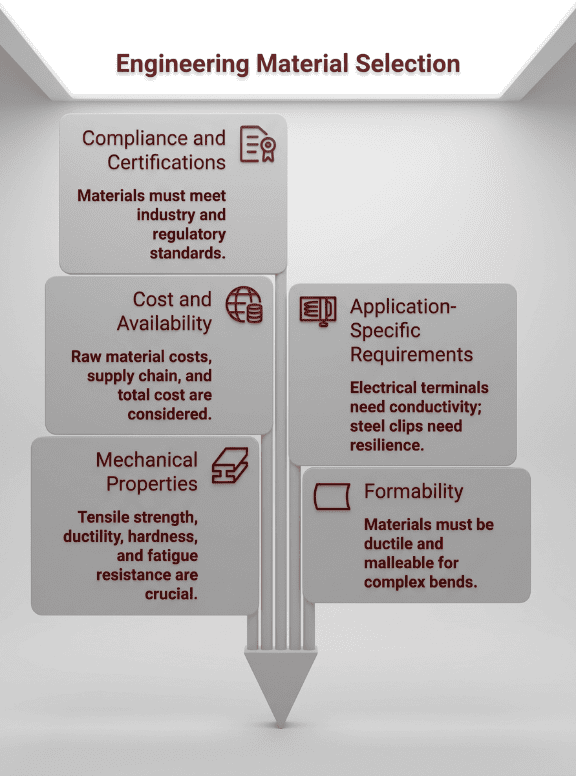
Material evaluation process:
- Conduct mechanical and metallurgical testing (tensile, hardness, microstructure analysis)
- Prototype and trial runs on production equipment
- Analyze defect rates, tool wear, and process stability
- Iterate material and process parameters as needed
This rigorous methodology ensures that each component, whether a custom shield, a formed wire component, or a precision assembly, is manufactured to exacting standards.
Keats Manufacturing’s vertically integrated approach, featuring in-house tool & die development and lifetime guarantees, enables rapid prototyping and iterative material trials. This capability is particularly valuable for high-volume runs, where early identification of material-driven defect risks can prevent costly downstream issues. Furthermore, the company’s compliance with ISO 9001, ISO 14001, and IATF 16949 ensures that all materials are vetted against stringent quality and environmental standards, reducing the risk of non-conformance and process variability.
How does material selection impact the quality of a sheet metal component?
The intrinsic properties of a material dictate not only how it can be formed but also the final quality and reliability of the stamped part. For example:
Benefit from aluminum’s lightweight, corrosion resistance, and ease of forming. However, improper alloy selection can lead to cracking or excessive springback, increasing defect rates.
Require high-carbon or alloy steels with precise heat treatment to achieve the necessary strength and fatigue resistance. Variations in steel grade or temper can result in premature failure, dimensional drift, or excessive brittleness.
Material-related factors influencing sheet metal quality:
- Ductility: Low-ductility materials are prone to fracture during forming
- Thickness tolerance: Variations can cause inconsistent bends or incomplete forming
- Surface quality: Imperfections can propagate cracks or accelerate tool wear
- Grain orientation: Anisotropy can lead to warping or uneven deformation
Ultimately, the synergy between material properties and process parameters determines the defect rate, yield, and overall performance of stamped components.
Keats Manufacturing’s expertise in handling a broad spectrum of metals, including steel, aluminum, brass, copper, and stainless steel, enables the production of components with highly specialized requirements. For instance, custom small metal stampings for automotive or electronics applications may demand ultra-tight tolerances (as precise as ±0.0005 in.) and defect-free surfaces to ensure reliable assembly and function. The integration of secondary services such as plating, heat-treating, and stress-relieving further enhances finished part quality, as these processes are tailored to the specific material and application.
How does the choice of material impact the likelihood of defects occurring in the stamping process?
The answer lies in the interaction between material characteristics and the dynamic forces of stamping. Key material attributes, such as ductility, hardness, and thickness, directly affect susceptibility to common stamping defects, including burrs, cracks, wrinkling, and dimensional inaccuracies.
Material-driven defect risks:
To minimize defects, advanced manufacturers utilize:
- In-house tool & die development with materials matched to specific part geometries and tolerances
- Real-time process monitoring and feedback to adjust forming forces and tool clearances
- Selection of the best four slide stamping machine configurations to optimize energy transfer and minimize stress concentrations
By integrating materials science with precision engineering, Keats Manufacturing Co. consistently achieves high-yield, defect-minimized production, delivering value across industries from automotive to electronics.
In addition, leveraging predictive simulation technology during the design and process engineering stages allows for proactive identification of potential defect zones based on material properties and part geometry. This digital validation step is crucial when working with high-volume production runs, as it enables rapid adjustments to material selection or tool design before full-scale manufacturing begins. The result is a significant reduction in trial-and-error cycles, faster time-to-market, and a measurable decrease in defect rates.
For a deeper look at common defect types and prevention strategies, see What are the defects of stamping? and What types of materials are best suited for four-slide stamping, and are there any limitations?
Final Thoughts
In the sector of custom precision metal stamping, material selection is not a secondary consideration; it is the foundation of defect-free, high-performance manufacturing. Keats Manufacturing Co.’s legacy since 1958 has been built on a commitment to technical excellence, from the largest fleet of four-slide and Wünsch multi-slide machines in North America to our in-house tool & die development with lifetime guarantees. By combining rigorous material evaluation, advanced simulation, and vertically integrated secondary services, we help our customers achieve just-in-time delivery, ultra-tight tolerances, and consistent quality — no matter the application or production volume.
If you are ready to optimize your next project for quality, efficiency, and reliability, partner with a team that understands how material science and engineering precision converge. Contact Keats Manufacturing Co. today to discuss your specific requirements, explore custom solutions, and experience the difference that industry-leading expertise can make in your high-volume stamping operations.
Ready to optimize your material selection and eliminate stamping defects?
Contact Keats Manufacturing Co. today to discuss your specific requirements and explore custom solutions. Visit keatsmfg.com or reach out to our engineering team directly.
What is a four slide machine used for?
Comments Off on What is a four slide machine used for?
From intricate electrical contacts to custom wire bends and clips, the four-slide machine has become a cornerstone of modern precision metal stamping. As manufacturing pushes the boundaries of complexity and scale, this specialized equipment enables the efficient production of parts that would be difficult or costly to achieve with conventional presses.
In this article, we’ll explore what a four slide machine is used for, how it revolutionizes metal stamping workflows, and why it’s a vital asset for manufacturers seeking speed, accuracy, and adaptability. For a deeper dive into the broader process, see our Four‑Slide Stamping pillar page.
Key Takeaways
- ›Four-slide machines deliver unparalleled efficiency and precision for forming, bending, and shaping small metal stampings, wire bends, and clips.
- ›These machines are essential for high-volume manufacturing of complex parts, especially in industries like automotive, electronics, and electrical engineering.
- ›Four-slide stamping offers unique advantages over traditional presses, including multi-directional forming and reduced secondary operations.
- ›Material selection is crucial for optimal performance, with copper, brass, and certain steels being ideal for four-slide processes.
- ›Understanding the capabilities and limitations of four-slide machines helps manufacturers achieve tighter tolerances and higher throughput.
What is a four slide machine used for metal stamping?
A four-slide machine, also known as a multi-slide or four-way slide, specializes in forming, bending, and shaping small metal parts with exceptional precision and speed. If you’re asking what is a four slide machine used for in the context of high-volume manufacturing, the answer is clear: these machines excel at producing complex components with multiple bends and intricate geometries, all within a single, continuous operation. This makes them indispensable for industries where part complexity, tight tolerances, and production efficiency are paramount.
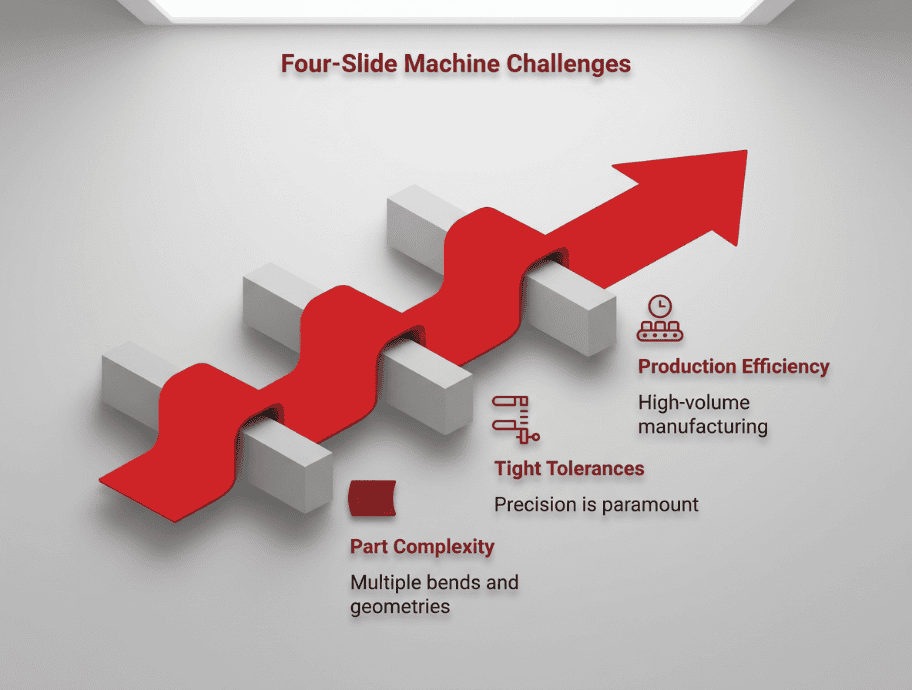
For those specifically seeking what is a four slide machine used for metal stamping, the answer lies in its unique ability to perform simultaneous multi-directional forming. Unlike traditional stamping presses that operate in a single direction, four-slide machines use four synchronized slides to form material from multiple angles in a single cycle.
Integrates cutting, bending, and forming in one cycle, minimizing handling and errors.
Forming across four axes achieves tight tolerances for complex geometries.
Exceptional repeatability for small, intricate parts at high volume.
Four-slide excels at producing parts with multiple bends at high volume. Typical applications include electrical terminals, custom small metal stampings, wire forms, battery terminals, clips, and complex assemblies. Industries served span automotive, electronics, electrical, aerospace, medical, and industrial controls.
What does a stamping machine do?
What does a stamping machine do in manufacturing? At its core, a stamping machine uses dies and high pressure to form flat metal sheets into specific shapes. This process can include blanking, bending, coining, embossing, and more, depending on the machine and tooling. As the National Institute of Standards and Technology describes, “metal stamping is a manufacturing process used to convert flat metal sheets into specific shapes using a tool and die surface.”
Modern four-slide stamping machines combine speed with precision, ensuring each part meets strict specifications. This digital workflow accelerates prototyping, streamlines improvements, and reduces errors for higher first-pass yield.
Unlike single-direction presses, four-slide machines are engineered for complex, small-scale parts, forming components from multiple angles at once. This enables greater part complexity and throughput. Four-slide machines complement conventional stamping by delivering superior precision and efficiency for demanding, high-volume applications.
What is metal finishing? After the stamping process, a critical phase called metal finishing comes into play. This refers to a range of secondary processes including plating, heat treating, e-coating, and stress relieving, applied to stamped parts to enhance surface quality, corrosion resistance, electrical conductivity, and mechanical performance. Effective metal finishing is essential for parts destined for demanding environments, such as automotive connectors or electrical terminals, ensuring longevity and reliability in the field.
How does a four-slide machine differ from other types of metal stamping equipment?
When comparing four-slide machines to other common metal stamping equipment, several distinctions emerge.
Note on limitations: For example, producing a busbar in substation application often requires heavy tonnage forming which can only be accomplished in a larger press. Four-slide machines are best suited for small to medium-sized parts and are not optimal for heavy-gauge or large components.
The strategic deployment of four-slide and traditional stamping press machines across Keats’ three state-of-the-art campuses in Illinois, Texas, and Mexico enables the company to serve customers with regionally optimized production and logistics. This distributed manufacturing model supports rapid response to changing demand, while maintaining consistent quality standards across all locations.
What kinds of materials can be processed using a four-slide machine?
Four-slide machines are highly versatile and compatible with a broad range of metals and alloys. Commonly processed materials include:
Stainless Steels
Suitability for four-slide processes:
- Metals with good ductility and formability are ideal for four-slide operations.
- Material selection is critical for applications such as a bus bar in electrical panel assemblies, where conductivity and mechanical performance are essential.
Material compatibility drives tooling, tolerances, and production efficiency. Keats’ four-slide machines process a broad range of metals, from high-conductivity copper alloys for electrical terminals to high-strength steels for automotive parts. Fast material changeovers and in-house tool & die development enable efficient prototyping and high-volume runs with minimal downtime. Integrated secondary services, plating, heat treating, and stress relieving ensure compliance with stringent industry standards.
Keats’ four-slide equipment handles wire up to 0.18″ diameter, thicknesses to 0.06″, and widths to 3.00″. Material selection is application-driven, balancing formability and strength. Hard, brittle, or low-ductility metals are prone to cracking or tool wear; exotic alloys may require specialized tooling.
What materials are best suited for four-slide stamping, and are there any that should be avoided?
Material selection is critical to four-slide stamping performance. The process’s multi-directional forming, rapid cycling, and tight tolerances demand metals with specific properties to ensure consistent, precise results and minimize defects.
Properties of materials that work well with four-slide machines:
- Ductility and Formability: Metals that can be bent, shaped, or twisted without cracking are ideal. Ductility ensures the material can withstand the multi-directional forces applied during four-slide operations.
- Consistent Grain Structure: Uniformity in grain structure supports repeatability and reduces the risk of unpredictable deformation or tool wear.
- Appropriate Strength-to-Thickness Ratio: Materials should provide sufficient strength for the end-use application while remaining thin enough to be efficiently processed on four-slide equipment.
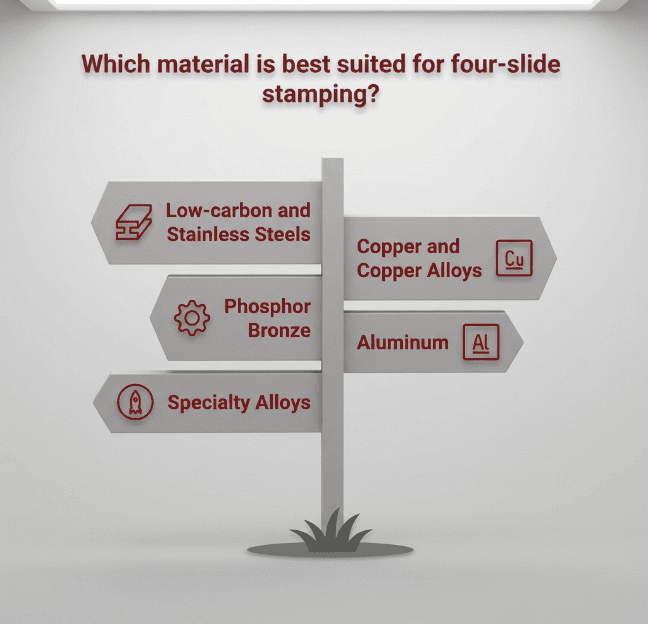
Best-suited materials for four-slide stamping:
Keats processes a wide range of metals on advanced four-slide equipment, holding tolerances to ±0.0002 in. for stampings. In-house tool & die development ensures optimal tooling for both prototyping and production. Materials typically excluded are hard, brittle, abrasive, or exotic alloys; thick-gauge metals beyond forming limits; and materials with poor surface quality. For mission-critical parts, such as copper ring terminal connectors or brackets near sensitive electronics, ductile, high-conductivity metals are preferred for performance and reliability.
What are the defects in stamping process?
Metal stamping, including four-slide operations, can result in several defects:
Sharp edges from incomplete cutting
Distortion from uneven stresses during forming
Fractures from excessive force or unsuitable materials
Scratches, dents, or tool marks
Four-slide machines address many of these challenges through synchronized multi-directional forming, which allows for more uniform force application and reduces the likelihood of stress concentrations. How four-slide machines help minimize defects:
- Precise, repeatable tooling alignment reduces burrs and warping
- Coning operations can be added from any of the 4 axes to remove burrs in specific areas of the part
- Multi-directional forming distributes stress more evenly
- Integrated process controls enable early detection and correction
After stamping, parts may undergo metal finishing, such as deburring, plating, or heat treating, to improve appearance, performance, and durability. What is metal finishing, in this context, is the stage where residual surface defects, burrs, scratches, or minor dimensional drift from the forming process are corrected before final inspection, ensuring parts like sleeve bushings meet both functional and aesthetic specifications.
At Keats, secondary services such as e-coating, stress relieving, and plating are fully integrated, streamlining the path from raw material to finished product and ensuring consistent quality at every step. Integrating metal finishing into the metal stamping process allows manufacturers to eliminate residual imperfections, significantly improving both the durability and long-term performance of stamped components.
What clips do electricians use and how are they made?
Electricians rely on a variety of clips and brackets for wire management, grounding, and mounting:
cable retention
secure connections
panel assemblies
for power distribution
Many of these components are produced using four-slide machines due to their complex shapes and the need for high-volume, precise manufacturing. Material selection, such as copper brackets or steel, depends on electrical conductivity, corrosion resistance, and mechanical strength, especially in bus bar in electrical panel applications. The U.S. Occupational Safety and Health Administration (OSHA) points out that “proper selection and installation of electrical connectors and clips is critical to ensuring safe, reliable electrical systems.” (source)
The ability to execute multiple forming and bending operations in a single cycle makes four-slide stamping uniquely suited for manufacturing intricate electrical clips and terminals. Full compliance with ISO 9001, ISO 14001, and IATF 16949 standards ensures that each batch of stamped clips and brackets meets the rigorous quality and traceability requirements of the electrical industry.
How are copper battery terminals made?
Are copper battery terminals better than alternatives? In most electrical applications, copper is preferred for battery terminals due to:
- Superior electrical conductivity
- Excellent corrosion resistance
- High mechanical strength
Compared to other materials, copper terminals offer lower resistance and longer service life, justifying their use in critical applications. Four-slide machines are highly effective in producing copper ring terminal crimp connectors and other custom copper components, ensuring consistent quality at scale. For high-volume production, the combination of advanced four-slide technology and in-house tool & die expertise enables rapid prototyping and efficient scaling from initial design to production of millions of finished terminals. This is particularly important in automotive, aerospace, and industrial battery assemblies, where reliability and repeatability are non-negotiable.
For high-volume production, the combination of advanced four-slide technology and in-house tool & die expertise enables rapid prototyping and efficient scaling from initial design to production of millions of finished terminals. This is particularly important in automotive, aerospace, and industrial battery assemblies, where reliability and repeatability are non-negotiable. The ability to maintain tight tolerances and deliver defect-free surfaces further enhances the electrical performance and longevity of copper battery terminals.
What factors should I consider when deciding if a four-slide machine is right for my manufacturing needs?
When evaluating four-slide technology for your operation, consider the following:
Four-slide stamping consolidates multiple forming, bending, and cutting operations into a single, continuous process, eliminating extra workstations, reducing handling errors, and accelerating throughput. This efficiency is ideal for just-in-time manufacturing and rapid adaptation to changing demand without sacrificing quality.
Conclusion
Four-slide machines stand at the forefront of custom precision metal stamping, offering unmatched capabilities in forming, bending, and shaping complex small metal parts at scale. Their unique multi-directional forming action, high repeatability, and ability to integrate secondary services make them indispensable for automotive, electrical, electronics, and industrial applications where part complexity, tight tolerances, and production efficiency are non-negotiable.
At Keats Manufacturing, our legacy of technical excellence, backed by in-house tool & die development, a lifetime tooling guarantee, and one of North America’s largest four-slide fleets, ensures your project benefits from world-class quality, rapid prototyping, and just-in-time delivery. If you’re ready to streamline your manufacturing process, reduce costs, and elevate product performance, contact Keats Manufacturing today to discuss your requirements.
Ready to put four-slide technology to work for your project?
Contact Keats Manufacturing today to discuss your requirements. Visit keatsmfg.com or reach out to our engineering team directly.
What are the different types of metal stamping?
Comments Off on What are the different types of metal stamping?
From the tiniest electrical terminals to the most robust automotive assemblies, metal forming shapes the backbone of modern manufacturing. The diversity of fabrication methods, each tailored to specific tolerances and production scales, means choosing the right approach is pivotal.
This article explores the full spectrum of Types of stamping processes and highlights how precision Four‑Slide Stamping delivers the ideal balance of performance, cost, and manufacturability.
Key Takeaways
- ›Metal stamping encompasses several distinct methods, including progressive, transfer, and compound stamping, each offering unique advantages for specific part geometries.
- ›Process selection is driven by material properties, part complexity, required tolerances, and production scale.
- ›Specialized components, such as small metal wire clamps, require precise multi-axis forming to achieve high repeatability.
- ›Stamping operations like blanking, embossing, or bending directly influence the structural strength and suitability for application of the final component.
Breaking Down the Main Types of Metal Stamping
Metal stamping transforms flat metal sheets or wire into complex components through targeted engineering methods:
Performs multiple operations across sequential stations within a single die set as the strip advances.
Moves individual, pre-cut blanks from one die station to the next using mechanical transfer systems. This approach is ideal for larger, three-dimensional parts requiring deep-drawn operations.
Executes multiple operations, such as blanking and piercing, simultaneously in a single press stroke. It is best suited for flat, simple geometries requiring high dimensional precision.
This process offers unmatched flexibility for bending, coining, and shaping intricate wire forms or custom small metal stampings.
What factors should I consider when choosing between different metal stamping methods for my project?
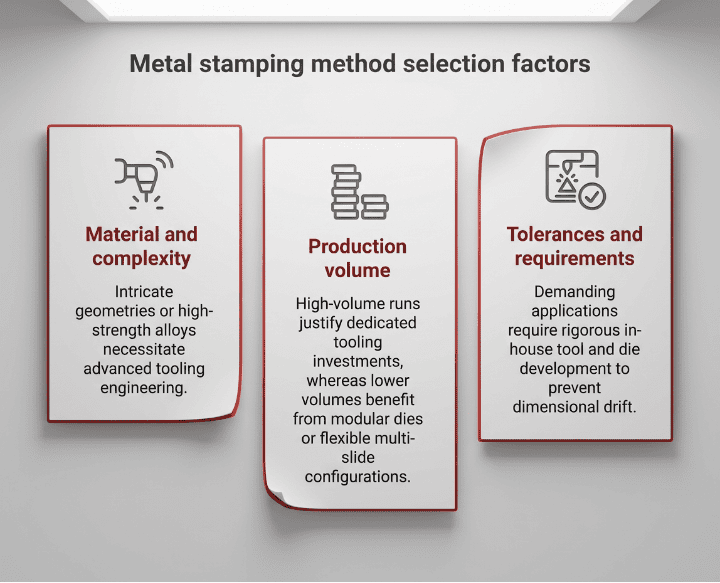
Selecting the optimal production method requires a holistic evaluation of several manufacturing variables:
Intricate geometries or high-strength alloys necessitate advanced tooling engineering, making it critical to partner with experienced progressive stamping die manufacturers.
High-volume runs justify dedicated tooling investments, whereas lower volumes benefit from modular dies or flexible multi-slide configurations.
Demanding applications require rigorous in-house tool and die development to prevent dimensional drift over long production lifecycles.
Research published in MDPI Materials underscores this, confirming that dimensional control in progressive dies directly dictates part quality and functional reliability across high-volume production lots. To safeguard these variables, implementing metal stamping best practices is essential. These practices include conducting early Design for Manufacturability (DFM) reviews, using automated digital process monitoring, and prioritizing suppliers that hold ISO 9001, ISO 14001, and IATF 16949 quality certifications.
For additional insights on how manufacturers make decisions, see How do manufacturers decide which metal stamping process to use for a particular part or product?
How do the various metal stamping operations, like blanking or embossing, affect the properties of the finished part?
The specific die operations executed during manufacturing fundamentally alter the mechanical properties and performance of the final component:
The execution of these operations directly dictates the component’s functional readiness. For example, evaluating what is a busbar used for (conducting high-current electrical energy between circuits) shows that improper stamping can introduce surface resistance or microcracking. Research in MDPI Energies confirms that precision-stamped copper busbars optimize electrical contact and minimize resistive losses without requiring extra connection elements. Integrating secondary services, such as plating, heat-treating, and stress-relieving, directly within the production workflow ensures that post-stamping characteristics meet strict commercial standards.
For more on how quality is maintained throughout these operations, see What quality control measures are commonly used during and after the metal stamping process?
Can you explain how production scale impacts the cost and efficiency of metal stamping?
Production volume dictates the cost structure and tooling amortization of a project:
Prioritizes lower initial tooling costs through modular components, though per-part costs are higher due to setup variables.
Reduces per-part costs dramatically by using dedicated progressive or four-slide tooling, supporting throughputs of up to 50 million components.
The economics of scale are significant. MIT manufacturing research estimates that over $100 billion is spent annually in the United States on the design, fabrication, and assembly of stamped parts. This expenditure highlights why aligning tooling investment with production volume is critical. Applying metal stamping best practices, such as statistical process control and utilization of a multi-campus manufacturing footprint, ensures supply chain redundancy, optimized material yield, and reliable just-in-time delivery for high-volume programs.
Conclusion
Selecting the right metal stamping process directly impacts part quality, production efficiency, and total cost of ownership. By aligning part geometry with the optimal tooling method, engineering teams can maximize component performance while reducing waste.
Discover how four-slide stamping can streamline your manufacturing process and deliver precision results for your next project. Ready to learn more or discuss your specific needs? Contact us to explore customized solutions and see how four-slide stamping can benefit your business.
Ready to find the right metal stamping process for your project?
Contact Keats Manufacturing to explore customized solutions. Visit keatsmfg.com or reach out to our engineering team directly.