

What are the defects of stamping?
Comments Off on What are the defects of stamping?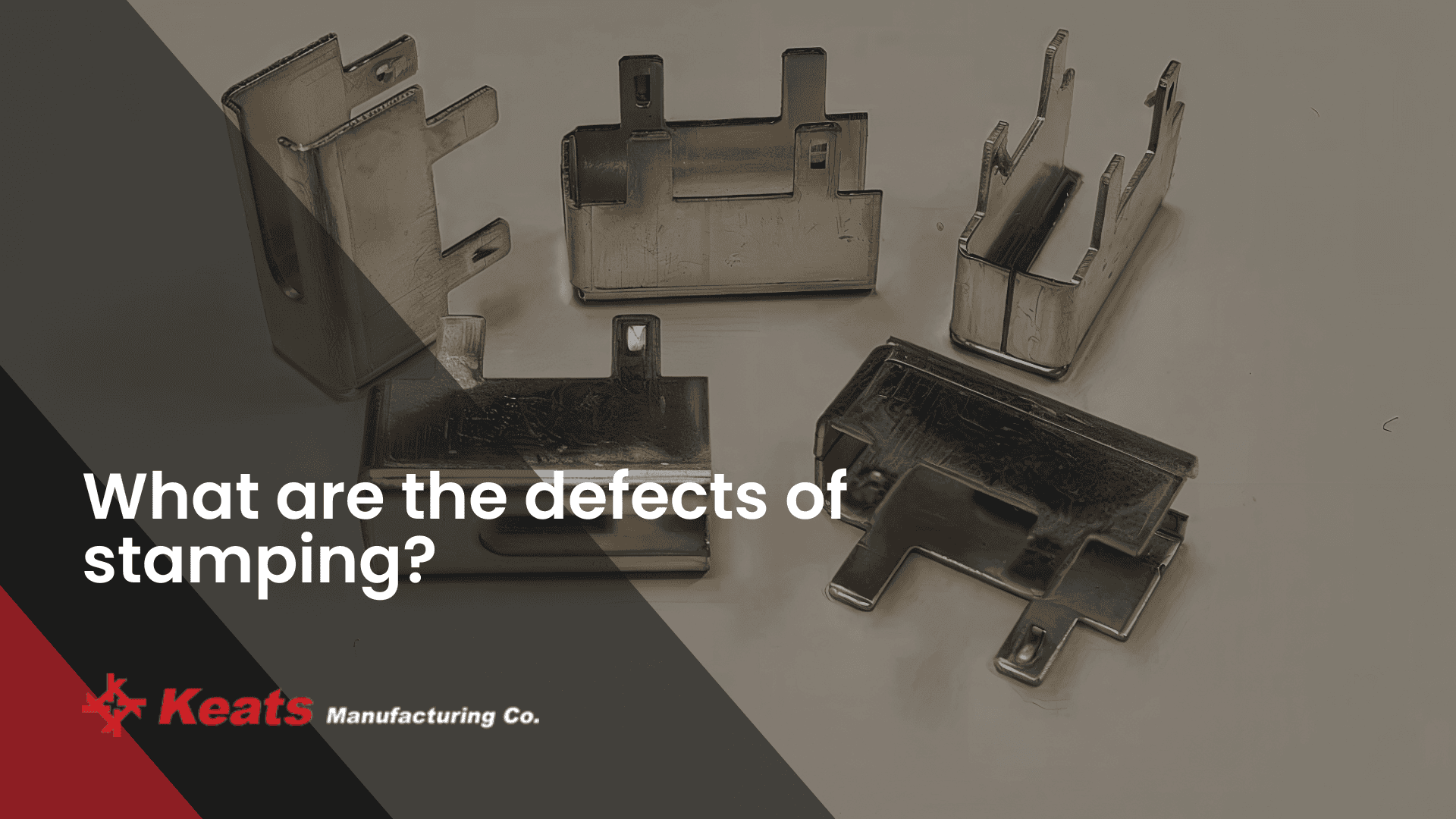
Achieving zero-defect component manufacturing at scale requires strict control over material behavior, press force, and tooling geometry. For engineering decision-makers, understanding stamping defects is vital to preventing costly production delays and sub-assembly failures.
This article uncovers primary failure modes in high-speed manufacturing, examines how alloy variations alter process risks, and details how advanced engineering strategies safeguard quality. To see how process selection mitigates these risks, explore our parent guide on the different Types of stamping process options, or visit our comprehensive Four‑Slide Stamping page.
Key Takeaways
- ›Stamping defects like cracks, wrinkles, and burrs arise from improper stress, incorrect clearances, or material variations.
- ›Maintaining manufacturing tolerances down to 0.0005 in. dramatically reduces part rejection.
- ›Material choices dictate failure modes: ductile copper requires strict die sharpening, while bronze risks edge cracking.
- ›In-house tool design optimization and integrated secondary services stabilize material flow, eliminating defects at scale.
What are the defects of stamping in metal forming?
Metal stamping transforms flat sheet or wire into intricate geometries via high-pressure die contact. During plastic deformation, uneven stress distribution or improper press alignment can introduce structural anomalies. Recognizing these imperfections early is the first step toward optimizing overall equipment effectiveness.
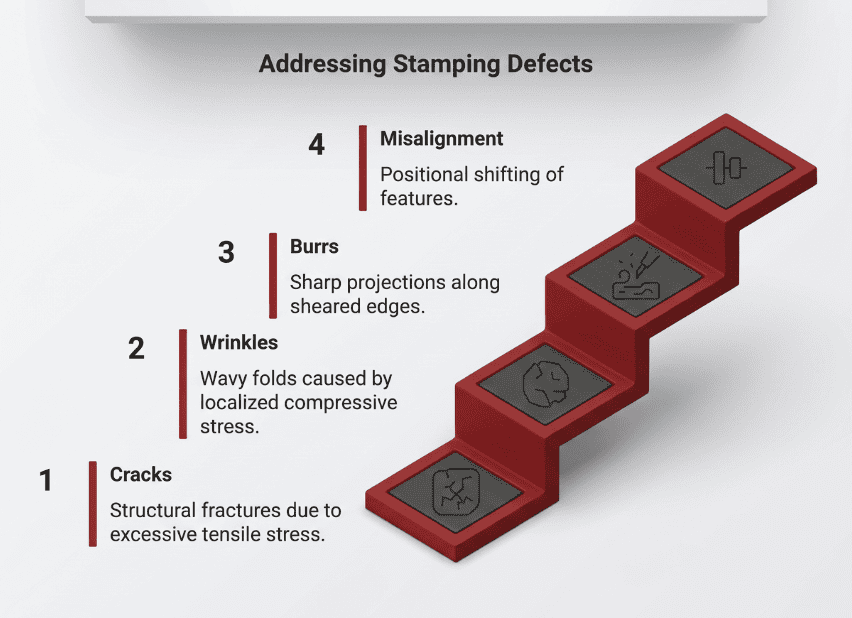
The most prevalent issues encountered in production include:
Structural fractures occurring when tensile stresses exceed the material’s ultimate tensile strength.
Wavy folds caused by localized compressive stress and uncontrolled material flow.
Sharp projections along sheared edges developing from incorrect tool clearances or dull dies.
Positional shifting of features that skews critical dimensions and compromises geometric tolerances.
These flaws result in immediate financial penalties, including elevated scrap rates, premature tooling wear, and expensive line downtime. Peer-reviewed research published in MDPI Applied Sciences confirms that wrinkles and cracks in sheet metal forming are best prevented by methods that tightly control material flow and apply calculated tension to prevent elastic restoration. Managing process variables, such as blank holder force, die geometry, and press speed, is essential to maintain part consistency as production scales up.
What types of defects or issues can occur during the stamping process, and how are they typically prevented?
Eliminating defects requires a proactive engineering strategy that begins during tool design and continues through active production monitoring. Technicians deploy targeted countermeasures to address the mechanical root causes of failure:
Advanced simulation reinforces these prevention strategies before cutting steel. A progressive stamping study published in MDPI Materials on how process variables affect part quality demonstrates that precise control of forming parameters ensures uniform material flow, minimizes elastic recovery, and reduces microcracking and grain-boundary separation. This provides verification that advanced process modeling has a measurable, peer-validated impact on defect reduction.
For instance, in the production of a copper stub-out bracket, robust process controls guarantee that edge quality and dimensional accuracy meet strict commercial specifications. At Keats Manufacturing Co., proprietary tool and die development enables consistent defect prevention. Utilizing an extensive fleet of four-slide and Wünsch multi-slide machines allows for complex multi-axis forming with minimal risk of burrs. Furthermore, integrating in-line secondary services, such as plating, heat treating, and stress relieving, reduces downstream handling and material distortion.
For additional insights into the equipment that supports high-precision production, see our Four-slide stamping machine page.
Can you explain how different materials or alloys impact the likelihood of stamping defects?
Being that metallurgical properties govern how an alloy behaves under extreme mechanical stress, selection of materials directly determines baseline defect risks.
Known for high ductility, copper is ideal for intricate components but remains susceptible to surface scratching and edge burrs. Maximizing a clean break over a broad range of tool clearances directly reduces tool wear and burr height. Consequently, die maintenance and rigorous clearance control are the primary levers for preventing edge defects in high-volume copper stamping. See copper alloys for stamping.
This copper-tin alloy offers excellent strength but reduced ductility, making it more prone to cracking during sharp bends. Silicon-tin bronzes are highly susceptible to edge cracking due to elemental segregation during casting. When forming mechanical components such as bronze bushings for high-wear mechanical assemblies, precise force control, specialized lubrication, and modified die geometries are mandatory due to the alloy’s inherent microstructure.
By leveraging advanced process modeling, our engineering team accounts for each alloy’s unique yield strength and springback characteristics in the initial tool design. Achieving tolerances as tight as 0.0005 in. for stampings provides an added layer of assurance. This precision, backed by full material traceability and compliance with ISO 9001, ISO 14001, and IATF 16949 standards, keeps defect rates exceptionally low across high-volume production lots.
For more on material behavior, explore: What types of materials are best suited for four-slide stamping, and are there any limitations?
What are examples of manufacturing defects?
Manufacturing defects can manifest across all metalworking processes if operational parameters drift. In high-volume production, these flaws introduce severe operational and commercial risks:
These fasteners can exhibit severe springback or dimensional inconsistencies. Another study in MDPI Metals confirms that wrinkling, cracking, and poor forming accuracy readily occur due to low material plasticity at room temperature, thereby necessitating highly optimized parameters to maintain clip geometry at scale.
Minor process deviations or inadequate quality checks can result in incomplete bends or misaligned wire eyes.
Improper integration of secondary finishing can cause surface oxidation, plating adhesion failures, or poor mechanical fit. See our guide on electrical terminals.
The consequences extend from immediate scrap costs to delayed delivery schedules and field failures. To protect brand reputation and guarantee regulatory compliance, Keats Manufacturing Co. integrates comprehensive quality management systems (ISO 9001, 14001, and IATF 16949) across three strategic campuses in Illinois, Texas, and Mexico. Continuous investment in machine-vision inspection and digital process monitoring ensures only components that meet exacting standards proceed to final packaging.
For a closer look at our quality assurance measures, see What quality control measures are commonly used during and after the metal stamping process?
Conclusion: Precision stamping — defect prevention as a competitive advantage
Proactive defect management is the foundation of operational excellence. Keats Manufacturing Co. combines decades of engineering expertise, a massive multi-slide fleet, and rigorous IATF 16949 quality controls to deliver consistent, defect-free results at production scales of up to 50 million parts.
Discover how four-slide stamping can streamline your manufacturing process and deliver precision results for your next project. Ready to learn more or discuss your specific needs? Contact us to explore customized solutions and see how four-slide stamping can benefit your business.
Ready to eliminate defects from your stamping production?
Contact Keats Manufacturing to explore customized solutions and see how four-slide stamping can benefit your business. Visit keatsmfg.com or reach out to our engineering team directly.
How do manufacturers decide which metal stamping process to use for a particular part or product?
Comments Off on How do manufacturers decide which metal stamping process to use for a particular part or product?
Determining the best metal types of stamping process for a specific part shapes every stage of a product’s journey, from the initial prototype to large-scale manufacturing. For decision-makers in manufacturing, gaining further insight into this selection process is crucial for achieving precise specifications, meeting regulatory requirements, and controlling costs.
This article breaks down how manufacturers evaluate and select the ideal stamping method for diverse applications, from electrical terminals to intricate wire forms. For additional background, please reference our comprehensive Four‑Slide Stamping and Types of Stamping Process articles.
Key Takeaways
- ›Manufacturers choose metal stamping processes based on part complexity, production volume, material, and quality requirements.
- ›Four-slide stamping offers unique design flexibility and efficiency advantages for intricate, high-volume components.
- ›Tooling design and process selection directly affect compatibility with terminal sizes and specialized connectors.
- ›Selecting the right process ensures optimal cost, precision, and speed for applications such as battery terminals and wire-clamp connectors.
- ›
Partnering with a provider that offers advanced in-house tooling and secondary services streamlines production and ensures long-term quality.
What is the process of terminal stamping?
Terminal stamping is a specialized manufacturing technique focused on producing electrical terminals and connectors with high precision and repeatability. These components, ranging from battery terminal lugs sizes to copper terminals sizes, are essential in automotive, industrial, and consumer electronics applications.
The process typically follows these steps:
Common applications include:
- Automotive wiring harnesses (requiring precise battery terminal lug sizes)
- Industrial control systems (using a variety of copper terminal sizes)
- Power distribution assemblies and custom connector solutions for circuit breakers
Terminal stamping is the foundation for reliable electrical connectivity, and process selection is driven by part geometry, volume, and end-use requirements.
Manufacturers with vertically integrated operations and in-house tool & die development can offer significant advantages at this stage. By designing and maintaining custom tooling internally, they ensure tighter process control and a lifetime guarantee on die performance. This is especially valuable for long-running, high-volume projects. Additionally, integrating secondary services such as plating and heat-treating within the same facility streamlines production, reduces lead times, and helps maintain consistent quality across large production runs.
How does the tooling design process for four-slide stamping differ from traditional stamping methods?
Tooling design is a decisive factor in the efficiency and versatility of metal stamping operations. Four-slide stamping, in particular, offers a unique approach compared to traditional progressive die stamping.
Ideal for wire forms, custom small metal stampings, and assemblies with challenging bends or cutouts.
Achieves ±0.0002 in. for stamping across high-volume runs.
Supports up to 50 million parts with just-in-time delivery.
These tooling differences directly impact production cost, speed, and the ability to accommodate evolving part designs, making four-slide stamping the preferred solution for advanced applications like wire clamp connector manufacturing.
The presence at Keats Manufacturing of one of the largest fleets of four-slide machines in North America, including unique Wünsch multi-slide machines, provides unmatched capacity and versatility. This infrastructure enables rapid scaling from prototyping to full production while maintaining consistent quality and precision across millions of parts. The ability to execute complex forming operations in a single setup not only shortens lead times but also minimizes the risk of dimensional variation, ensuring every part meets stringent industry standards.
To learn more about the machines themselves, or for additional insights into the manufacturing process, see What is fourslide manufacturing?
How do you choose the most suitable manufacturing processes for a given sheet metal product?
A multifaceted evaluation is required to decide on the right manufacturing process, considering both technical and commercial factors. Manufacturers systematically assess:
- Part geometry: If the part geometry allows for the raw material to be purchased to the exact width of the part, it will be a candidate for four-slide. If the part has more than 10 bends, it will likely be a candidate for progressive die stamping.
- Material type: The choice between copper, brass, bronze, steel, or specialty alloys affects both tooling design and process compatibility.
- Production volume: High-volume runs benefit from processes with short cycle times and automated handling, such as four-slide or progressive-die stamping.
- Tolerances and quality requirements: Applications demanding extreme precision (e.g., ±0.0002 in.) or compliance with ISO 9001/IATF 16949 standards necessitate advanced tooling and in-process controls.
- Secondary services: The need for plating, heat-treating, or assembly may influence process selection.
- Compatibility with terminal sizes: When manufacturing terminals, especially those with specific copper terminal sizes, the process must ensure consistent fit and electrical performance. Manufacturers may also reference local suppliers by searching for copper terminals near me to streamline sourcing and logistics.
- › Partner with manufacturers offering in-house tool & die development and a lifetime guarantee.
- › Verify compliance with relevant standards (ISO 9001, ISO 14001, IATF 16949).
- › Ensure access to secondary services to minimize supply chain complexity.
The right process selection balances performance, cost, and supply chain efficiency, ensuring that each part meets its intended function and market demand.
With strategically located facilities in Illinois, Texas, and Mexico, Keats Manufacturing Co. provides logistical advantages for just-in-time delivery and regional support. This geographic reach enables Keats to respond quickly to customer needs, adapt to supply chain disruptions, and optimize shipping costs. Full compliance with ISO 9001, ISO 14001, and IATF 16949, as well as Mil-Spec and other industry certifications, further assures customers of consistent quality and adherence to global standards, regardless of production location.
How do manufacturers decide which metal stamping process to use for a particular part or product?
The decision-making process for selecting a metal stamping method is both technical and strategic. Manufacturers start by analyzing the part’s functional requirements, geometry, and operational environment. For instance, components requiring precise battery terminal lugs sizes or wire clamp connector solutions will often benefit from four-slide or multi-slide stamping due to their superior flexibility and speed.
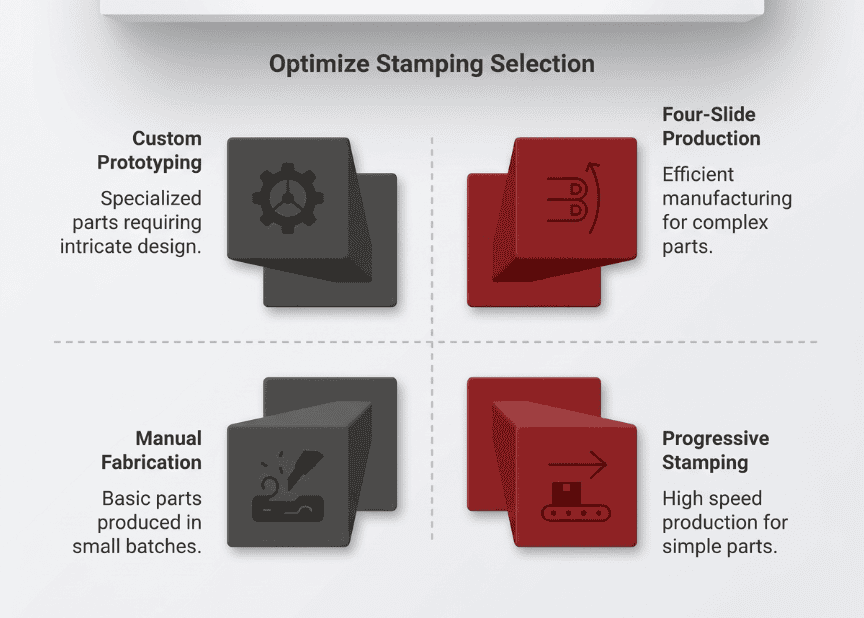
Selecting the right metal stamping process means matching manufacturing capabilities to each project’s specific requirements, balancing quality, efficiency, and long-term value. The process begins with a product feasibility analysis that assesses material thickness, geometry, and manufacturing method. Economic feasibility and production planning ensure technical suitability and cost-effectiveness at scale. Advanced digital modeling and simulation optimize tool paths and reduce prototyping, accelerating development and lowering costs.
Vertically integrated manufacturers like Keats Manufacturing Co. streamline every phase, from raw material sourcing to final assembly, for a seamless, end-to-end solution.
Final Thoughts
Choosing the optimal metal stamping process is a critical decision that directly impacts product performance, cost efficiency, and long-term reliability. By considering factors such as part complexity, production volume, material selection, and quality requirements, manufacturers can align their process selection with both technical and commercial objectives.
Keats Manufacturing Co. stands apart with its extensive fleet of four-slide and multi-slide machines, in-house tool & die development backed by a lifetime guarantee, and a full suite of integrated secondary services. With strategically located facilities and a legacy of precision dating back to 1958, we deliver just-in-time, high-volume solutions for the most demanding industrial and engineering applications.
If you’re ready to optimize your next project with industry-leading expertise and reliability, connect with our team today to discuss your requirements and discover how our custom precision metal stamping capabilities can drive your business forward.
Ready to optimize your next stamping project?
Connect with Keats Manufacturing to discuss your requirements and discover how our custom precision metal stamping capabilities can drive your business forward. Visit keatsmfg.com or reach out to our engineering team directly.
Types of stamping process
Comments Off on Types of stamping process
From automotive electronics to industrial controls, the ability to produce high-precision, complex metal components at scale is a cornerstone of modern manufacturing. Companies seeking to optimize their supply chain and production efficiency must navigate a range of stamping process types, each offering distinct benefits and suited to specific applications.
This article breaks down the leading stamping methodologies, explores how material and production factors drive process selection, and highlights the operational advantages of advanced techniques like four-slide stamping. For an in-depth exploration of four-slide technology, see our Four‑Slide Stamping.
Key Takeaways
- ›Precision metal stamping encompasses multiple process types, each optimized for distinct production needs, tolerances, and part complexities.
- ›Four-slide stamping offers unrivaled flexibility for intricate forms and high-volume runs, enabled by unique machine architecture and in-house tool & die expertise.
- ›Material selection, ranging from copper to heavy-duty steel, directly influences the stamping method, defect risk, and end-use performance.
- ›Proper process control, advanced tooling, and rigorous quality standards are essential to minimizing defects and ensuring reliable, high-volume output.
- ›Strategic decisions between in-house stamping and outsourcing hinge on production scale, complexity, and long-term ROI, with four-slide stamping providing unique advantages for custom applications.
What are the different types of stamping?
The types of stamping process in manufacturing are defined by tooling configuration, part complexity, and production volume requirements. Understanding the stamping process is essential for selecting the right method for your application. The principal methods include:
This process feeds strip metal through a series of stations, each performing incremental forming or cutting operations. Progressive die stamping is ideal for high-volume parts runs requiring multiple features, delivering tight tolerances and consistent repeatability.
Four-slide machines use four synchronized slides to manipulate material from multiple axes, enabling the creation of highly intricate forms and bends in a single cycle.
In deep drawing, a punch forces a sheet metal blank into a die cavity, producing deep, hollow shapes such as enclosures or housings. This method is preferred for components requiring significant depth relative to their diameter, with applications in automotive, aerospace, and electronics.
Transfer systems move individual blanks through a series of dies, each performing a unique operation. Transfer stamping is suited for large, complex parts that cannot be produced from a continuous strip.
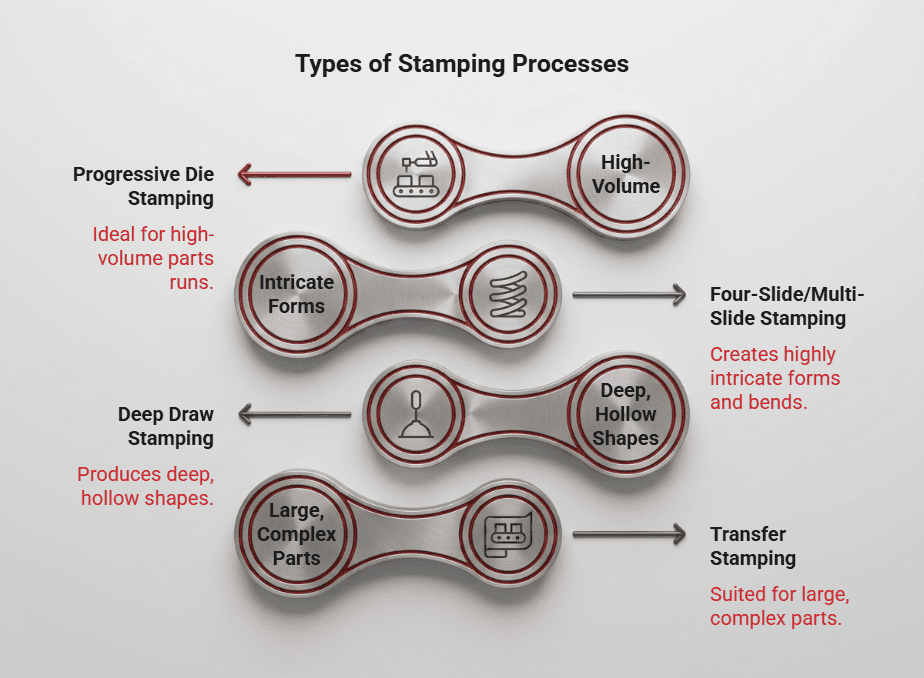
Each of these types of stamping processes is engineered to address specific manufacturing challenges. For example, the stamping process selected for a given project will consider factors such as material behavior, desired tolerances, and production scale to ensure optimal efficiency and part quality.
Advantages and typical applications:
Selecting the optimal stamping process depends on part geometry, volume, and tolerance. For high-volume runs up to 50 million parts, progressive die and four-slide stamping deliver exceptional speed and precision. Keats’ four-slide and multi-slide machines, backed by in-house tool-and-die development, achieve tolerances of ±0.0002 in. for stampings, essential for automotive electronics, medical devices, and industrial controls. Integrated secondary services like plating, heat-treating, and stress-relieving ensure components meet demanding mechanical and electrical standards.
This vertical integration benefits assemblies and custom shields where both performance and appearance matter. Material selection guides process choice; copper’s conductivity suits electrical terminals, while tougher alloys require specialized tooling to prevent springback or cracking. The ability to handle a wide range of metals, including advanced alloys and pre-plated materials, distinguishes industry leaders.
Rigorous process control, anchored by ISO 9001, ISO 14001, and IATF 16949, ensures quality from tool design through inspection, minimizing defects and supporting just-in-time delivery. For OEMs and supply chain managers, working with a partner offering in-house tool-and-die expertise and a lifetime tooling guarantee reduces risk and ensures reliable, scalable supply.
Stamping tolerance
Parts per run capacity
Campuses (IL, TX, Mexico)
What is a four-slide used for?
A four-slide stamping machine is purpose-built for forming and bending operations requiring multiple simultaneous manipulations. Unlike conventional presses, four-slide machines feature four tool-carrying slides arranged orthogonally, each capable of independent or synchronized movement. This configuration allows for:
Creation of complex forms not feasible with single-axis presses.
Multiple bends, twists, and cutouts completed in a single pass.
High repeatability at volumes up to 50 million parts.
What is a four-slide used for? Four-slide stamping is essential for manufacturing intricate wire forms, metal clips, and small assemblies with exacting tolerance requirements (down to ±0.0002 in.). This process is a cornerstone among the types of stamping processes available to manufacturers, offering unmatched flexibility for custom small metal stampings and assemblies. Common parts include electrical terminals, custom brackets, and spring clips. The process is highly adaptable, supporting rapid prototyping and just-in-time delivery for engineering-driven industries.
In-house tool and die development is a critical enabler of four-slide process flexibility. By designing and maintaining on-site tooling, manufacturers can rapidly iterate on part designs, implement engineering changes, and ensure tool longevity. This approach not only reduces lead times but also ensures that every die is optimized for the part’s specific material and geometry, resulting in consistent quality and minimized downtime. A lifetime guarantee on tooling further underscores the commitment to long-term reliability and cost control.
What is a copper terminal, and how are they made?
Copper terminals are critical components in electrical and mechanical systems, providing secure, conductive connections in wiring harnesses, switchgear, and control panels. During the stamping process for copper terminals, a high-conductivity copper strip is precisely formed, cut, and optionally plated to ensure optimal electrical performance. Among the types of stamping processes available, progressive die stamping and four-slide stamping are most frequently utilized, as these methods support the tight tolerances and high-volume production required for reliable electrical connectivity.
Copper is selected for its:
- Superior electrical conductivity
- Corrosion resistance
- Malleability for precise forming
Related products include copper brackets for copper pipe, which are stamped to exacting tolerances to support and secure piping in HVAC, plumbing, and industrial applications. These components benefit from the same high-precision, high-volume stamping processes that define advanced terminal manufacturing.
The production of copper terminals often incorporates secondary operations such as selective plating, stress relieving, and automated inspection to ensure both functional and regulatory compliance. For applications in automotive, aerospace, and industrial controls, copper terminals must meet stringent dimensional and performance criteria, including resistance to vibration, thermal cycling, and environmental exposure. The ability to deliver these components at scale, with consistent quality and traceability, is a direct result of advanced process control and integrated quality management systems.
What is the best material for a busbar, and how are they made?
Material selection for busbars in particular hinges on one property above all others: electrical conductivity, balanced against cost, corrosion resistance, and formability under high-speed stamping. Among the types of stamping process available, copper remains the default choice for high-current applications, while aluminum is increasingly specified where weight and cost savings outweigh its lower conductivity.
The industry standard for most electrical busbar systems due to its exceptional conductivity, ductility, and oxidation resistance. See copper alloys for stamping.
Selected for applications demanding higher mechanical strength, structural rigidity, or cost efficiency, though at the expense of conductivity. See aluminum alloys for stamping.
Electrical busbar systems are engineered for low-resistance, high-current environments, such as switchboards, substations, and industrial control panels. Material choice directly impacts system efficiency, heat dissipation, and long-term reliability.
Busbar manufacturing processes must accommodate both the electrical and structural demands of the end-use environment. Progressive die stamping and four-slide stamping are frequently employed to create busbars with complex profiles, mounting features, and integrated insulation barriers. Advanced quality assurance protocols, including dimensional inspection and material certification, ensure that each busbar meets the precise specifications required for safe and efficient operation in mission-critical systems.
What types of materials are best suited for these stamping operations?
Material selection for stamping is driven by the interplay of mechanical properties, conductivity, corrosion resistance, and end-use requirements. Among the types of stamping processes utilized in high-volume manufacturing, the following materials are most commonly chosen for their compatibility and performance:
- Copper: Preferred for electrical components (terminals, busbars) due to conductivity and malleability.
- Aluminum: Lightweight, corrosion-resistant; used in applications where weight savings are critical.
Material properties such as hardness, thickness, and ductility influence the choice of stamping process. For instance, intricate forms with tight tolerances may require four-slide or progressive-die stamping, while deep drawing is reserved for ductile materials in deep-drawn geometries.
In high-volume industrial and engineering applications, the ability to work with a wide range of alloys, including stainless steel, beryllium copper, bronze, and specialty spring steels, ensures that the finished components meet stringent requirements for electrical conductivity, mechanical performance, and environmental resistance. The selection process often involves close collaboration between engineering teams and material suppliers to balance manufacturability with end-use demands, especially when parts must maintain performance under thermal, electrical, or corrosive stress. Advanced simulation and CAD/CAM modeling further optimize material selection by predicting formability and the functionality of the final part before production begins.
Can you explain some common defects that can occur during the stamping process and how to prevent them?
Common defects in stamping include:
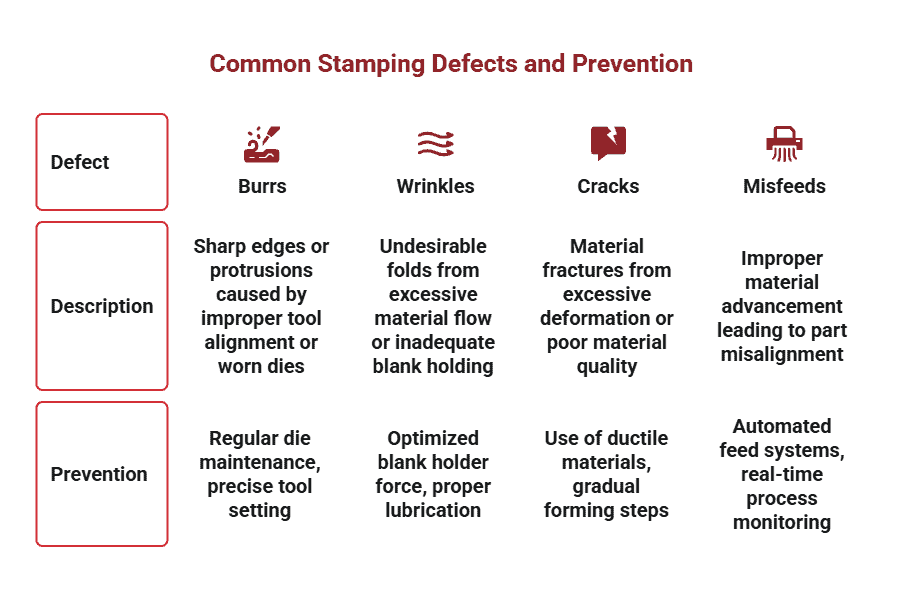
Rigorous process control, in-house tool & die development, and adherence to ISO 9001 and IATF 16949 standards are essential to defect mitigation. For detailed troubleshooting guidance, consult our stamping process.
Integrating advanced process monitoring systems and digital simulation tools — core elements of Industry 4.0 manufacturing — enables real-time detection and correction of process deviations. By digitally modeling the stamping process, potential issues such as springback, thinning, or excessive stress concentrations can be identified and resolved before tooling is finalized.
This proactive approach minimizes costly rework and ensures dimensional accuracy from the first production run. In addition, comprehensive documentation and traceability protocols, supported by ISO 14001 environmental management systems, further reduce the risk of nonconforming parts entering downstream assembly or customer supply chains.
For more information on quality control in stamping, see What quality control measures are commonly used during and after the metal stamping process?
How does the setup time and tooling cost for four-slide stamping compare to progressive die stamping?
Four-slide stamping offers significant advantages in tooling cost for certain applications. When considering what a four-slide is used for, it is important to note that four-slide machines are engineered for highly intricate, multi-bend components where rapid tool change and flexible production are critical. This makes four-slide stamping a preferred choice for custom small metal stampings, wire forms, and assemblies that require multiple forming operations in a single cycle. Conversely, progressive die stamping is more cost-efficient for extremely high-volume, single-plane parts due to its automation and speed.
For high-volume production of metal wire clips with intricate bends, four-slide stamping enables faster tooling changes and lower upfront costs, whereas a progressive die is preferred for flat, high-speed-stamped parts.
Keats Manufacturing’s ownership of one of the largest fleets of four-slide machines in North America, including unique Wünsch multi-slide machines, provides unmatched flexibility for custom small metal stampings and wire forms. This extensive equipment base allows for rapid scaling from prototype to full production, with tooling developed and maintained in-house under a lifetime guarantee. The result is minimized downtime, reduced total cost of ownership, and consistent part quality — even for highly complex geometries or when frequent design iterations are required.
What are the benefits of stamping?
The benefits of modern types of stamping process are far-reaching for high-volume, precision-driven industries:
High-speed, automated production reduces per-part costs, making stamping the most scalable solution for both standard and custom components.
Advanced stamping technologies routinely achieve tolerances as tight as ±0.0002 in. for stampings, supporting mission-critical applications such as electrical busbar system components and custom assemblies.
Stamping supports a wide range of metals, including copper, steel, and aluminum. Specialized products such as copper brackets for copper pipe are manufactured to exacting tolerances, ensuring reliable performance in demanding environments like HVAC and industrial piping.
Modern stamping processes enable the creation of complex forms and geometries, from intricate wire forms to multi-bend brackets to highly engineered parts found in an electrical busbar system. This flexibility supports rapid prototyping and iterative design, reducing time to market for new products.
Capable of producing up to 50 million parts with just-in-time delivery, stamping processes are engineered to support both prototype runs and sustained, high-volume production for industries such as automotive, electronics, and industrial controls.
Integrated secondary services, including plating, heat-treating, stress relieving, kitting, and automated screw insertion, streamline production and shorten lead times. This vertical integration delivers stamped parts ready for assembly, minimizing vendor handoffs. With advanced campuses in Illinois, Texas, and Mexico, Keats Manufacturing ensures just-in-time delivery and supply chain reliability across North America.
What factors should I consider when outsourcing four slide production to a service provider?
Key considerations include:
Evaluating which types of stamping processes best fit your application will impact tooling, production agility, and long-term scalability. For organizations that prioritize rapid prototyping, frequent design changes, or custom assemblies with complex geometries, understanding what a four-slide is used for can be a deciding factor in whether to invest in capital equipment or leverage an experienced manufacturing partner.
Outsourcing to a specialized partner gives you instant access to advanced manufacturing, expert engineering, and rigorous quality systems, without capital or maintenance burdens. This approach supports rapid scaling, design agility, and strict compliance. Choosing a provider with in-house tool & die development and a lifetime tooling guarantee ensures consistent quality and responsive support. Fully integrated prototyping, high-volume production, and secondary services streamline complexity and speed time to market.
Discover how four-slide stamping can streamline your manufacturing process with greater precision and efficiency. Whether you need custom small metal stampings, wire forms, or complex assemblies, a vertically integrated partner with advanced capabilities ensures your project’s success from concept through delivery.
Ready to find the right stamping process for your project?
Request a quote to discuss your requirements or receive a personalized quote from Keats Manufacturing. Visit keatsmfg.com or reach out to our engineering team directly.
What types of materials are best suited for four-slide stamping, and are there any limitations?
Comments Off on What types of materials are best suited for four-slide stamping, and are there any limitations?
Precision and versatility define the multi-axis forming process, making it a preferred choice for manufacturing intricate components at scale. The success of any project hinges on selecting raw stock that aligns with both application demands and process mechanics.
This article delves into the types of materials best suited for four-slide stamping and examines any limitations. We will examine how physical properties interact with machine parameters and tight manufacturing tolerances. For a comprehensive overview of our equipment capabilities, learn more about our Four-slide stamping machine systems, or explore our Four‑slide stamping resource.
Key Takeaways
- ›Four-slide stamping is compatible with a wide range of metals, including copper, bronze, aluminum, stainless steel, and specialty alloys.
- ›Material selection balances mechanical strength, ductility, and electrical conductivity with application-specific needs.
- ›Precise cam-driven slide synchronization successfully mitigates common stamping defects such as warping and springback.
- ›Advanced four-slide tooling achieves tolerances down to ±0.0002 in. for high-volume small stampings.
What materials are used for stamping?
Metal stamping leverages a diverse array of metals and alloys, each selected for its unique mechanical and physical properties:
Carbon, Stainless & Spring Steel — chosen for high tensile strength and long-term durability in automotive and industrial environments. Learn more about steel alloys in stamping.
Valued for exceptional conductivity, making it ideal for various copper terminal sizes in power distribution. See copper alloys for stamping.
Provide an excellent balance of corrosion resistance and low friction, making them ideal for structural connectors and bronze bushing material.
Highly formable, lightweight, and naturally corrosion-resistant. Explore aluminum alloys for stamping.
The primary attributes evaluated are ductility, yield strength, and conductivity. The U.S. Department of Energy’s Critical Materials Assessment confirms that aluminum, copper, and electrical steel remain the most strategically vital metals for high-volume manufacturing due to their combination of performance and production compatibility, which aligns directly with how Keats selects materials across its fleet.
For a broader look at the benefits and applications of metal stamping, see What are the benefits of metal stamping?
What are the stages of stamping?
The stamping process transforms raw metal strip or wire, including copper, bronze, aluminum, stainless steel, and specialty alloys, into finished components through a series of controlled operations:
Sheet metal forming encompasses bending, drawing, and multi-stage stamping operations that produce high-precision parts through controlled plastic deformation, with process control variables directly governing dimensional outcomes.
A specialized four-slide stamping machine enhances this sequence by replacing vertical presses with four horizontal slides. This configuration executes complex, multi-directional forming actions around a central mandrel in a single cycle, highly effective for fabricating parts like shelf brackets with minimal material scrap.
Advanced CAD/CAM and CNC technologies are integrated to optimize control. NIST’s Springback Predictability and Agile Precision Sheet Metal Stamping research demonstrates that finite element modeling of metal forming operations has significant potential for “decreasing the time and cost of these operations as well as allowing increased precision of the resulting parts,” the same engineering principle that guides Keats’ tool development.
For more on how different metal stamping techniques are applied in manufacturing, see Can you explain the different techniques involved in the metal stamping process?
Four-Slide Stamping Tolerance±0.0002 in.
Maintained across runs of up to 50 million units across three strategically located campuses.
What is the tolerance of metal stamping?
Tolerance refers to the allowable deviation from specified dimensions, ensuring component interchangeability, reliable assembly, and eliminating costly secondary rework. At Keats Manufacturing Co., four-slide stamping achieves tolerances as close as ±0.0002 in. For stamping demanding applications, such as the best aluminum wire clips, require these strict thresholds to ensure vibration-resistant fastening and electrical continuity. Factors influencing this precision include stock thickness, material springback, and active tool wear.
These high-precision tolerances are maintained across our three strategically located campuses in Illinois, Texas, and Mexico, using advanced optical inspection and in-house tool development backed by a lifetime guarantee. The International Organization for Standardization (ISO) specifies that adherence to ISO 9001 and IATF 16949 standards ensures full material traceability, rigorous process control, and repeatable product quality across runs of up to 50 million units.
For a deeper dive, visit the Precision metal stamping page.
What types of materials are best suited for four-slide stamping, and are there any limitations?
The multi-slide process is remarkably versatile, but certain alloys perform best because of their inherent formability. Copper excels in forming custom copper terminal sizes with excellent electrical continuity. Aluminum provides fast, lightweight throughput for clips, while copper alloys allow bronze bushing material to be formed into wear-resistant mechanical sleeves without fracturing.
Process Limitations & Challenges:

The Society of Manufacturing Engineers (SME) resource on Sheet Metal Stamping Dies & Processes notes that formability — i.e., the ability to undergo plastic deformation without tearing — is the primary variable analyzed during die design. By utilizing smart design-for-manufacturing (DFM) principles, Keats’ engineering team analyzes your material choice during early-stage prototyping and modifies tool timing to accommodate specific springback properties before production launch.
Conclusion
Selecting the optimal material for four-slide stamping is critical to ensuring part performance, production efficiency, and cost-effectiveness. Knowledge of which types of materials are best suited for four-slide stamping, and any limitations involved, empowers engineers to specify the right solutions for their unique requirements. Keats Manufacturing Co. combines decades of expertise, advanced in-house tooling, and a broad material portfolio to deliver custom small metal stampings, wire bends, clips, and assemblies at scale.
Discover how four-slide stamping can streamline your manufacturing process and deliver precision results for your next project. Ready to learn more or discuss your specific needs? Contact us to explore customized solutions and see how four-slide stamping can benefit your business.
Ready to find the right material for your four-slide stamping project?
Contact Keats Manufacturing to explore customized solutions and put our material expertise to work for you. Visit keatsmfg.com or reach out to our engineering team directly.
What are the advantages of stamping?
Comments Off on What are the advantages of stamping?
Manufacturers seeking to boost productivity and maintain high-quality standards are increasingly turning to metal stamping. This process has become a cornerstone for producing complex, high-precision parts at scale.
Here, we examine the advantages of stamping, exploring its role in modern industry, the engineering possibilities enabled by a specialized four-slide stamping machine, and how these advantages translate into manufacturing success. Gain insight into these benefits through our comprehensive Four‑slide stamping resource for guidance with your next project requirements.
Key Takeaways
- ›Metal stamping delivers high efficiency, cost-effectiveness, and precision for high-volume industrial applications.
- ›Key industries such as automotive, electronics, and appliances rely on stamping to produce complex components, including electrical bus bars and heavy-duty spring clips.
- ›Stamped components frequently surpass casting in surface finish and dimensional consistency, while offering superior cost efficiency over CNC machining in high-volume applications.
- ›Specialized four-slide tooling and expert design for manufacturing (DFM) principles successfully mitigate common material and geometric limitations.
Can you explain what types of products or industries typically use metal stamping the most?
Metal stamping is foundational to the production of countless components across a wide array of industries. Its scalability, repeatability, and ability to maintain precise tolerances make it the process of choice for sectors demanding both volume and accuracy.
Core industries relying on metal stamping include:
Stamped parts form the backbone of vehicle safety, electrical, and structural systems.
High-density connectors, shielding, and electrical bus bar components rely on stamping to ensure consistent conductivity.
Internal and external assemblies, including heavy-duty spring clips and brackets, are efficiently produced via stamping.
Mission-critical hardware requiring strict material traceability and tight tolerances.
At the heart of producing these complex, high-performance parts is the multi-axis forming process. For buyers asking what a four-slide machine is used in modern factories, it is a specialized piece of equipment designed to form intricate geometries with exceptional repeatability. Four-slide stamping machines, such as those operated at Keats Manufacturing Co., enable the efficient fabrication of challenging designs that would be cost-prohibitive using traditional methods.
With one of the largest fleets of four-slide and Wünsch multi-slide machines in North America, Keats Manufacturing Co. is positioned to deliver high-volume metal stampings. This equipment base supports rapid turnaround across three strategically located campuses in Illinois, Texas, and Mexico, facilitating just-in-time delivery for tier-1 suppliers.
What are the advantages of stamping?
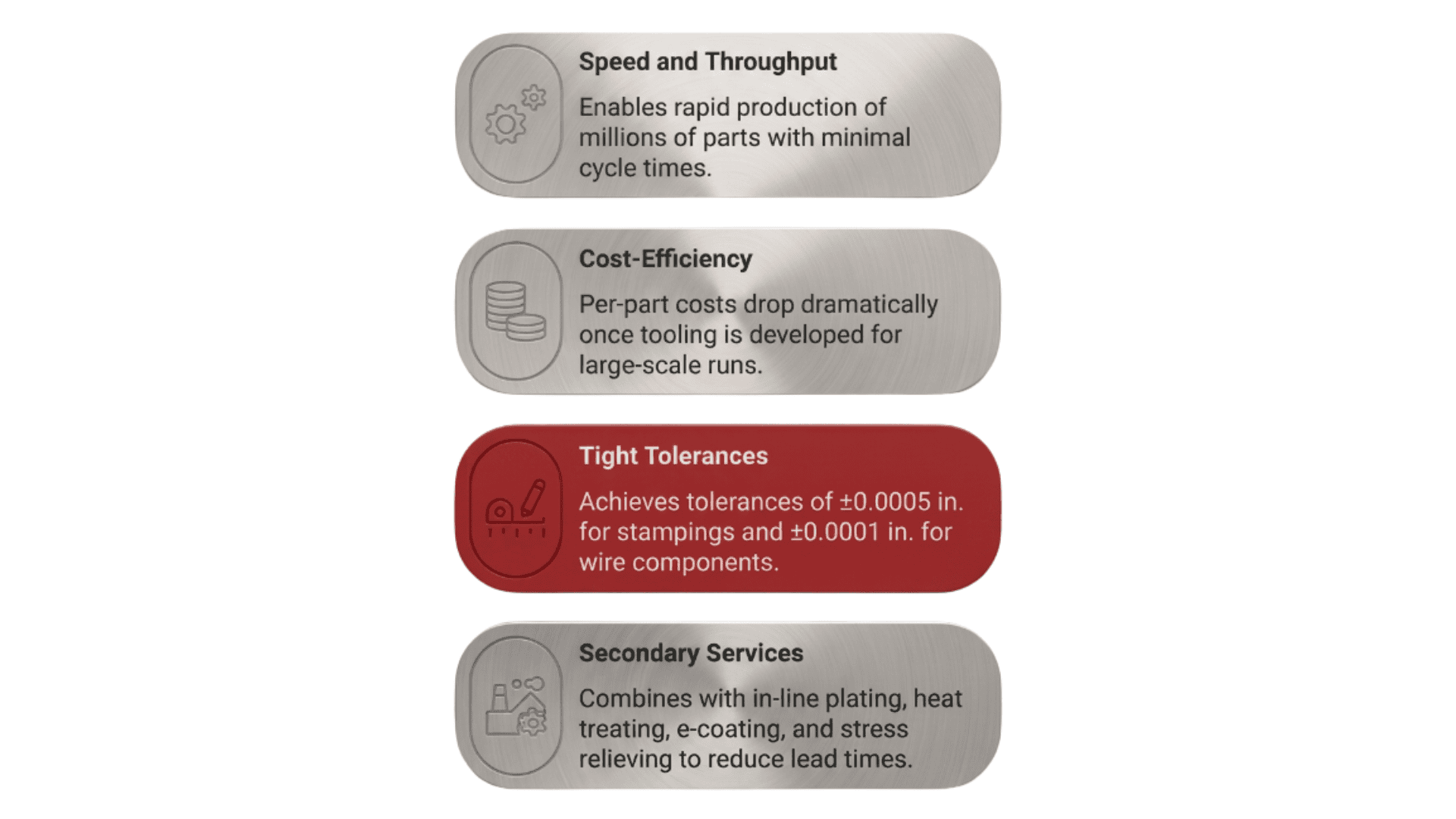
When evaluating the advantages of stamping, several critical benefits emerge for high-volume, quality-sensitive applications:
Stamping processes, particularly with progressive dies and four-slide machines, enable rapid production of millions of parts with minimal cycle times.
Once tooling is developed, per-part costs drop dramatically, making stamping ideal for large-scale runs.
Advanced tool & die capabilities at Keats achieve tolerances of ±0.0005 in. for stampings and ±0.0001 in. for wire bends and formed wire components.
Stamping can be combined with in-line plating, heat treating, e-coating, and stress relieving, thereby reducing overall lead times.
Research published in MDPI Materials confirms that “dimensional control in progressive stamping is critical to maintaining part quality, repeatability, and functional reliability in high-volume production” — a principle that applies equally to four-slide technology, where cam-driven synchronization governs those same process variables.
Real-world design-for-manufacturing examples clearly demonstrate these advantages. Consider a custom shield for an electronics enclosure: stamping enables the integration of mounting tabs, ventilation slots, and grounding contacts into a single part. This vertical manufacturing approach streamlines production, ensures long-term tooling value, and maintains full compliance with ISO 9001, ISO 14001, and IATF 16949 standards.
For a deeper dive into the specific benefits, see What are the benefits of metal stamping?, and Can you explain the different types of metal stamping processes used in manufacturing?
How does the quality of stamped parts compare to those made with other manufacturing processes like casting or CNC machining?
Stamped components frequently surpass alternatives produced by casting or CNC machining in surface finish, dimensional accuracy, and consistency depending on the specific application or end use. High-volume stamping ensures every part matches the original design, minimizing variation on automated assembly lines.
As documented in peer-reviewed research in MDPI Metals, stamped parts demonstrate “controllability and repeatability” as core process advantages, with “uniform strain distribution and good surface quality” distinguishing precision-formed components from those produced by alternative bulk or subtractive methods.
For instance, heavy-duty spring clips manufactured via stamping maintain consistent spring force and dimensional integrity across millions of cycles — performance levels difficult to match with casting due to porosity or CNC machining due to tool wear. While CNC machining offers greater flexibility for low-volume prototypes, stamping remains superior for structural and electrical scalability.
For more information on quality metrics, visit the Precision metal stamping page.
Are there any limitations or challenges associated with metal stamping that manufacturers should be aware of?
While metal stamping offers significant advantages, it is not without challenges:
- Material Constraints: Extremely hard or brittle metals may crack or wear tooling prematurely.
- Upfront Tooling Costs: Initial investment in tool & die development can be substantial, though mitigated by an in-house lifetime guarantee.
- Geometric Limits: Deep draws or complex undercuts require highly specialized machinery.
Advanced equipment, such as the four-slide machine, addresses many of these challenges by enabling the formation of intricate bends and multiple features in a single, highly controlled operation. High initial investment in die design and fabrication is most cost-effective when amortized over high-volume production runs. This reinforces the fact that stamping delivers its greatest cost and quality advantages specifically in the high-volume applications where Keats Manufacturing Co. specializes.
Applying smart design-for-manufacturing examples, such as optimizing part geometries for uniform material flow and specifying proper bend radii, helps prevent material thinning and reduces tooling wear. Partnering with an engineering team that offers integrated tool design ensures that these physical limitations are addressed before making a tooling investment.
Ready to put stamping’s advantages to work for your project?
Discover how four-slide stamping can streamline your manufacturing process and deliver precision results for your next project. Contact us to explore customized solutions and see how four-slide stamping can benefit your business.