

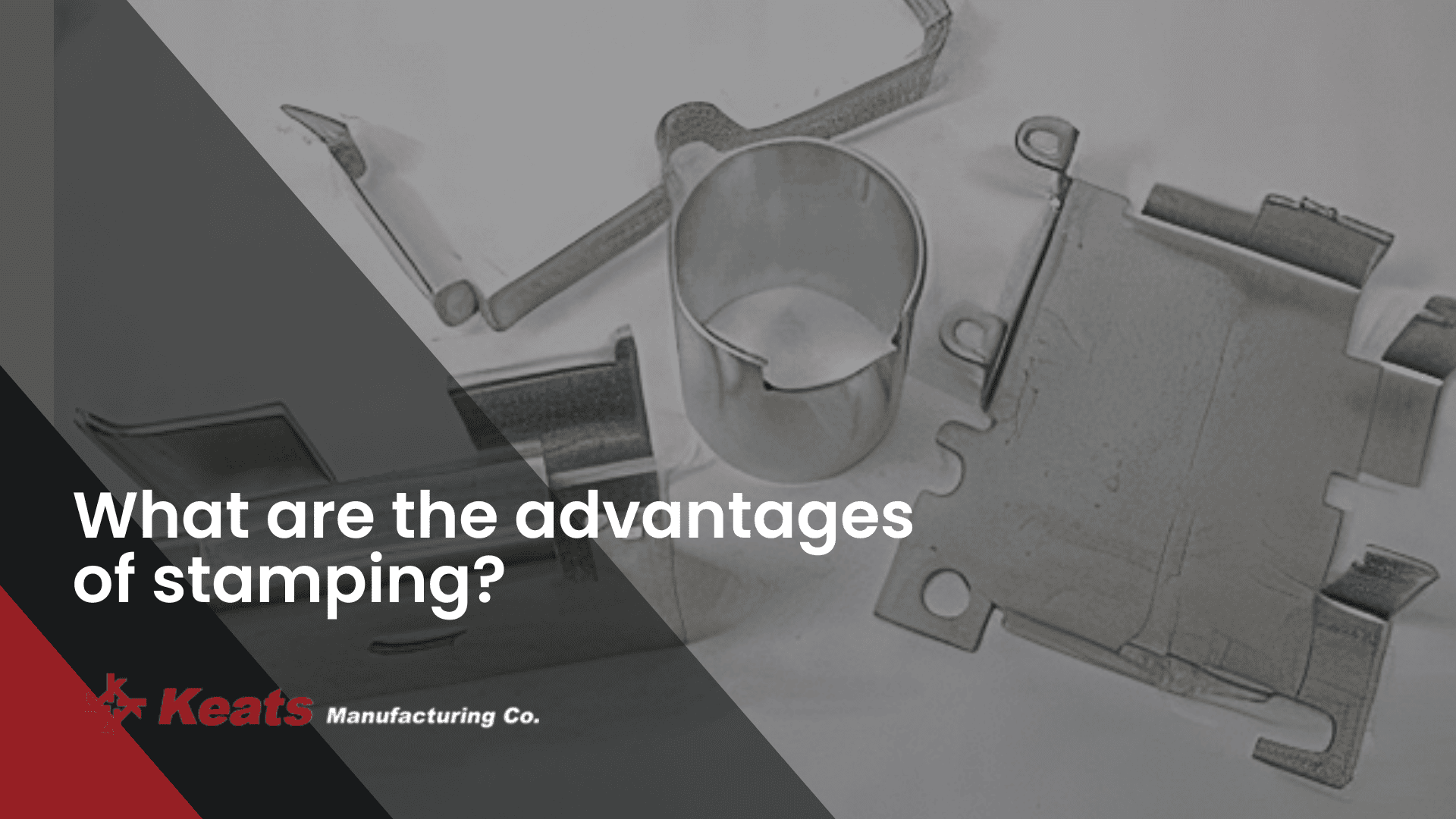
Manufacturers seeking to boost productivity and maintain high-quality standards are increasingly turning to metal stamping. This process has become a cornerstone for producing complex, high-precision parts at scale.
Here, we examine the advantages of stamping, exploring its role in modern industry, the engineering possibilities enabled by a specialized four-slide stamping machine, and how these advantages translate into manufacturing success. Gain insight into these benefits through our comprehensive Four‑slide stamping resource for guidance with your next project requirements.
Key Takeaways
- ›Metal stamping delivers high efficiency, cost-effectiveness, and precision for high-volume industrial applications.
- ›Key industries such as automotive, electronics, and appliances rely on stamping to produce complex components, including electrical bus bars and heavy-duty spring clips.
- ›Stamped components frequently surpass casting in surface finish and dimensional consistency, while offering superior cost efficiency over CNC machining in high-volume applications.
- ›Specialized four-slide tooling and expert design for manufacturing (DFM) principles successfully mitigate common material and geometric limitations.
Can you explain what types of products or industries typically use metal stamping the most?
Metal stamping is foundational to the production of countless components across a wide array of industries. Its scalability, repeatability, and ability to maintain precise tolerances make it the process of choice for sectors demanding both volume and accuracy.
Core industries relying on metal stamping include:
Stamped parts form the backbone of vehicle safety, electrical, and structural systems.
High-density connectors, shielding, and electrical bus bar components rely on stamping to ensure consistent conductivity.
Internal and external assemblies, including heavy-duty spring clips and brackets, are efficiently produced via stamping.
Mission-critical hardware requiring strict material traceability and tight tolerances.
At the heart of producing these complex, high-performance parts is the multi-axis forming process. For buyers asking what a four-slide machine is used in modern factories, it is a specialized piece of equipment designed to form intricate geometries with exceptional repeatability. Four-slide stamping machines, such as those operated at Keats Manufacturing Co., enable the efficient fabrication of challenging designs that would be cost-prohibitive using traditional methods.
With one of the largest fleets of four-slide and Wünsch multi-slide machines in North America, Keats Manufacturing Co. is positioned to deliver high-volume metal stampings. This equipment base supports rapid turnaround across three strategically located campuses in Illinois, Texas, and Mexico, facilitating just-in-time delivery for tier-1 suppliers.
What are the advantages of stamping?
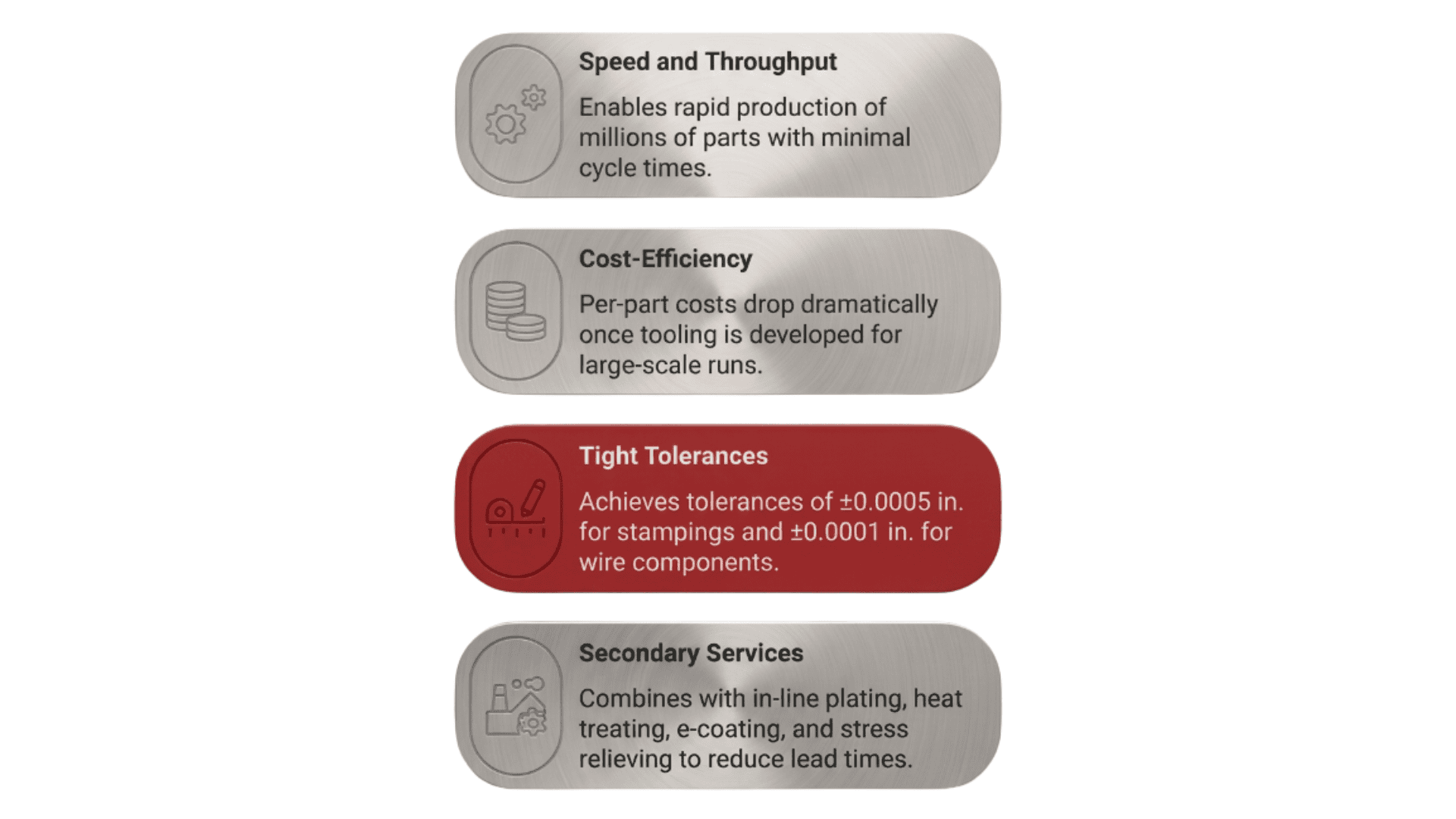
When evaluating the advantages of stamping, several critical benefits emerge for high-volume, quality-sensitive applications:
Stamping processes, particularly with progressive dies and four-slide machines, enable rapid production of millions of parts with minimal cycle times.
Once tooling is developed, per-part costs drop dramatically, making stamping ideal for large-scale runs.
Advanced tool & die capabilities at Keats achieve tolerances of ±0.0005 in. for stampings and ±0.0001 in. for wire bends and formed wire components.
Stamping can be combined with in-line plating, heat treating, e-coating, and stress relieving, thereby reducing overall lead times.
Research published in MDPI Materials confirms that “dimensional control in progressive stamping is critical to maintaining part quality, repeatability, and functional reliability in high-volume production” — a principle that applies equally to four-slide technology, where cam-driven synchronization governs those same process variables.
Real-world design-for-manufacturing examples clearly demonstrate these advantages. Consider a custom shield for an electronics enclosure: stamping enables the integration of mounting tabs, ventilation slots, and grounding contacts into a single part. This vertical manufacturing approach streamlines production, ensures long-term tooling value, and maintains full compliance with ISO 9001, ISO 14001, and IATF 16949 standards.
For a deeper dive into the specific benefits, see What are the benefits of metal stamping?, and Can you explain the different types of metal stamping processes used in manufacturing?
How does the quality of stamped parts compare to those made with other manufacturing processes like casting or CNC machining?
Stamped components frequently surpass alternatives produced by casting or CNC machining in surface finish, dimensional accuracy, and consistency depending on the specific application or end use. High-volume stamping ensures every part matches the original design, minimizing variation on automated assembly lines.
As documented in peer-reviewed research in MDPI Metals, stamped parts demonstrate “controllability and repeatability” as core process advantages, with “uniform strain distribution and good surface quality” distinguishing precision-formed components from those produced by alternative bulk or subtractive methods.
For instance, heavy-duty spring clips manufactured via stamping maintain consistent spring force and dimensional integrity across millions of cycles — performance levels difficult to match with casting due to porosity or CNC machining due to tool wear. While CNC machining offers greater flexibility for low-volume prototypes, stamping remains superior for structural and electrical scalability.
For more information on quality metrics, visit the Precision metal stamping page.
Are there any limitations or challenges associated with metal stamping that manufacturers should be aware of?
While metal stamping offers significant advantages, it is not without challenges:
- Material Constraints: Extremely hard or brittle metals may crack or wear tooling prematurely.
- Upfront Tooling Costs: Initial investment in tool & die development can be substantial, though mitigated by an in-house lifetime guarantee.
- Geometric Limits: Deep draws or complex undercuts require highly specialized machinery.
Advanced equipment, such as the four-slide machine, addresses many of these challenges by enabling the formation of intricate bends and multiple features in a single, highly controlled operation. High initial investment in die design and fabrication is most cost-effective when amortized over high-volume production runs. This reinforces the fact that stamping delivers its greatest cost and quality advantages specifically in the high-volume applications where Keats Manufacturing Co. specializes.
Applying smart design-for-manufacturing examples, such as optimizing part geometries for uniform material flow and specifying proper bend radii, helps prevent material thinning and reduces tooling wear. Partnering with an engineering team that offers integrated tool design ensures that these physical limitations are addressed before making a tooling investment.
Ready to put stamping’s advantages to work for your project?
Discover how four-slide stamping can streamline your manufacturing process and deliver precision results for your next project. Contact us to explore customized solutions and see how four-slide stamping can benefit your business.