

From intricate electrical connectors to custom brackets, manufacturers depend on advanced processes to achieve precision and efficiency at scale. Fourslide manufacturing excels in producing complex geometries and high-volume runs with exceptional accuracy.
For engineers and business leaders, understanding this process reveals new design opportunities and streamlines production. This article outlines the essentials, advantages, and key considerations of utilizing fourslide manufacturing for your next project.
Key Takeaways
- ›Fourslide manufacturing is a precision metal forming process ideal for producing complex, high-volume custom small metal stampings and wire forms.
- ›The fourslide machine uses synchronized slides to perform multiple operations in a single cycle, delivering exceptional accuracy and repeatability.
- ›This process accommodates a wide range of metals and alloys, offering tight tolerances (as precise as ±0.0002 in.) and efficient high-volume production.
- ›Compared to traditional stamping, fourslide manufacturing reduces tooling costs, streamlines secondary operations, and supports just-in-time delivery.
- ›A successful four-slide part design requires careful attention to bend radius and part complexity to maximize efficiency and manufacturability.
What is fourslide manufacturing?
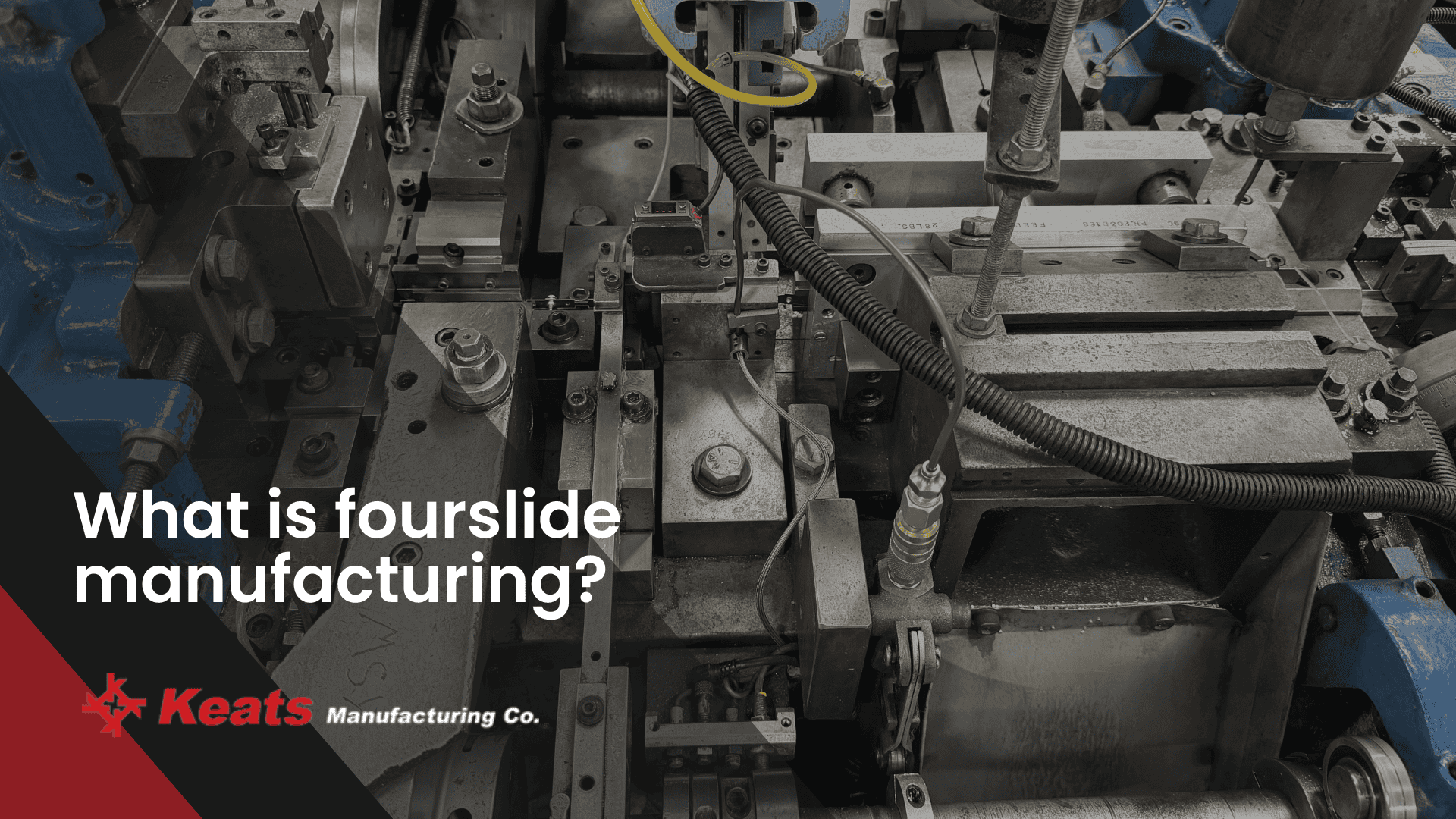
Fourslide manufacturing is a metal forming process designed to produce custom small metal stampings, wire forms, and assemblies with exceptional accuracy and repeatability. At its core, fourslide manufacturing employs a unique machine architecture that uses four synchronized slides, each equipped with its own tooling, to bend, cut, and shape metal stock from multiple directions within a single cycle.
Developed in the early 20th century to streamline complex wire forms and flat stampings, fourslide manufacturing has been in use by Keats Manufacturing Co. since 1958. Operating one of North America’s largest fleets of four‑slide and Wünsch multi‑slide machines, Keats delivers precision solutions for automotive, electrical, aerospace, and consumer electronics applications, including electrical terminals, custom shields, brackets, precision wire forms, and intricate small assemblies.
With locations in Illinois, Texas, and Mexico, Keats Manufacturing Co. delivers rapid, just-in-time production across North America. Our extensive fleet, including Nilson and Wunsch machines, enables flexible, high-volume output of complex custom assemblies with reliable on-schedule delivery.
For a closer look at the equipment behind this process, see the Four-slide stamping machine.
Industry-Leading Tolerance±0.0002 in.
Precision achievable with fourslide manufacturing across a wide range of metals and alloys.
What is the four-slide manufacturing process?
The fourslide machine is engineered for continuous, automated production of intricate metal parts. Its distinctive design sets it apart from conventional stamping presses and progressive die systems.
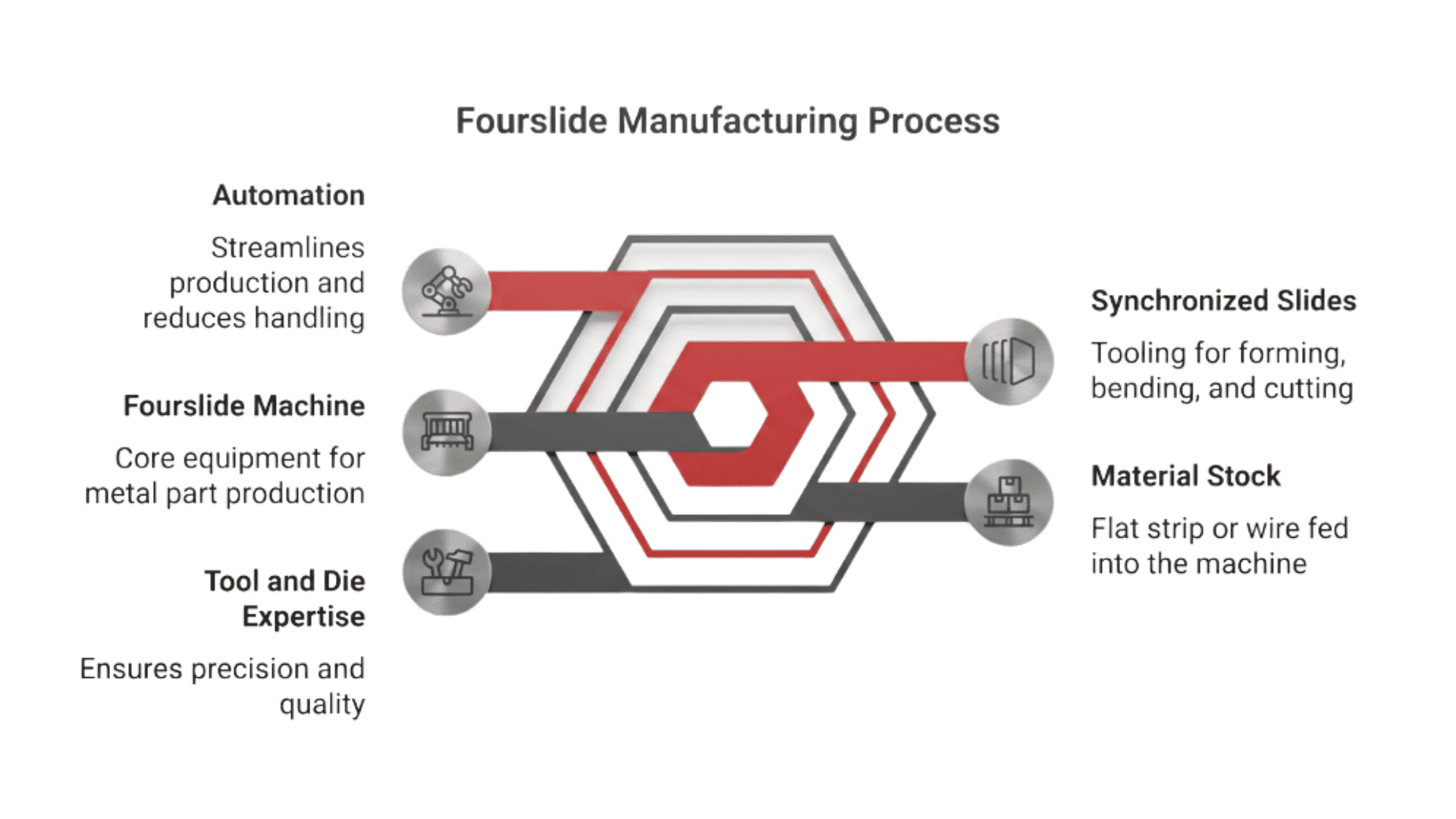
The process relies on synchronized horizontal slides, each fitted with custom tooling, to perform multiple forming, bending, and cutting operations in a single cycle. This precise coordination enables the efficient production of complex geometries with high repeatability and minimal handling. Engineered for speed and precision at scale, fourslide manufacturing integrates automation, in-house tool-and-die expertise, and advanced process controls to deliver consistent, high-quality parts in every run.
Fourslide manufacturing feeds flat strip or wire stock into the machine’s center, where four synchronized slides with custom tooling bend, cut, and shape material from multiple directions in a single pass. Finished parts are ejected automatically for continuous, efficient production.
Bending, punching, and forming completed in one run — no separate setups required.
Rapid prototyping and lifetime-guaranteed tools minimize downtime and accelerate delivery.
Streamlined integration of plating, heat-treating, and more within the production workflow.
Compared to traditional stamping, fourslide manufacturing reduces the need for multiple tools and secondary machine setups, streamlining the entire production workflow. Advanced CAD/CAM systems ensure precise, repeatable results. In-house tool and die development accelerates prototyping and provides lifetime-guaranteed tools, supporting consistent quality and minimizing downtime for demanding, fast-paced industries.
What types of materials can be used with fourslide manufacturing?
Fourslide manufacturing supports a broad spectrum of metals and alloys, allowing engineers to tailor material selection to the application’s demands. Common materials include:
stainless steel
(brass, phosphor bronze)
aluminum alloys
& bronze
demanding environments
Material selection directly impacts part performance, manufacturability, and cost. For example, stainless steel offers corrosion resistance for harsh environments, while copper provides excellent electrical conductivity for terminals and connectors.
Design engineers should consider:
- Ductility and formability of the chosen metal
- Required mechanical and electrical properties
- Surface finish and compatibility with secondary services (e.g., plating or heat-treating)
By leveraging in-house CAD/CAM capabilities, Keats Manufacturing Co. ensures optimal material performance and part integrity from prototype to high-volume production.
The process supports material thicknesses up to 0.090″ and widths up to 3.000″, enabling the production of both delicate and robust components for demanding sectors such as automotive, medical, and aerospace. Secondary services, such as zinc-plating, galvanization, black oxide, and chrome plating, further broaden the range of materials and finishes achievable.
How does the fourslide process impact production speed and efficiency compared to other methods?
Fourslide manufacturing delivers significant speed and efficiency advantages, especially for high-volume and complex parts. The four-slide machine’s ability to perform multiple forming and cutting operations in a single cycle eliminates the need for separate tooling setups and secondary handling.
Key efficiency benefits include:
- Reduced cycle times: Multiple bends and forms are completed simultaneously, not sequentially.
- Lower tooling costs: One set of slides can replace several progressive dies.
- Just-in-time delivery: High-volume capacity (up to 50 million parts) support lean manufacturing and inventory optimization.
In contrast, conventional stamping presses often require multiple dies, additional handling, and longer setup times, making them less efficient for parts with intricate geometries or that require frequent design changes.
Scenarios where fourslide manufacturing excels:
- Complex parts with multiple bends or cutouts
- High-volume production runs demand tight tolerances and repeatability
- Projects requiring quick design iterations
With production rates up to 10,000 pieces per hour, fourslide technology enables manufacturers to scale efficiently without compromising quality or delivery. Full compliance with ISO 9001, ISO 14001, and IATF 16949 ensures rigorous quality management and traceability, both of which are critical for regulated industries that require consistent documentation and process control. The International Organization for Standardization (ISO) notes that “adherence to ISO 9001 and related standards is a critical factor in ensuring product consistency and customer satisfaction in precision manufacturing.”
Are there any limitations or challenges associated with designing parts for fourslide manufacturing?
While four-slide manufacturing offers excellent speed, precision, and flexibility for many small metal components, it is not the best fit for every part design. Four-slide machines are typically best suited for smaller parts made from strip or wire stock that can be formed efficiently through a sequence of bends, cuts, and forms. Large parts, especially those made from material thicker than approximately 0.090″ or wider than approximately 3″, are often better suited for traditional progressive die stamping or other metal forming processes.
Common design constraints include:
Optimize the four-slide part design by engaging your manufacturing partner early to gather input on bend radii, material selection, and feature feasibility. Leverage CAD/CAM simulation to validate manufacturability and plan for integrated secondary operations like plating for maximum efficiency.
Keats Manufacturing Co. delivers in-house tool and die development with lifetime guarantees, optimizing your designs for quality, efficiency, and cost from the start. Early collaboration with our process engineers and use of digital modeling ensure challenges are addressed prior to tooling, supporting consistent quality and streamlined production.
Final Insights
Fourslide manufacturing is a proven solution for producing high-precision, high-volume custom small metal stampings, wire forms, and assemblies. By leveraging the unique capabilities of the fourslide machine, manufacturers can achieve complex geometries, tight tolerances, and rapid production speeds, all while maintaining strict quality and compliance standards.
Discover how four-slide stamping can streamline your manufacturing process and deliver precision results for your next project. Ready to learn more or discuss your specific needs? Contact us to explore customized solutions and see how four-slide stamping can benefit your business.
Ready to explore fourslide manufacturing for your next project?
Contact Keats Manufacturing to explore customized solutions and see how fourslide stamping can benefit your business. Visit keatsmfg.com or reach out to our engineering team directly.