

Achieving flawless metal stamping results requires more than advanced machinery; it demands rigorous, proactive quality control at every stage. For organizations that depend on high-precision components, understanding the quality measures used during and after stamping is essential when selecting a manufacturing partner.
This article details how Keats Manufacturing Co. ensures defect-free custom small metal stampings, wire forms, and assemblies at scale by implementing industry-leading quality protocols. It further outlines the core steps of quality control and examines specialized inspection and finishing strategies.
Key Takeaways
- ›Robust quality control in metal stamping is essential to ensure precision, reliability, and consistent high-volume production, especially for critical industrial applications.
- ›Leading metal stamping companies integrate advanced inspection, testing, and documentation throughout every stage of the stamping process.
- ›Common stamping defects are proactively identified and prevented with sophisticated measurement technologies and in-house tool & die expertise.
- ›Industry-specific requirements, such as those in the automotive or aerospace industries, drive the selection of specialized metal-finishing and quality-control protocols.
- ›Proximity to advanced four-slide stamping capabilities can significantly enhance both process efficiency and quality outcomes.
What is a metal stamping company?
A metal stamping company is a specialized manufacturer that transforms raw metal into precision-engineered components using high-speed presses and dies. These firms serve as critical partners to industries such as automotive, aerospace, electronics, and medical devices, delivering components that meet exacting standards for form, fit, and function.
At the core of every reputable metal stamping company is a commitment to the metal stamping process, which encompasses a series of precise, engineered steps designed to convert raw material into high-performance components. This process is driven by advanced technology, in-house tool-and-die expertise, and rigorous quality control protocols, ensuring that each part meets demanding specifications for critical industrial and engineering applications.
Typical services provided by a metal stamping company include:
- Custom small metal stampings: Engineered parts produced to tight tolerances (as fine as ±0.0002 in. for stampings)
- Wire forms and assemblies: Complex shapes and integrated assemblies, often produced with advanced four-slide and multi-slide equipment.
- In-house tool and die development: Custom tooling designed and maintained for the life of each part, ensuring repeatable accuracy.
- Secondary services: Integrated plating, heat treating, stress relieving, kitting, and screw insertion, for streamlined supply chains.
Quality control is at the core of every reputable metal stamping process. Companies like Keats Manufacturing Co. maintain ISO 9001, ISO 14001, and IATF 16949 certifications, demonstrating a rigorous commitment to quality management and traceability throughout the production lifecycle.
Tolerance Precision Achieved±0.0002 in.
Maintained across high-volume runs of up to 50 million parts, from first to last unit.
A key differentiator is the ownership and operation of one of the largest fleets of four-slide machines in North America, including unique Wünsch multi-slide machines. This extensive equipment base enables manufacturers to execute highly complex forming operations with exceptional repeatability and process control. The ability to maintain high-precision tolerances down to ±0.0002 inches for stampings ensures that even the most demanding applications in electronics, automotive, and aerospace are consistently met.
What are the five steps of quality control?
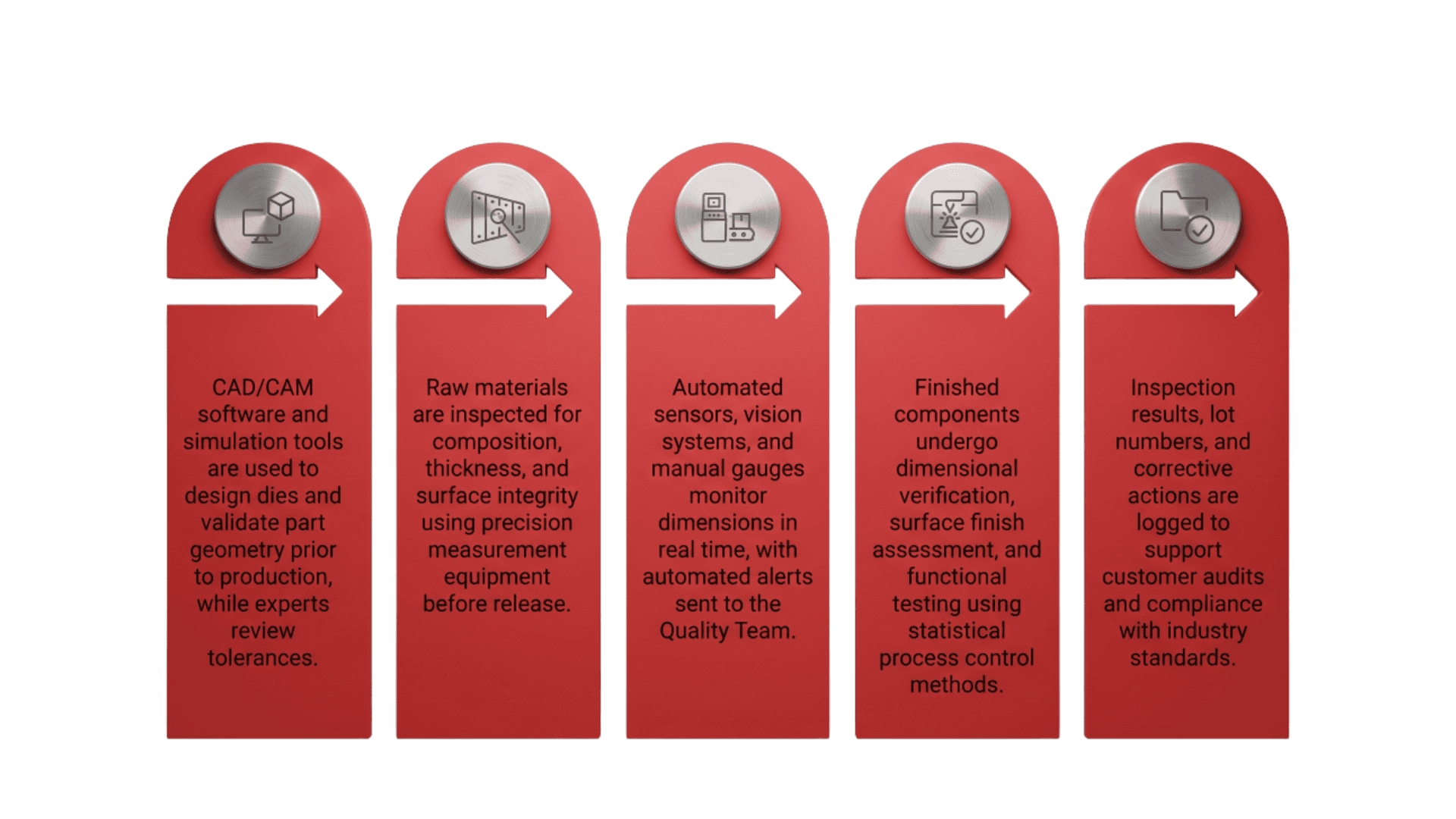
Effective quality control in metal stamping is a structured, stepwise process designed to prevent defects and ensure every part meets specifications. The stamping process, step by step, integrates these key quality control stages:
Design and tool validation
- CAD/CAM software and simulation tools are used to design dies and validate part geometry prior to production.
- In-house tool and die experts review tolerances and performance to ensure tools meet project requirements.
Incoming material inspection
- Raw materials are inspected for composition, thickness, and surface integrity using precision measurement equipment.
- Only materials that meet strict specifications are released to the production floor.
In-process inspection and monitoring
- During the metal stamping process, automated sensors, vision systems, and manual gauges monitor critical dimensions in real time.
- Operators perform regular spot checks to verify part consistency and machine calibration.
- Paper-free inspection process as all inspection gauges are connected to the Inspection Mobile platform.
- Real-time automated emails are sent to the Quality Team and Plant Manager to alert all when a series of points are consistently increasing or decreasing over time, suggesting a gradual change in process conditions.
Post-production inspection
- Finished components undergo dimensional verification, surface finish assessment, and functional testing.
- Statistical process control (SPC) methods are applied to detect trends or deviations before parts reach final packaging.
Documentation and traceability
- All inspection results, lot numbers, and corrective actions are logged for full traceability.
- Quality documentation supports customer audits and compliance with industry standards (ISO, IATF, VDA, Mil-Spec).
By following this structured approach, manufacturers can catch issues early, minimize rework, and maintain a zero-defect culture.
The integration of simulation technology during the design and engineering phases further enhances quality control. By leveraging advanced modeling and virtual compensation strategies, manufacturers can predict and correct potential issues such as springback, thinning, or surface imperfections before production begins. This proactive approach reduces the need for multiple tooling correction cycles and ensures a more consistent match between the engineering model and the final stamped part.
What quality control measures are commonly used during and after the metal stamping process?
A robust quality assurance program is essential to delivering reliable, high-precision stamped components. The most effective measures used during and after the metal stamping process include:
Common stamping defects, such as burrs, warping, incomplete forming, or surface scratches, are systematically identified and prevented through:
- In-house tool and die maintenance (guaranteed for the lifetime of the part)
- Proactive die sharpening and alignment
- Use of advanced multi-slide and four-slide equipment to reduce process variability
For further technical details on defect types and their prevention, consult resources such as the Precision Metalforming Association (PMA) or ASM International’s guidelines on sheet metal forming defects.
The strategic deployment of production monitoring systems at each Keats facility enables real-time adjustments to process parameters, material characteristics, and feed rates. These systems are designed to adapt to day-to-day variations, ensuring that high-volume runs of up to 50 million parts maintain consistent quality from the first to the last unit. Additionally, the presence of three state-of-the-art, company-owned locations in Illinois, Texas, and Mexico enables localized quality oversight and faster responses to customer requirements, further minimizing risk and maximizing reliability.
Are there specific industries or applications where one type of metal finishing is preferred over the others?
Industry requirements often dictate the choice of metal finishing after stamping, directly impacting both performance and quality control. For example:
Demands robust corrosion resistance and durability, favoring zinc plating, e-coating, or heat-treating for safety-critical components.
Requires tight tolerances and lightweight finishes, with a preference for anodizing, chromate conversion coating, or specialized coatings to meet AS9100 and regulatory standards.
Prioritizes conductivity and surface smoothness, making selective plating and stress relief essential for electrical terminals and contacts.
For companies evaluating finishing options, integrating finishing with the metal stamping process is a key differentiator. Tight control of finishing within the same facility enhances traceability, reduces handling risks, and enables immediate post-stamping quality checks. This is particularly valuable for industries where regulatory compliance, part cleanliness, and precise dimensional accuracy are non-negotiable.
Additionally, advanced processes like metal four-slide stamping offer unique advantages for complex geometries and high-volume runs. For procurement professionals and engineers searching for metal four-slide stamping near me, having proximity to a supplier with in-house four-slide capabilities can significantly reduce lead times, improve communication, and enhance quality control through on-site inspection and rapid iteration. The ability to partner locally for both metal stamping and finishing ensures that specifications are met without compromise and that adjustments can be implemented swiftly, critical for industries with tight product launch windows or ongoing engineering changes.
The integration of secondary services, such as plating, heat treating, and stress relieving within the same facility further streamlines the quality assurance process. This vertical integration minimizes the risk of handling damage, ensures better process control, and provides a single point of accountability for the finished product’s performance. For sectors with stringent regulatory or environmental requirements, full compliance with ISO 14001 and IATF 16949 further demonstrates a commitment to both product quality and sustainable manufacturing practices.
To learn more about the advantages of stamping, visit What are the advantages of stamping?
Conclusion
Quality control in metal stamping is not a single checkpoint but a continuous, integrated discipline spanning design, materials, production, and finishing. Partnering with a manufacturer that combines state-of-the-art equipment, in-house expertise, and rigorous process controls secures the precision, reliability, and scalability your applications demand.
Discover how four-slide stamping can streamline your manufacturing process and deliver precision results for your next project. Ready to learn more or discuss your specific needs? Contact us to explore customized solutions and see how four-slide stamping can benefit your business.
Ready to elevate your quality control standards?
Contact Keats Manufacturing to explore customized solutions and see how four-slide stamping can benefit your business. Visit keatsmfg.com or reach out to our engineering team directly.