

Precision and speed are at the heart of modern metal component manufacturing. The four-slide machine stands out as the preferred platform for companies needing intricate, high-volume parts. Since 1958, Keats Manufacturing Co. has harnessed the power of advanced four-slide technology to deliver custom solutions with exceptional accuracy and efficiency.
This article answers the essential question: “How does a 4-slide machine work?” For a deeper dive, visit our Four-slide stamping machine page or explore our Four‑slide stamping resource.
Key Takeaways
- ›Four-slide machines deliver unmatched efficiency and precision for high-volume custom metal stamping and forming.
- ›Simultaneous multi-directional forming enables complex geometries and tight tolerances that are not achievable with traditional presses.
- ›Four-slide stamping is ideal for producing small, intricate parts such as clips, brackets, and electrical terminals at scale.
- ›Setup and tooling for four-slide machines require specialized expertise but enable rapid, repeatable production with minimal waste.
- ›Material and geometric limitations exist, but four-slide technology remains a cornerstone for industries demanding high-precision, custom solutions.
What is a four-slide machine used for stamping?
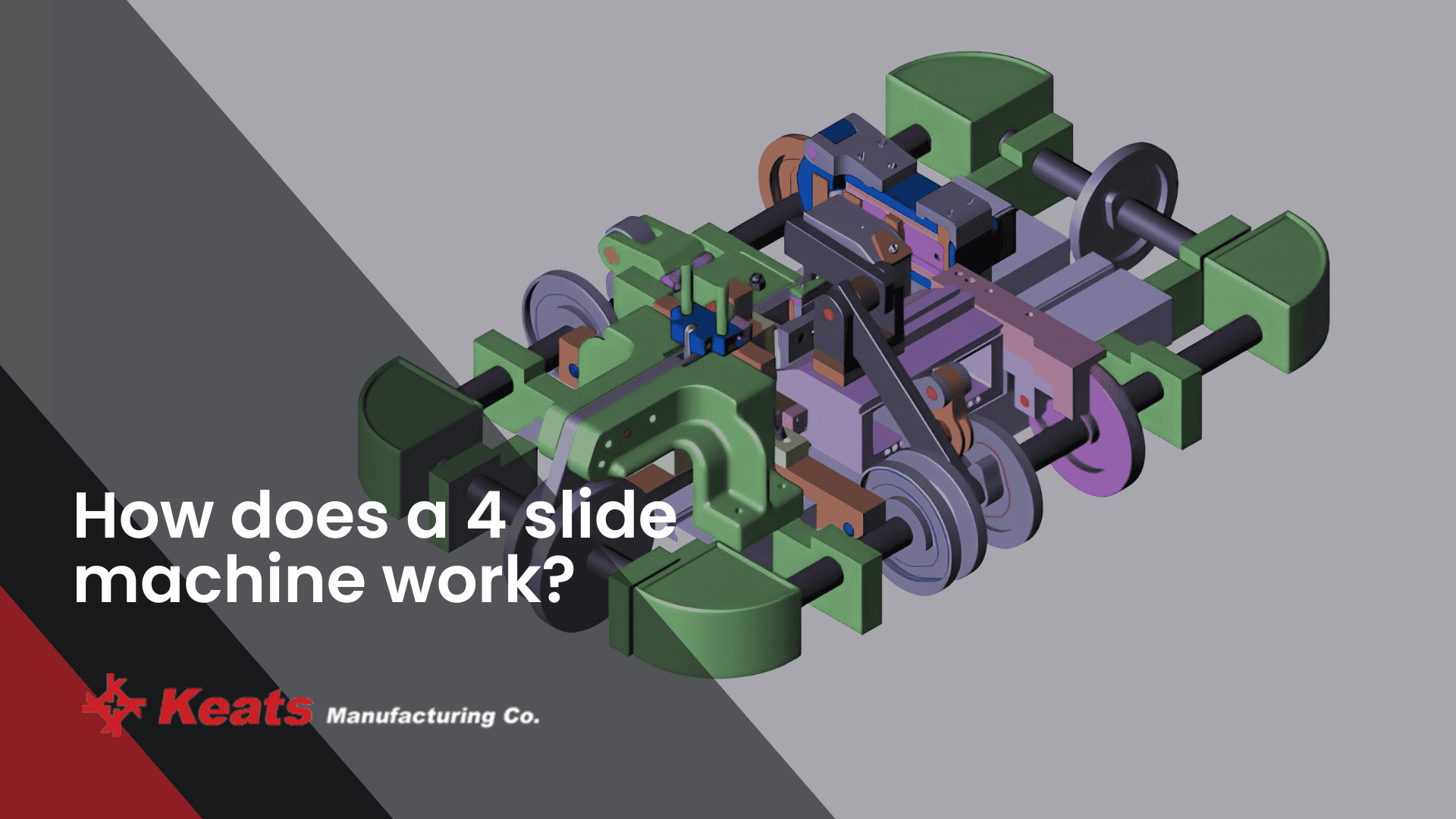
A four-slide machine, also known as a multi-slide or four-slide press, is a specialized metalworking platform engineered for high-speed, high-precision forming and stamping of small metal parts. Unlike conventional presses that use a single vertical ram, the four-slide machine features four synchronized slides approaching the workpiece from perpendicular directions simultaneously or in rapid sequence, performing multiple forming, bending, and cutting operations in a single continuous cycle.
Advantages over other methods:
Multiple operations are performed in one pass, reducing cycle times and labor costs.
Capable of achieving tolerances as tight as ±0.0002 in. for stampings components.
Minimal scrap due to precise forming. Raw material can often be purchased to the exact width of the part, resulting in 90%+ material utilization.
Supports a wide range of custom small metal stampings, wire bends, clips, and assemblies.
Keats Manufacturing operates one of the largest fleets of four-slide machines in North America, including unique Wünsch multi-slide machines, expanding the range of achievable part geometries well beyond what standard four-slide platforms offer.
For more information on the advantages of this process, see What are the advantages of stamping.
How does a 4-slide machine work?
The four-slide machine’s efficiency lies in its cam-driven mechanical configuration:
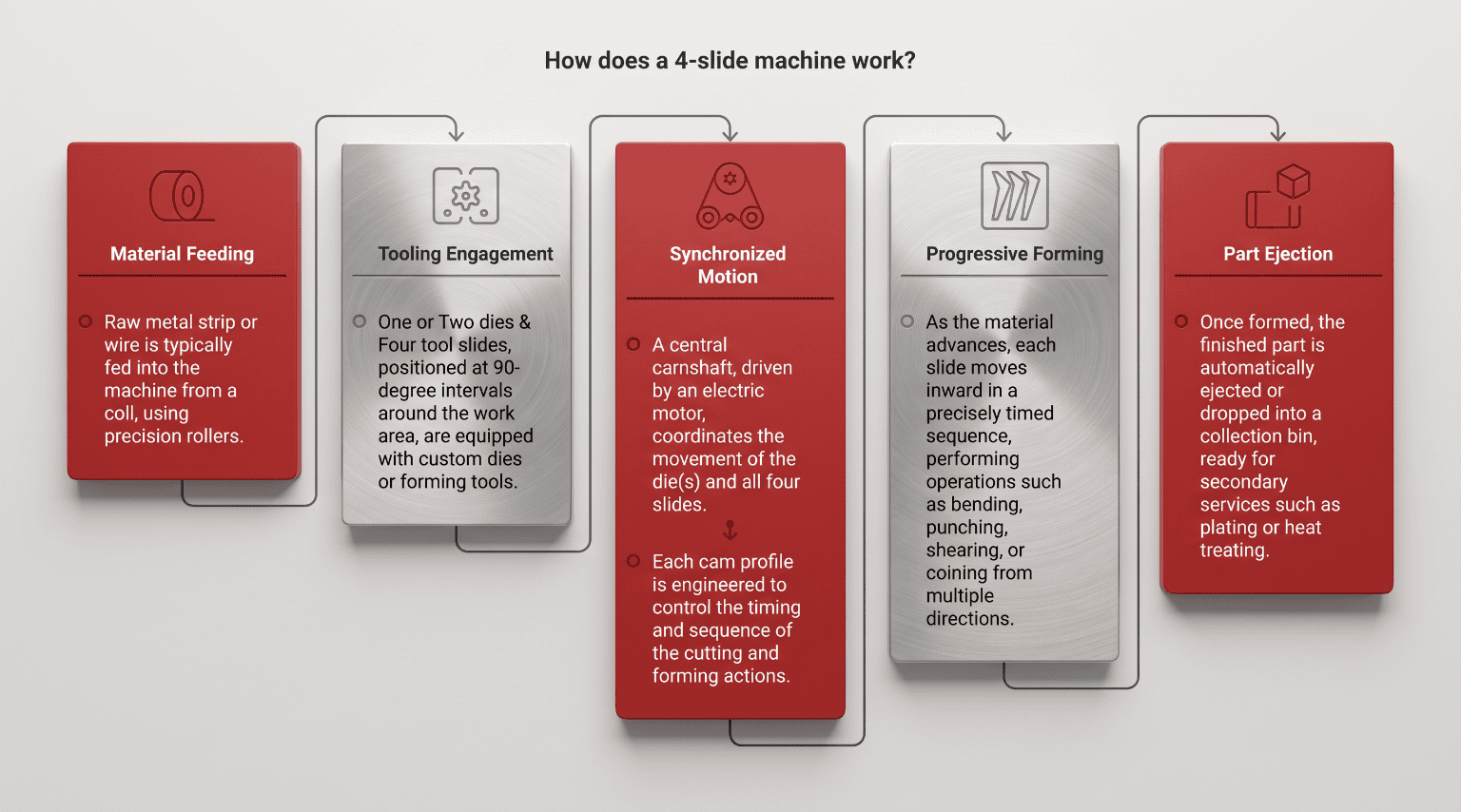
This continuous process can produce up to 15,000 pieces per hour and scale to 50 million parts. At Keats’ campuses in Illinois, Texas, and Mexico, in-house tool-and-die teams using CAD/CAM, EDM, and CNC develop and maintain all tooling, with a lifetime guarantee.
To understand how four-slide stamping compares with other methods, see Can you explain the different types of metal stamping processes used in manufacturing?
What types of parts or products are most commonly made using a 4-slide machine?
The four-slide machine is the preferred platform for the following product categories, serving automotive, electronics, aerospace, medical device, and industrial equipment sectors:
Keats manages the secondary service supply chain to ensure parts receive the proper plating, heat-treating, e-coating, stress-relieving, kitting, and screw insertion. Keats delivers fully finished assemblies ready for direct integration. For companies searching for ‘custom metal four-slide stamping near me’, Keats’ three strategically located campuses provide regional access to engineering consultation and full-scale production.
For more on how precision is achieved in these components, see What is Precision Metal Stamping.
How does the setup process for a 4-slide machine differ from other metalworking machines?
Four-slide setup differs from conventional presses in three key ways:
- Custom in-house toolingEach of the four slides requires custom in-house tooling developed via CAD/CAM, EDM, and CNC. Four-slide tooling often integrates a small progressive die section to pierce or blank the strip before the four horizontal slides execute the final forming around a mandrel.
- Specialized hands-on expertiseWhile tooling is engineered using digital CAD/CAM and precision CNC/EDM, the four-slide machines themselves are mechanically synchronized via custom cam profiles and linkage geometry, requiring specialized hands-on expertise from experienced technicians during setup.
- Verified cam timing and synchronizationPrecise cam timing and slide synchronization must be verified through controlled test runs before production launch. Investing in machine optimization and targeted operator training has been shown to reduce setup times while achieving higher precision on complex parts.
At Keats, full compliance with ISO 9001, ISO 14001, and IATF 16949 ensures every setup is documented, traceable, and repeatable. For a visual reference, consult our metal stamping process flow chart for an overview of the stages and setup considerations unique to four-slide operations.
Are there any limitations to the shapes or materials that a 4-slide machine can handle?
As NIST research on manufacturing processes and material selection confirms, matching the process to the part geometry at the conceptual design stage is the most effective way to control costs and guarantee manufacturability. For buyers searching for ‘custom metal four-slide stamping near me’, Keats’ engineering team provides early-stage design consultation to evaluate feasibility before any tooling investment is made.
Ready to see how four-slide stamping can work for your project?
Discover how four-slide stamping can streamline your manufacturing process and deliver precision results for your next project. Contact us to explore customized solutions and see how four-slide stamping can benefit your business.