


From intricate electrical terminals to robust spring clips, four-slide stamping enables manufacturers to produce complex metal components at remarkable speed and precision. For companies aiming to streamline their production lines and maintain a competitive edge, recognizing the variables that influence four-slide machine performance is vital.
This article examines the essential factors – ranging from material selection and tooling to finishing techniques and process optimization – that shape the speed and efficiency of four-slide stamping, to aid in making strategic decisions for your manufacturing needs.
Key Takeaways
- ›Four-slide stamping offers unmatched speed and flexibility for producing complex, high-volume precision metal components.
- ›Material selection, tooling design, and machine maintenance are primary drivers of production speed and efficiency.
- ›Four-slide stamping often offers lower costs and faster turnaround than progressive die stamping for suitable part geometries.
- ›Strategic process optimization and manufacturer expertise are essential for maximizing four-slide machine throughput and quality.
What is four-slide stamping, and how does the process work?
Four-slide stamping is a highly specialized metal stamping process that utilizes a unique machine design to produce complex, small metal stampings and wire forms with exceptional precision and repeatability. Unlike traditional punch presses, four-slide machines (sometimes referred to as “multi-slide” machines) feature synchronized slides arranged at right angles around the workpiece. Each slide is equipped with tooling that can bend, cut, punch, or form the material from multiple directions in a single cycle.
Basic operation of four-slide machines:
- Coiled or strip metal is automatically fed into the machine.
- Four independent slides, driven by a central camshaft, move tooling horizontally to form the part.
- Multiple operations (bending, forming, shearing) occur simultaneously or in rapid sequence.
- Finished parts are ejected, and the cycle repeats at high speed.
Unique features of four-slide stamping compared to other metal forming processes:
- High production speeds (thousands of parts per hour)
- Ability to perform multiple operations in one setup
- Exceptional precision (tolerances up to ±0.0002 in.)
- Cost-effective for high-volume, complex geometries
- In-house tool and die development, as practiced by Keats Manufacturing Co., ensures lifetime tooling guarantees and rapid prototyping
State-of-the-art four-slide machines, including Keats’ Nilson and US Baird models, are engineered for both speed and flexibility. These machines accommodate a range of raw material sizes, with feed lengths up to 15.000″, supporting both prototyping and high-volume runs exceeding 50 million parts. The unique Wünsch multi-slide machines further extend the range of part complexity and throughput, enabling simultaneous forming operations across multiple axes.
What are the main uses or applications for each type of metal?
Four-slide stamping is highly versatile, enabling the production of a wide range of precision metal components across industries. The following are the key product applications where this process excels, each matched to the metals best suited for its performance requirements.
Brackets
Custom metal brackets are among the most common four-slide stampings, used in automotive systems (ABS brakes, airbag assemblies, instrument panels), appliances, and electrical distribution equipment. They are typically produced from steel, aluminum, or stainless steel, with material choice driven by the required strength, weight, and corrosion resistance. Keats Manufacturing handles bracket orders of up to 50 million parts and offers barrel and rack plating to ensure long-term durability.
Electrical Terminals
Terminals require precise geometries and reliable conductivity, making four-slide stamping the ideal process. Phosphor-bronze is widely used for high-reliability automotive terminals (steering position sensors and lighting systems), while General Copper alloys are used in appliance timer controls. Beryllium Copper (C17200) is reserved for high-precision spring contacts in hearing aids, medical devices, and aerospace applications. Keats produces terminals to tolerances of ±0.0002 in., meeting IATF 16949 and ISO 9001 standards.
Metal Bushings
Bushings are cylindrical components that reduce friction, limit torque and support rotational or sliding motion in mechanical assemblies. Four-slide stamping produces bushings with tight tolerances and full material traceability. Aluminum & Cold Rolled steel are the most common materials used for bushings. Stainless steel variants are used where corrosion resistance is critical. Industries served include automotive, medical, and precision mechanical systems.
Metal Clips
Spring clips and retaining clips benefit from the high-speed, material-efficient nature of four-slide stamping. Stainless steel (301/302) with “½ hard” temper is the standard choice for flat spring clips, providing the spring-back force needed for secure retention. Four-slide technology eliminates the need for a carrier strip, reducing material costs by up to 35% compared to progressive die stamping, a significant advantage for high-volume clip production across appliance, automotive, and electronics applications.
Bus Bars
Bus bars are conductive components used in power distribution units to distribute electrical current across circuits. C110 Copper is the material of choice due to its excellent electrical conductivity and suitability for high-current applications. These include power distribution units for electric vehicles (EVs), construction equipment, and industrial electrical systems. While most busbars are made from traditional progressive die stamping, Four-slide stamping allows busbars to be formed with complex geometries while maintaining tight tolerances on conductivity and dimensions.
Lead Frames
Lead frames are structural elements in electronic packages that connect semiconductor chips to external circuits. They demand extreme dimensional accuracy and consistent surface quality. General Copper alloys are commonly used for standard lead frames in consumer electronics and appliance controls, while Phosphor Bronze or specialty copper alloys may be selected when spring properties or higher fatigue resistance are required. In-house CAD/CAM tooling at Keats ensures the precision required for high-volume lead frame production.
Shields
Metal shields protect sensitive electronic components from electromagnetic interference (EMI) and heat. Cold Rolled Steel (1008/1010) is widely used for fuel-injection shields in automotive engines, while Galvanized Steel provides corrosion protection for carbon-steel pins and light-gauge components. Four-slide and multi-slide technology (including Wunsch machines) enables shields to be formed through simultaneous operations across multiple axes, meeting complex geometry and tight-fit requirements for automotive, electronics, and industrial applications.
Across all these applications, material selection must align with the required mechanical properties, desired finish, tolerance requirements, and application-specific standards (ISO 9001, IATF 16949, Mil-Spec). Keats Manufacturing’s in-house CAD/CAM engineering, toolmaking, and advanced simulation tools ensure optimal part accuracy and manufacturability across every product type.
How do the different metal finishing techniques affect the durability and lifespan of the finished product?
Metal finishing and material selection enhance a product’s lifespan by protecting it against environmental and mechanical stress:
Coatings such as zinc plating, galvanization, and black oxide are applied to carbon steel to provide essential rust protection. Alternatively, using 304 or 316 stainless steel provides inherent corrosion resistance in high-moisture environments.
Components such as custom bushings are designed to cushion movement and reduce friction, extending the service life of mechanical assemblies. Chrome plating is also utilized to improve the surface durability of wireforms.
Tin plating is often used on copper, brass, and other conductive materials to improve corrosion resistance, solderability, and long-term electrical performance. It is especially valuable for electrical terminals, contacts, and connectors where consistent conductivity and protection from oxidation are important. Tin plating can also help reduce contact resistance and improve the reliability of components used in automotive, electronics, and power distribution applications.
Replacing plastic components with metal clips helps prevent parts from failing under high heat. Additionally, super-tight tolerance manufacturing prevents minor defects that could lead to catastrophic failure in critical aerospace or medical applications.
Precious metal plating, such as silver, gold, palladium, or nickel underplating, is often used when parts require superior conductivity, corrosion resistance, solderability, or long-term contact reliability. These finishes are especially important for electrical contacts, battery components, medical devices, and high-performance connector applications where even small increases in resistance or surface oxidation can affect performance. While precious metal plating adds cost, it can significantly improve durability and reliability in demanding environments.
The choice and sequence of finishing techniques directly influence product durability, corrosion resistance, and service life, especially in demanding applications such as automotive, aerospace, and medical devices. Keat’s practice of integrating these secondary services in-house streamlines production and ensures quality control at every stage.
Secondary services, including plating, heat treating, stress relieving, and e-coating, are outsourced and managed by Keats. All of Keats’ approved suppliers meet stringent ISO 9001 and IATF 16949 quality standards. The result is a finished product with enhanced durability and consistent performance, even in the most challenging operating environments.
Can you explain the main factors that affect the speed and efficiency of four-slide machines in production?
This is a critical question for manufacturers seeking to optimize throughput and reduce costs. The primary factors include:
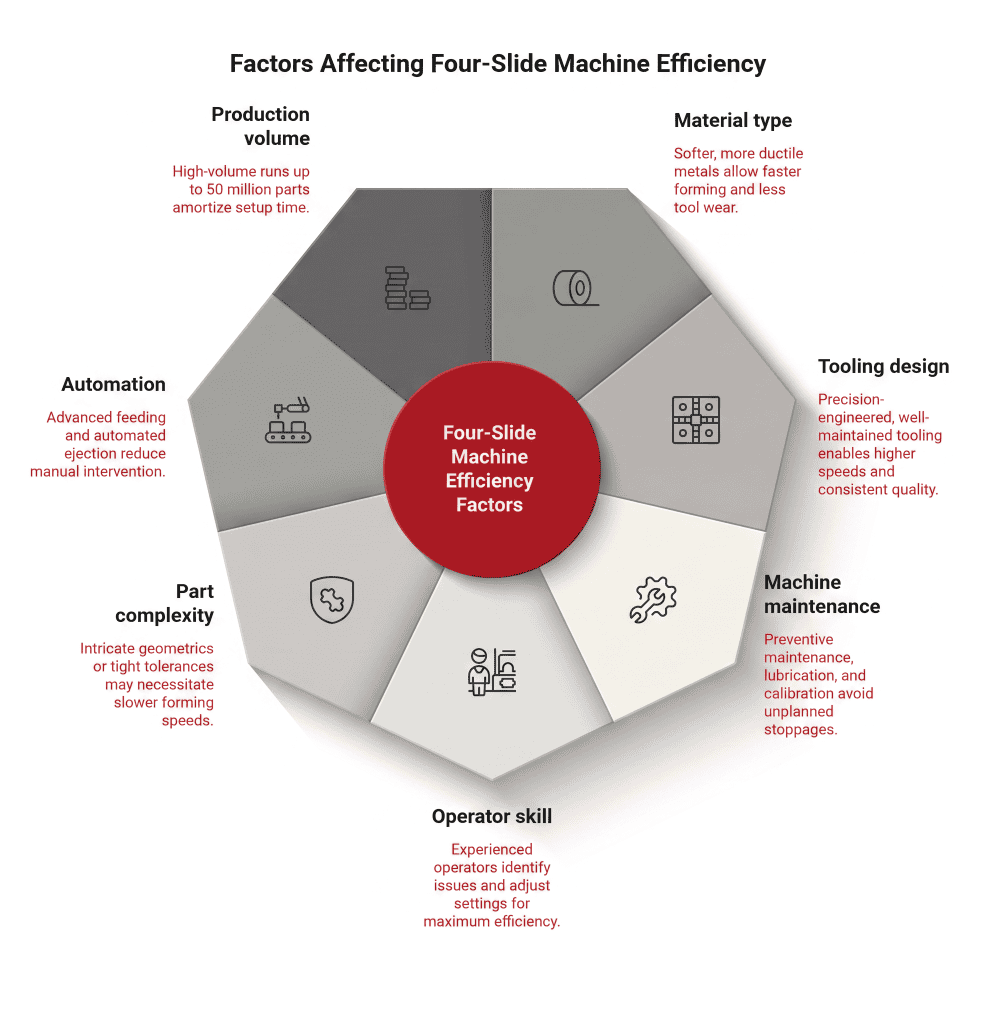
It’s important to note that four-slide stamping technology inherently supports rapid, multi-directional forming, allowing for simultaneous operations that drastically reduce cycle times compared to conventional stamping. In combination with in-house tool-and-die expertise and rigorous preventive maintenance, manufacturers can achieve both high throughput and consistent quality across large production runs. Strategic investments in operator training and automation further amplify these benefits, ensuring each run is optimized for both speed and precision.
Adhering to strict sheet metal stamping design guidelines during the engineering phase further enhances manufacturability, reduces tool wear, and supports just-in-time delivery strategies.
Keats Manufacturing operates one of North America’s largest fleets of four-slide and proprietary Wünsch multi-slide machines, enabling precise, high-speed forming with minimal changeover and maximum throughput. Industry 4.0 technologies, real-time monitoring, and simulation-driven engineering enhance efficiency through predictive maintenance and rapid troubleshooting. With three strategically located campuses (IL, TX, Mexico), Keats delivers distributed production, optimized logistics, and just-in-time delivery, all under full compliance with ISO 9001, ISO 14001, and IATF 16949.
How does the cost and speed of four-slide stamping compare to other metal-forming methods like progressive die stamping?
When evaluating metal forming technologies, decision-makers often compare four-slide stamping to progressive die stamping.
Cost Comparison
Four-slide stamping is often considered one of the most cost-efficient options for high-volume production due to several factors:
- Lower Tooling Investment: Compared to traditional metalworking methods, fourslide stamping typically requires a lower initial tooling investment. In contrast, traditional power presses require expensive, specialized tooling to achieve intricate cuts and sharp bends.
- Material Efficiency: The fourslide process uses material more efficiently and generates less waste than traditional processes. This is particularly beneficial when working with expensive metals, as the reduction in scrap translates directly to lower material costs.
- Elimination of Secondary Operations: Because fourslide machines are “start-to-finish” operations that perform multiple forming and stamping tasks in a single run, they often eliminate the need for one or more secondary operations, reducing the total cost per part.
- Inexpensive Design Changes: Modifying a part design in traditional press operations can be expensive and time-consuming, often requiring a new die. Fourslide machines can accommodate design changes with simple adjustments to individual sliding tools.
Speed and Turnaround
The unique mechanics of the fourslide machine allow for high-speed manufacturing and faster project completion:
- High Production Rates: Fourslide machines can achieve production rates of nearly 10,000 pieces per hour, depending on part complexity.
- Faster Turnaround: The ability to perform multiple operations in a single run, accessing the metal from four orthogonal directions simultaneously or sequentially, results in a much faster turnaround than traditional methods that might require multiple machine setups.
While progressive die stamping is often cited as a “solid fit” for high-volume runs (such as 250,000+ pieces annually) that require precision hole placement and consistent tolerances, fourslide stamping remains the preferred choice for designs that require complex twists, curves, or multiple bends that a single-direction vertical press cannot easily achieve. For further analysis, refer to our metal stamping process and four-slide stamping techniques resources.
Ultimately, the choice depends on part geometry, volume, and project requirements. Keats Manufacturing Co. offers both four-slide and progressive die stamping, providing objective guidance to ensure optimal results for your application.
Conclusion
Four-slide stamping stands out as a premier solution for high-speed, high-precision metal component manufacturing, driven by factors such as material selection, advanced tooling, integrated finishing, and expert operation. By understanding the main drivers of speed and efficiency, you can make informed decisions that maximize productivity and product quality.
Discover how four-slide stamping can streamline your manufacturing process and deliver precision results for your next project. Ready to learn more or discuss your specific needs? Contact us to explore customized solutions and see how four-slide stamping can benefit your business.
Ready to optimize your four-slide stamping production?
Contact Keats Manufacturing to explore customized solutions and see how four-slide stamping can benefit your business. Visit keatsmfg.com or reach out to our engineering team directly.