

Choosing the right tooling architecture is a pivotal decision in custom precision manufacturing, directly influencing production quality, lead times, and total cost of ownership. As the demand for intricate, high-volume components grows, engineering teams must evaluate how different forming mechanisms impact part execution.
This article breaks down the foundational differences in tool engineering, providing actionable insights for optimizing your production approach. For core technical context, explore What is a four-slide machine used for or visit our comprehensive Four‑slide Stamping pillar page.
Key Takeaways
- ›Four-slide tooling enables simultaneous multi-directional forming, offering unmatched flexibility for complex geometries compared to traditional vertical stamping dies.
- ›Conventional stamping relies on sequential press operations, which often require more material handling and higher tooling investments for intricate designs.
- ›Component requirements, such as specialized bushings with bearings or high-tensile clips, dictate whether multi-slide or progressive stamping is optimal.
- ›Digital in-house tool design optimization consolidates multiple manufacturing steps into a single, high-speed automated pass.
What is the difference between stamping and machining?
Stamping and machining represent two fundamentally different mechanical approaches to component fabrication:
A high-speed, structural forming process that uses custom-engineered die sets and mechanical presses to shape flat sheet metal. It is designed for rapid cycle times, high volume repeatability, and extreme cost-efficiency at scale.
A subtractive manufacturing process that removes material from a solid workpiece using CNC mills, lathes, or cutting tools. It is preferred for low-volume production runs or extreme three-dimensional geometries that require heavy-gauge materials.
Material specifications and application architecture drive this selection. For example, producing high-volume bushings with bearings requires exceptional surface finishes and precise dimensional control. When manufactured at scale, stamping is the optimal process due to its velocity. Compared to the extensive cycle times required by alternative machining workflows, stamping achieves significantly higher throughput and lower manufacturing costs than subtractive methods because the entire forming operation completes in a matter of seconds. For more on how materials affect stamping outcomes, see How does the choice of material impact the likelihood of defects occurring in the stamping process?
What are the different types of stamping machines?
Industrial metal forming utilizes diverse press configurations engineered for specific material behaviors and geometries:
The traditional workhorses of the industry. Mechanical systems use a flywheel-driven ram for high-speed, flat blanking, while hydraulic presses deliver variable force profiles for deeper material draws.
Advance raw coil stock through sequential internal stations, completing separate cuts or bends at each stage of the stroke.
Engineered with high tonnage capacities to process thick-gauge alloys for structural automotive and industrial sub-assemblies.
Utilize four or more independent, synchronized slides driven by a unified camshaft network.
Patent literature on multi-slide forming technology confirms that four-slide machines arrange tool slides in opposing pairs, each perpendicular to the other, and reciprocating toward a common center to execute forming operations from multiple directions simultaneously. This unique mechanical configuration allows multi-slide systems to efficiently produce specialized round metal spring clips and various aluminum wire clip sizes without requiring complex multi-station dies or separate secondary operations.
For a deeper dive into the machinery, see our Four-slide stamping machine page.
What are the methods of stamping?
Selecting a manufacturing methodology depends on balancing part complexity, production volume, and throughput requirements:
At Keats Manufacturing Co., the ability to deliver high-volume production up to 50 million parts, while meeting demanding tolerances (as tight as ±0.0002 in. for stampings) is supported by advanced process engineering and comprehensive quality management. Full compliance with ISO 9001, ISO 14001, and IATF 16949 ensures that every stamped part meets rigorous industrial and engineering standards.
Industry documentation from the Society of Manufacturing Engineers (SME) confirms that while progressive dies require a continuous carrier strip to advance components through separate stations, four-slide processing utilizes synchronous slides acting on a single focal point. For components like variable aluminum wire clip sizes, this minimizes raw material scrap and eliminates the need for downstream handling.
For an overview of the main types of stamping processes, see our specialized page.
How does the tooling design process for four-slide stamping differ from traditional stamping methods?
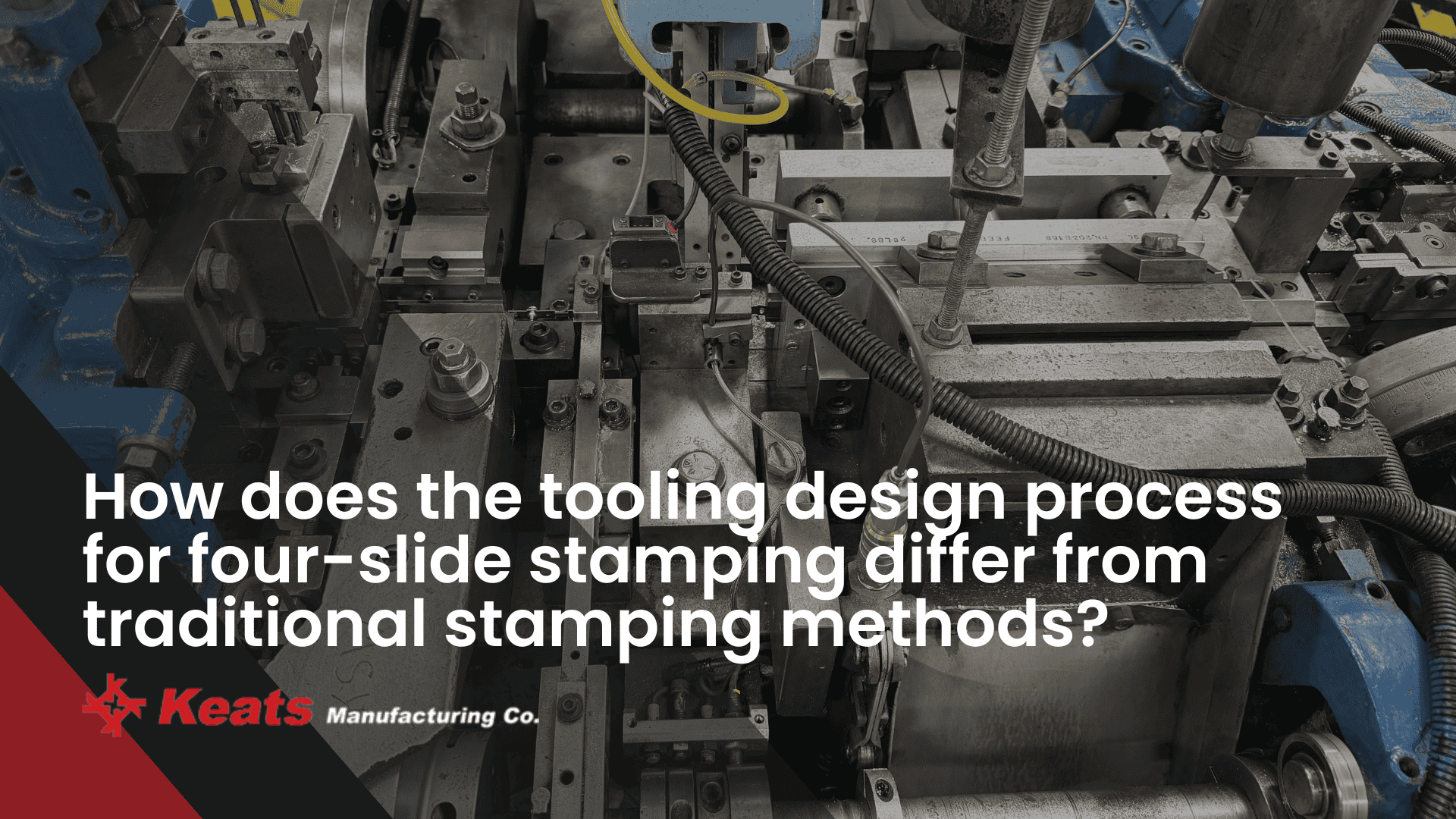
The core distinction between these processes lies in how forming forces are delivered to the material. Traditional vertical stamping relies on upper and lower halves of a single die set moving exclusively along a vertical axis. For complex parts, this layout requires long, intricate progressive tracks.
Cams strike the workpiece from four different directions in a single pass. This multi-directional capability provides distinct advantages for components such as high-tensile round metal spring clips or cylindrical bushings with bearings, which require complex, multi-plane bends around a central mandrel.
Our engineering team optimizes tool development by integrating CAD/CAM modeling, CNC machining, and Electrical Discharge Machining (EDM) across our strategic production network. Transitioning from traditional toolmaker methods to digital CAD/CAM workflows yields more predictable and repeatable stamping results, reducing prototype cycles and improving dimensional stability across high-volume runs. This digital engineering foundation allows for rapid prototyping, lower initial tooling costs, and exceptional dimensional stability across high-volume production runs of up to 50 million parts.
Conclusion
Selecting the optimal tooling design directly dictates part quality, process efficiency, and total cost of ownership. Four-slide stamping, with its advanced multi-directional forming and rapid tooling adaptability, offers significant advantages for complex, high-volume components.
Discover how four-slide stamping can streamline your manufacturing process and deliver precision results for your next project. Ready to learn more or discuss your specific needs? Contact us to explore customized solutions and see how four-slide stamping can benefit your business.
Ready to optimize your tooling design for precision and efficiency?
Contact Keats Manufacturing to explore customized solutions. Visit keatsmfg.com or reach out to our engineering team directly.