

Every stamped metal component begins its journey with a critical decision: the selection of raw material. In precision manufacturing, where tolerances can be measured in ten-thousandths of an inch, the link between material properties and stamping defects is profound.
This article delves into how the characteristics of your chosen material can shape the outcome of four-slide stamping operations, affecting everything from defect rates to overall part performance. For foundational concepts, see What is fourslide manufacturing? and Four‑Slide Stamping. Below, we examine the technical factors that engineers must weigh to prevent defects and optimize production.
Key Takeaways
- ›Material selection is a primary determinant of defect rates in four-slide stamping, directly influencing part quality, process stability, and yield.
- ›The unique capabilities of four-slide stamping machines enable high-precision, high-volume production, but only when materials are matched to both design and machine parameters.
- ›Engineers must evaluate properties such as ductility, hardness, and thickness to ensure optimal material compatibility and minimize stamping defects.
- ›Poor material choices can lead to more frequent burrs, fractures, and dimensional inconsistencies, especially in complex geometries or high-tolerance applications.
- ›Strategic material selection, combined with advanced in-house tool & die development, is essential for achieving just-in-time delivery and consistent quality in custom precision metal stampings.
What is a fourslide stamping machine and how does it work?
What is a fourslide stamping machine? It is an advanced metal forming system engineered for the efficient production of complex, high-precision components. Unlike traditional punch presses, the fourslide (or multi-slide) machine utilizes four synchronized slides, each equipped with forming tools, that approach the workpiece from multiple angles. This enables simultaneous bending, forming, and cutting operations, all within a single cycle.
Key advantages of fourslide stamping machines include:
- Multi-directional forming for intricate geometries
- Rapid tool changes and high throughput, supporting just-in-time manufacturing
- Exceptional repeatability and tolerance control (as tight as ±0.0005 in. for stampings)
- Reduced secondary operations due to integrated forming capabilities
The best four slide stamping machine configurations, such as those operated by Keats Manufacturing Co., leverage proprietary Wünsch multi-slide technology and in-house tool & die development. This combination supports both prototyping and full-scale production up to 50 million parts, while maintaining rigorous quality standards (ISO 9001, ISO 14001, IATF 16949).
The use of advanced simulation and process modeling during the engineering phase further enhances defect prevention. By digitally validating material behavior, thickness variation, and forming parameters before production, manufacturers can proactively identify and address potential sources of defects. This practice is especially critical when working with high-hardness or specialty alloys, where even minor deviations in material properties can result in wrinkling, splits, or excessive springback.
Why is material selection important in engineering design?
Material selection is a cornerstone of engineering design, directly impacting product performance, manufacturability, and lifecycle cost. The right material ensures that components meet application-specific requirements for strength, conductivity, corrosion resistance, and dimensional stability.
For instance, when producing Aluminum Bushing spacers, engineers must consider:
The material’s modulus of elasticity and yield strength to prevent deformation under load.
Longevity in harsh environments is directly dependent on material selection.
Compatibility with downstream processes such as plating or heat-treating.
Selecting an inappropriate alloy or temper can compromise not only the part’s mechanical integrity but also the efficiency and yield of the stamping process. In high-volume applications, even minor material inconsistencies can lead to significant defect rates, resulting in increased scrap, rework, and cost overruns.
Material guidelines established by Keats Manufacturing emphasize the importance of matching the inside bend radius at least to the material thickness, particularly for less ductile metals. This design principle reduces the risk of cracking and ensures smoother bends, directly lowering the likelihood of defects. Additionally, maintaining proper hole spacing and sizing — keeping hole diameters at least equal to the material thickness and spacing them at least twice the thickness from the edges — helps prevent deformation and burr formation during stamping.
For a broader overview of how different stamping processes interact with various materials, see Types of stamping process.
How do engineers choose the right material for a product or system?
Engineers employ a systematic approach to material selection, balancing technical requirements, economic constraints, and process compatibility. The following criteria are paramount:
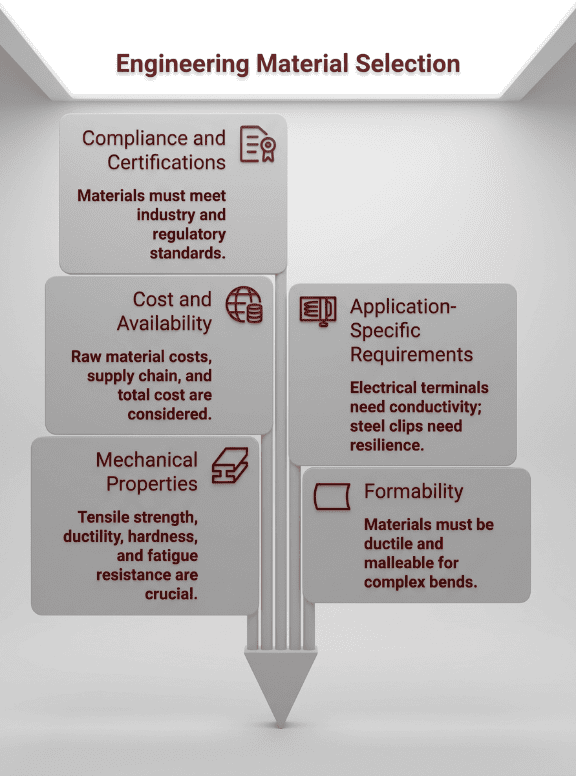
Material evaluation process:
- Conduct mechanical and metallurgical testing (tensile, hardness, microstructure analysis)
- Prototype and trial runs on production equipment
- Analyze defect rates, tool wear, and process stability
- Iterate material and process parameters as needed
This rigorous methodology ensures that each component, whether a custom shield, a formed wire component, or a precision assembly, is manufactured to exacting standards.
Keats Manufacturing’s vertically integrated approach, featuring in-house tool & die development and lifetime guarantees, enables rapid prototyping and iterative material trials. This capability is particularly valuable for high-volume runs, where early identification of material-driven defect risks can prevent costly downstream issues. Furthermore, the company’s compliance with ISO 9001, ISO 14001, and IATF 16949 ensures that all materials are vetted against stringent quality and environmental standards, reducing the risk of non-conformance and process variability.
How does material selection impact the quality of a sheet metal component?
The intrinsic properties of a material dictate not only how it can be formed but also the final quality and reliability of the stamped part. For example:
Benefit from aluminum’s lightweight, corrosion resistance, and ease of forming. However, improper alloy selection can lead to cracking or excessive springback, increasing defect rates.
Require high-carbon or alloy steels with precise heat treatment to achieve the necessary strength and fatigue resistance. Variations in steel grade or temper can result in premature failure, dimensional drift, or excessive brittleness.
Material-related factors influencing sheet metal quality:
- Ductility: Low-ductility materials are prone to fracture during forming
- Thickness tolerance: Variations can cause inconsistent bends or incomplete forming
- Surface quality: Imperfections can propagate cracks or accelerate tool wear
- Grain orientation: Anisotropy can lead to warping or uneven deformation
Ultimately, the synergy between material properties and process parameters determines the defect rate, yield, and overall performance of stamped components.
Keats Manufacturing’s expertise in handling a broad spectrum of metals, including steel, aluminum, brass, copper, and stainless steel, enables the production of components with highly specialized requirements. For instance, custom small metal stampings for automotive or electronics applications may demand ultra-tight tolerances (as precise as ±0.0005 in.) and defect-free surfaces to ensure reliable assembly and function. The integration of secondary services such as plating, heat-treating, and stress-relieving further enhances finished part quality, as these processes are tailored to the specific material and application.
How does the choice of material impact the likelihood of defects occurring in the stamping process?
The answer lies in the interaction between material characteristics and the dynamic forces of stamping. Key material attributes, such as ductility, hardness, and thickness, directly affect susceptibility to common stamping defects, including burrs, cracks, wrinkling, and dimensional inaccuracies.
Material-driven defect risks:
To minimize defects, advanced manufacturers utilize:
- In-house tool & die development with materials matched to specific part geometries and tolerances
- Real-time process monitoring and feedback to adjust forming forces and tool clearances
- Selection of the best four slide stamping machine configurations to optimize energy transfer and minimize stress concentrations
By integrating materials science with precision engineering, Keats Manufacturing Co. consistently achieves high-yield, defect-minimized production, delivering value across industries from automotive to electronics.
In addition, leveraging predictive simulation technology during the design and process engineering stages allows for proactive identification of potential defect zones based on material properties and part geometry. This digital validation step is crucial when working with high-volume production runs, as it enables rapid adjustments to material selection or tool design before full-scale manufacturing begins. The result is a significant reduction in trial-and-error cycles, faster time-to-market, and a measurable decrease in defect rates.
For a deeper look at common defect types and prevention strategies, see What are the defects of stamping? and What types of materials are best suited for four-slide stamping, and are there any limitations?
Final Thoughts
In the sector of custom precision metal stamping, material selection is not a secondary consideration; it is the foundation of defect-free, high-performance manufacturing. Keats Manufacturing Co.’s legacy since 1958 has been built on a commitment to technical excellence, from the largest fleet of four-slide and Wünsch multi-slide machines in North America to our in-house tool & die development with lifetime guarantees. By combining rigorous material evaluation, advanced simulation, and vertically integrated secondary services, we help our customers achieve just-in-time delivery, ultra-tight tolerances, and consistent quality — no matter the application or production volume.
If you are ready to optimize your next project for quality, efficiency, and reliability, partner with a team that understands how material science and engineering precision converge. Contact Keats Manufacturing Co. today to discuss your specific requirements, explore custom solutions, and experience the difference that industry-leading expertise can make in your high-volume stamping operations.
Ready to optimize your material selection and eliminate stamping defects?
Contact Keats Manufacturing Co. today to discuss your specific requirements and explore custom solutions. Visit keatsmfg.com or reach out to our engineering team directly.