

From the tiniest electrical terminals to the most robust automotive assemblies, metal forming shapes the backbone of modern manufacturing. The diversity of fabrication methods, each tailored to specific tolerances and production scales, means choosing the right approach is pivotal.
This article explores the full spectrum of Types of stamping processes and highlights how precision Four‑Slide Stamping delivers the ideal balance of performance, cost, and manufacturability.
Key Takeaways
- ›Metal stamping encompasses several distinct methods, including progressive, transfer, and compound stamping, each offering unique advantages for specific part geometries.
- ›Process selection is driven by material properties, part complexity, required tolerances, and production scale.
- ›Specialized components, such as small metal wire clamps, require precise multi-axis forming to achieve high repeatability.
- ›Stamping operations like blanking, embossing, or bending directly influence the structural strength and suitability for application of the final component.
Breaking Down the Main Types of Metal Stamping
Metal stamping transforms flat metal sheets or wire into complex components through targeted engineering methods:
Performs multiple operations across sequential stations within a single die set as the strip advances.
Moves individual, pre-cut blanks from one die station to the next using mechanical transfer systems. This approach is ideal for larger, three-dimensional parts requiring deep-drawn operations.
Executes multiple operations, such as blanking and piercing, simultaneously in a single press stroke. It is best suited for flat, simple geometries requiring high dimensional precision.
This process offers unmatched flexibility for bending, coining, and shaping intricate wire forms or custom small metal stampings.
What factors should I consider when choosing between different metal stamping methods for my project?
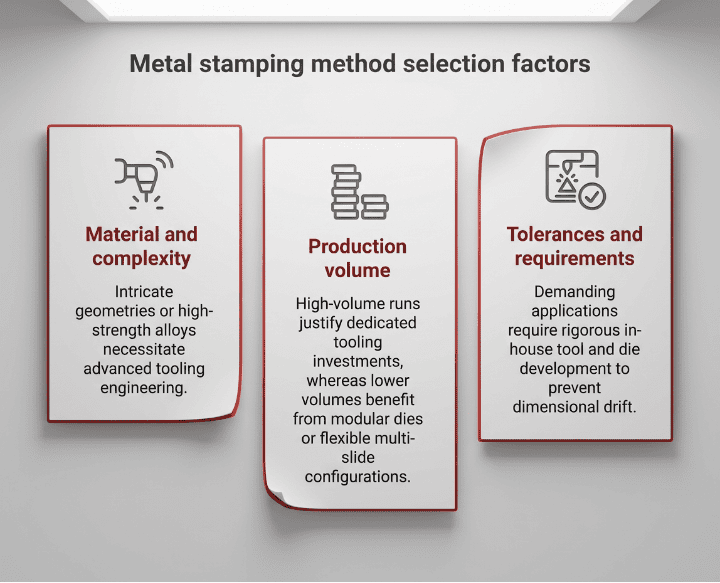
Selecting the optimal production method requires a holistic evaluation of several manufacturing variables:
Intricate geometries or high-strength alloys necessitate advanced tooling engineering, making it critical to partner with experienced progressive stamping die manufacturers.
High-volume runs justify dedicated tooling investments, whereas lower volumes benefit from modular dies or flexible multi-slide configurations.
Demanding applications require rigorous in-house tool and die development to prevent dimensional drift over long production lifecycles.
Research published in MDPI Materials underscores this, confirming that dimensional control in progressive dies directly dictates part quality and functional reliability across high-volume production lots. To safeguard these variables, implementing metal stamping best practices is essential. These practices include conducting early Design for Manufacturability (DFM) reviews, using automated digital process monitoring, and prioritizing suppliers that hold ISO 9001, ISO 14001, and IATF 16949 quality certifications.
For additional insights on how manufacturers make decisions, see How do manufacturers decide which metal stamping process to use for a particular part or product?
How do the various metal stamping operations, like blanking or embossing, affect the properties of the finished part?
The specific die operations executed during manufacturing fundamentally alter the mechanical properties and performance of the final component:
The execution of these operations directly dictates the component’s functional readiness. For example, evaluating what is a busbar used for (conducting high-current electrical energy between circuits) shows that improper stamping can introduce surface resistance or microcracking. Research in MDPI Energies confirms that precision-stamped copper busbars optimize electrical contact and minimize resistive losses without requiring extra connection elements. Integrating secondary services, such as plating, heat-treating, and stress-relieving, directly within the production workflow ensures that post-stamping characteristics meet strict commercial standards.
For more on how quality is maintained throughout these operations, see What quality control measures are commonly used during and after the metal stamping process?
Can you explain how production scale impacts the cost and efficiency of metal stamping?
Production volume dictates the cost structure and tooling amortization of a project:
Prioritizes lower initial tooling costs through modular components, though per-part costs are higher due to setup variables.
Reduces per-part costs dramatically by using dedicated progressive or four-slide tooling, supporting throughputs of up to 50 million components.
The economics of scale are significant. MIT manufacturing research estimates that over $100 billion is spent annually in the United States on the design, fabrication, and assembly of stamped parts. This expenditure highlights why aligning tooling investment with production volume is critical. Applying metal stamping best practices, such as statistical process control and utilization of a multi-campus manufacturing footprint, ensures supply chain redundancy, optimized material yield, and reliable just-in-time delivery for high-volume programs.
Conclusion
Selecting the right metal stamping process directly impacts part quality, production efficiency, and total cost of ownership. By aligning part geometry with the optimal tooling method, engineering teams can maximize component performance while reducing waste.
Discover how four-slide stamping can streamline your manufacturing process and deliver precision results for your next project. Ready to learn more or discuss your specific needs? Contact us to explore customized solutions and see how four-slide stamping can benefit your business.
Ready to find the right metal stamping process for your project?
Contact Keats Manufacturing to explore customized solutions. Visit keatsmfg.com or reach out to our engineering team directly.