

From intricate electrical contacts to custom wire bends and clips, the four-slide machine has become a cornerstone of modern precision metal stamping. As manufacturing pushes the boundaries of complexity and scale, this specialized equipment enables the efficient production of parts that would be difficult or costly to achieve with conventional presses.
In this article, we’ll explore what a four slide machine is used for, how it revolutionizes metal stamping workflows, and why it’s a vital asset for manufacturers seeking speed, accuracy, and adaptability. For a deeper dive into the broader process, see our Four‑Slide Stamping pillar page.
Key Takeaways
- ›Four-slide machines deliver unparalleled efficiency and precision for forming, bending, and shaping small metal stampings, wire bends, and clips.
- ›These machines are essential for high-volume manufacturing of complex parts, especially in industries like automotive, electronics, and electrical engineering.
- ›Four-slide stamping offers unique advantages over traditional presses, including multi-directional forming and reduced secondary operations.
- ›Material selection is crucial for optimal performance, with copper, brass, and certain steels being ideal for four-slide processes.
- ›Understanding the capabilities and limitations of four-slide machines helps manufacturers achieve tighter tolerances and higher throughput.
What is a four slide machine used for metal stamping?
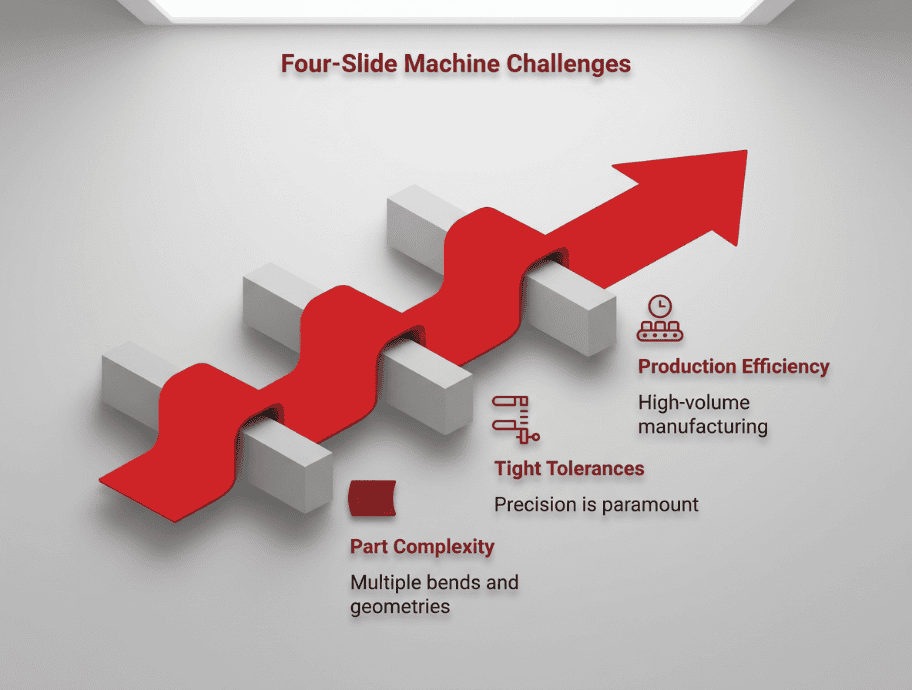
A four-slide machine, also known as a multi-slide or four-way slide, specializes in forming, bending, and shaping small metal parts with exceptional precision and speed. If you’re asking what is a four slide machine used for in the context of high-volume manufacturing, the answer is clear: these machines excel at producing complex components with multiple bends and intricate geometries, all within a single, continuous operation. This makes them indispensable for industries where part complexity, tight tolerances, and production efficiency are paramount.
For those specifically seeking what is a four slide machine used for metal stamping, the answer lies in its unique ability to perform simultaneous multi-directional forming. Unlike traditional stamping presses that operate in a single direction, four-slide machines use four synchronized slides to form material from multiple angles in a single cycle.
Integrates cutting, bending, and forming in one cycle, minimizing handling and errors.
Forming across four axes achieves tight tolerances for complex geometries.
Exceptional repeatability for small, intricate parts at high volume.
Four-slide excels at producing parts with multiple bends at high volume. Typical applications include electrical terminals, custom small metal stampings, wire forms, battery terminals, clips, and complex assemblies. Industries served span automotive, electronics, electrical, aerospace, medical, and industrial controls.
What does a stamping machine do?
What does a stamping machine do in manufacturing? At its core, a stamping machine uses dies and high pressure to form flat metal sheets into specific shapes. This process can include blanking, bending, coining, embossing, and more, depending on the machine and tooling. As the National Institute of Standards and Technology describes, “metal stamping is a manufacturing process used to convert flat metal sheets into specific shapes using a tool and die surface.”
Modern four-slide stamping machines combine speed with precision, ensuring each part meets strict specifications. This digital workflow accelerates prototyping, streamlines improvements, and reduces errors for higher first-pass yield.
Unlike single-direction presses, four-slide machines are engineered for complex, small-scale parts, forming components from multiple angles at once. This enables greater part complexity and throughput. Four-slide machines complement conventional stamping by delivering superior precision and efficiency for demanding, high-volume applications.
What is metal finishing? After the stamping process, a critical phase called metal finishing comes into play. This refers to a range of secondary processes including plating, heat treating, e-coating, and stress relieving, applied to stamped parts to enhance surface quality, corrosion resistance, electrical conductivity, and mechanical performance. Effective metal finishing is essential for parts destined for demanding environments, such as automotive connectors or electrical terminals, ensuring longevity and reliability in the field.
How does a four-slide machine differ from other types of metal stamping equipment?
When comparing four-slide machines to other common metal stamping equipment, several distinctions emerge.
Note on limitations: For example, producing a busbar in substation application often requires heavy tonnage forming which can only be accomplished in a larger press. Four-slide machines are best suited for small to medium-sized parts and are not optimal for heavy-gauge or large components.
The strategic deployment of four-slide and traditional stamping press machines across Keats’ three state-of-the-art campuses in Illinois, Texas, and Mexico enables the company to serve customers with regionally optimized production and logistics. This distributed manufacturing model supports rapid response to changing demand, while maintaining consistent quality standards across all locations.
What kinds of materials can be processed using a four-slide machine?
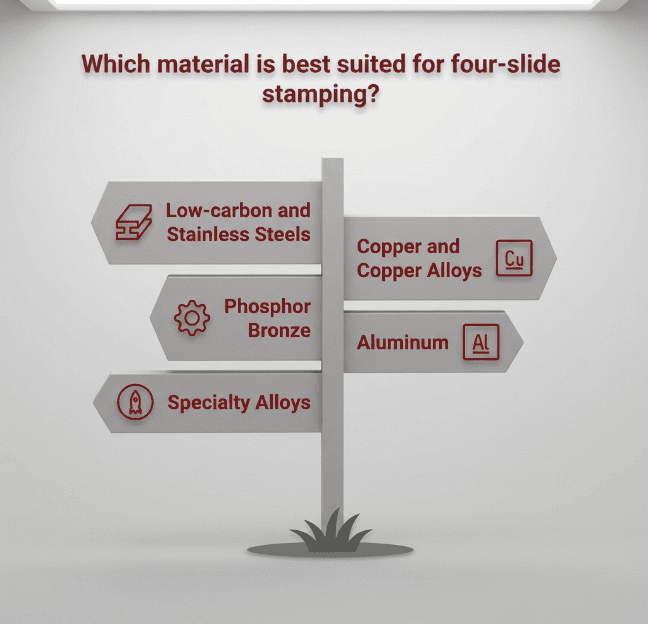
Four-slide machines are highly versatile and compatible with a broad range of metals and alloys. Commonly processed materials include:
Stainless Steels
Suitability for four-slide processes:
- Metals with good ductility and formability are ideal for four-slide operations.
- Material selection is critical for applications such as a bus bar in electrical panel assemblies, where conductivity and mechanical performance are essential.
Material compatibility drives tooling, tolerances, and production efficiency. Keats’ four-slide machines process a broad range of metals, from high-conductivity copper alloys for electrical terminals to high-strength steels for automotive parts. Fast material changeovers and in-house tool & die development enable efficient prototyping and high-volume runs with minimal downtime. Integrated secondary services, plating, heat treating, and stress relieving ensure compliance with stringent industry standards.
Keats’ four-slide equipment handles wire up to 0.18″ diameter, thicknesses to 0.06″, and widths to 3.00″. Material selection is application-driven, balancing formability and strength. Hard, brittle, or low-ductility metals are prone to cracking or tool wear; exotic alloys may require specialized tooling.
What materials are best suited for four-slide stamping, and are there any that should be avoided?
Material selection is critical to four-slide stamping performance. The process’s multi-directional forming, rapid cycling, and tight tolerances demand metals with specific properties to ensure consistent, precise results and minimize defects.
Properties of materials that work well with four-slide machines:
- Ductility and Formability: Metals that can be bent, shaped, or twisted without cracking are ideal. Ductility ensures the material can withstand the multi-directional forces applied during four-slide operations.
- Consistent Grain Structure: Uniformity in grain structure supports repeatability and reduces the risk of unpredictable deformation or tool wear.
- Appropriate Strength-to-Thickness Ratio: Materials should provide sufficient strength for the end-use application while remaining thin enough to be efficiently processed on four-slide equipment.
Best-suited materials for four-slide stamping:
Keats processes a wide range of metals on advanced four-slide equipment, holding tolerances to ±0.0002 in. for stampings. In-house tool & die development ensures optimal tooling for both prototyping and production. Materials typically excluded are hard, brittle, abrasive, or exotic alloys; thick-gauge metals beyond forming limits; and materials with poor surface quality. For mission-critical parts, such as copper ring terminal connectors or brackets near sensitive electronics, ductile, high-conductivity metals are preferred for performance and reliability.
What are the defects in stamping process?
Metal stamping, including four-slide operations, can result in several defects:
Sharp edges from incomplete cutting
Distortion from uneven stresses during forming
Fractures from excessive force or unsuitable materials
Scratches, dents, or tool marks
Four-slide machines address many of these challenges through synchronized multi-directional forming, which allows for more uniform force application and reduces the likelihood of stress concentrations. How four-slide machines help minimize defects:
- Precise, repeatable tooling alignment reduces burrs and warping
- Coning operations can be added from any of the 4 axes to remove burrs in specific areas of the part
- Multi-directional forming distributes stress more evenly
- Integrated process controls enable early detection and correction
After stamping, parts may undergo metal finishing, such as deburring, plating, or heat treating, to improve appearance, performance, and durability. What is metal finishing, in this context, is the stage where residual surface defects, burrs, scratches, or minor dimensional drift from the forming process are corrected before final inspection, ensuring parts like sleeve bushings meet both functional and aesthetic specifications.
At Keats, secondary services such as e-coating, stress relieving, and plating are fully integrated, streamlining the path from raw material to finished product and ensuring consistent quality at every step. Integrating metal finishing into the metal stamping process allows manufacturers to eliminate residual imperfections, significantly improving both the durability and long-term performance of stamped components.
What clips do electricians use and how are they made?
Electricians rely on a variety of clips and brackets for wire management, grounding, and mounting:
cable retention
secure connections
panel assemblies
for power distribution
Many of these components are produced using four-slide machines due to their complex shapes and the need for high-volume, precise manufacturing. Material selection, such as copper brackets or steel, depends on electrical conductivity, corrosion resistance, and mechanical strength, especially in bus bar in electrical panel applications. The U.S. Occupational Safety and Health Administration (OSHA) points out that “proper selection and installation of electrical connectors and clips is critical to ensuring safe, reliable electrical systems.” (source)
The ability to execute multiple forming and bending operations in a single cycle makes four-slide stamping uniquely suited for manufacturing intricate electrical clips and terminals. Full compliance with ISO 9001, ISO 14001, and IATF 16949 standards ensures that each batch of stamped clips and brackets meets the rigorous quality and traceability requirements of the electrical industry.
How are copper battery terminals made?
Are copper battery terminals better than alternatives? In most electrical applications, copper is preferred for battery terminals due to:
- Superior electrical conductivity
- Excellent corrosion resistance
- High mechanical strength
Compared to other materials, copper terminals offer lower resistance and longer service life, justifying their use in critical applications. Four-slide machines are highly effective in producing copper ring terminal crimp connectors and other custom copper components, ensuring consistent quality at scale. For high-volume production, the combination of advanced four-slide technology and in-house tool & die expertise enables rapid prototyping and efficient scaling from initial design to production of millions of finished terminals. This is particularly important in automotive, aerospace, and industrial battery assemblies, where reliability and repeatability are non-negotiable.
For high-volume production, the combination of advanced four-slide technology and in-house tool & die expertise enables rapid prototyping and efficient scaling from initial design to production of millions of finished terminals. This is particularly important in automotive, aerospace, and industrial battery assemblies, where reliability and repeatability are non-negotiable. The ability to maintain tight tolerances and deliver defect-free surfaces further enhances the electrical performance and longevity of copper battery terminals.
What factors should I consider when deciding if a four-slide machine is right for my manufacturing needs?
When evaluating four-slide technology for your operation, consider the following:
Four-slide stamping consolidates multiple forming, bending, and cutting operations into a single, continuous process, eliminating extra workstations, reducing handling errors, and accelerating throughput. This efficiency is ideal for just-in-time manufacturing and rapid adaptation to changing demand without sacrificing quality.
Conclusion
Four-slide machines stand at the forefront of custom precision metal stamping, offering unmatched capabilities in forming, bending, and shaping complex small metal parts at scale. Their unique multi-directional forming action, high repeatability, and ability to integrate secondary services make them indispensable for automotive, electrical, electronics, and industrial applications where part complexity, tight tolerances, and production efficiency are non-negotiable.
At Keats Manufacturing, our legacy of technical excellence, backed by in-house tool & die development, a lifetime tooling guarantee, and one of North America’s largest four-slide fleets, ensures your project benefits from world-class quality, rapid prototyping, and just-in-time delivery. If you’re ready to streamline your manufacturing process, reduce costs, and elevate product performance, contact Keats Manufacturing today to discuss your requirements.
Ready to put four-slide technology to work for your project?
Contact Keats Manufacturing today to discuss your requirements. Visit keatsmfg.com or reach out to our engineering team directly.