

Determining the best metal types of stamping process for a specific part shapes every stage of a product’s journey, from the initial prototype to large-scale manufacturing. For decision-makers in manufacturing, gaining further insight into this selection process is crucial for achieving precise specifications, meeting regulatory requirements, and controlling costs.
This article breaks down how manufacturers evaluate and select the ideal stamping method for diverse applications, from electrical terminals to intricate wire forms. For additional background, please reference our comprehensive Four‑Slide Stamping and Types of Stamping Process articles.
Key Takeaways
- ›Manufacturers choose metal stamping processes based on part complexity, production volume, material, and quality requirements.
- ›Four-slide stamping offers unique design flexibility and efficiency advantages for intricate, high-volume components.
- ›Tooling design and process selection directly affect compatibility with terminal sizes and specialized connectors.
- ›Selecting the right process ensures optimal cost, precision, and speed for applications such as battery terminals and wire-clamp connectors.
- ›
Partnering with a provider that offers advanced in-house tooling and secondary services streamlines production and ensures long-term quality.
What is the process of terminal stamping?
Terminal stamping is a specialized manufacturing technique focused on producing electrical terminals and connectors with high precision and repeatability. These components, ranging from battery terminal lugs sizes to copper terminals sizes, are essential in automotive, industrial, and consumer electronics applications.
The process typically follows these steps:
Common applications include:
- Automotive wiring harnesses (requiring precise battery terminal lug sizes)
- Industrial control systems (using a variety of copper terminal sizes)
- Power distribution assemblies and custom connector solutions for circuit breakers
Terminal stamping is the foundation for reliable electrical connectivity, and process selection is driven by part geometry, volume, and end-use requirements.
Manufacturers with vertically integrated operations and in-house tool & die development can offer significant advantages at this stage. By designing and maintaining custom tooling internally, they ensure tighter process control and a lifetime guarantee on die performance. This is especially valuable for long-running, high-volume projects. Additionally, integrating secondary services such as plating and heat-treating within the same facility streamlines production, reduces lead times, and helps maintain consistent quality across large production runs.
How does the tooling design process for four-slide stamping differ from traditional stamping methods?
Tooling design is a decisive factor in the efficiency and versatility of metal stamping operations. Four-slide stamping, in particular, offers a unique approach compared to traditional progressive die stamping.
Ideal for wire forms, custom small metal stampings, and assemblies with challenging bends or cutouts.
Achieves ±0.0002 in. for stamping across high-volume runs.
Supports up to 50 million parts with just-in-time delivery.
These tooling differences directly impact production cost, speed, and the ability to accommodate evolving part designs, making four-slide stamping the preferred solution for advanced applications like wire clamp connector manufacturing.
The presence at Keats Manufacturing of one of the largest fleets of four-slide machines in North America, including unique Wünsch multi-slide machines, provides unmatched capacity and versatility. This infrastructure enables rapid scaling from prototyping to full production while maintaining consistent quality and precision across millions of parts. The ability to execute complex forming operations in a single setup not only shortens lead times but also minimizes the risk of dimensional variation, ensuring every part meets stringent industry standards.
To learn more about the machines themselves, or for additional insights into the manufacturing process, see What is fourslide manufacturing?
How do you choose the most suitable manufacturing processes for a given sheet metal product?
A multifaceted evaluation is required to decide on the right manufacturing process, considering both technical and commercial factors. Manufacturers systematically assess:
- Part geometry: If the part geometry allows for the raw material to be purchased to the exact width of the part, it will be a candidate for four-slide. If the part has more than 10 bends, it will likely be a candidate for progressive die stamping.
- Material type: The choice between copper, brass, bronze, steel, or specialty alloys affects both tooling design and process compatibility.
- Production volume: High-volume runs benefit from processes with short cycle times and automated handling, such as four-slide or progressive-die stamping.
- Tolerances and quality requirements: Applications demanding extreme precision (e.g., ±0.0002 in.) or compliance with ISO 9001/IATF 16949 standards necessitate advanced tooling and in-process controls.
- Secondary services: The need for plating, heat-treating, or assembly may influence process selection.
- Compatibility with terminal sizes: When manufacturing terminals, especially those with specific copper terminal sizes, the process must ensure consistent fit and electrical performance. Manufacturers may also reference local suppliers by searching for copper terminals near me to streamline sourcing and logistics.
- › Partner with manufacturers offering in-house tool & die development and a lifetime guarantee.
- › Verify compliance with relevant standards (ISO 9001, ISO 14001, IATF 16949).
- › Ensure access to secondary services to minimize supply chain complexity.
The right process selection balances performance, cost, and supply chain efficiency, ensuring that each part meets its intended function and market demand.
With strategically located facilities in Illinois, Texas, and Mexico, Keats Manufacturing Co. provides logistical advantages for just-in-time delivery and regional support. This geographic reach enables Keats to respond quickly to customer needs, adapt to supply chain disruptions, and optimize shipping costs. Full compliance with ISO 9001, ISO 14001, and IATF 16949, as well as Mil-Spec and other industry certifications, further assures customers of consistent quality and adherence to global standards, regardless of production location.
How do manufacturers decide which metal stamping process to use for a particular part or product?
The decision-making process for selecting a metal stamping method is both technical and strategic. Manufacturers start by analyzing the part’s functional requirements, geometry, and operational environment. For instance, components requiring precise battery terminal lugs sizes or wire clamp connector solutions will often benefit from four-slide or multi-slide stamping due to their superior flexibility and speed.
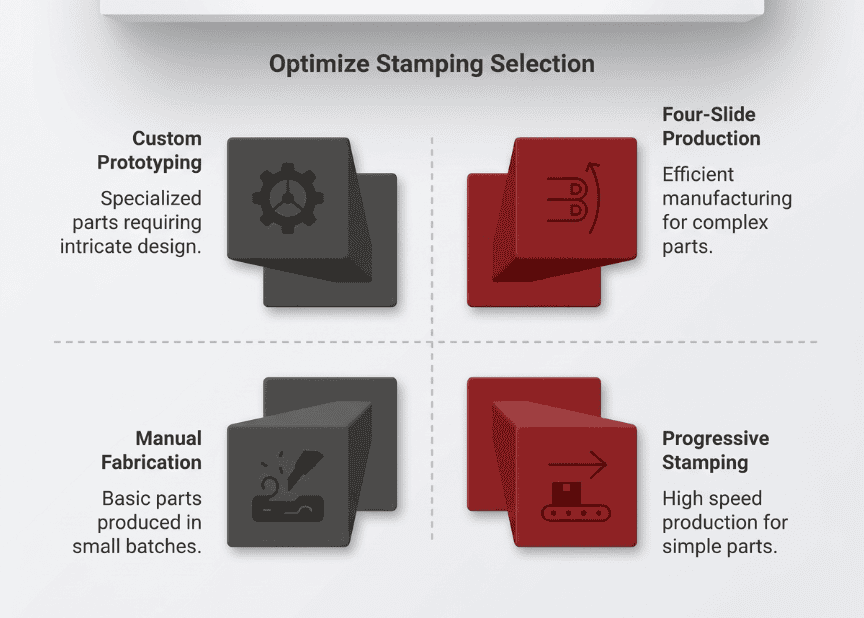
Selecting the right metal stamping process means matching manufacturing capabilities to each project’s specific requirements, balancing quality, efficiency, and long-term value. The process begins with a product feasibility analysis that assesses material thickness, geometry, and manufacturing method. Economic feasibility and production planning ensure technical suitability and cost-effectiveness at scale. Advanced digital modeling and simulation optimize tool paths and reduce prototyping, accelerating development and lowering costs.
Vertically integrated manufacturers like Keats Manufacturing Co. streamline every phase, from raw material sourcing to final assembly, for a seamless, end-to-end solution.
Final Thoughts
Choosing the optimal metal stamping process is a critical decision that directly impacts product performance, cost efficiency, and long-term reliability. By considering factors such as part complexity, production volume, material selection, and quality requirements, manufacturers can align their process selection with both technical and commercial objectives.
Keats Manufacturing Co. stands apart with its extensive fleet of four-slide and multi-slide machines, in-house tool & die development backed by a lifetime guarantee, and a full suite of integrated secondary services. With strategically located facilities and a legacy of precision dating back to 1958, we deliver just-in-time, high-volume solutions for the most demanding industrial and engineering applications.
If you’re ready to optimize your next project with industry-leading expertise and reliability, connect with our team today to discuss your requirements and discover how our custom precision metal stamping capabilities can drive your business forward.
Ready to optimize your next stamping project?
Connect with Keats Manufacturing to discuss your requirements and discover how our custom precision metal stamping capabilities can drive your business forward. Visit keatsmfg.com or reach out to our engineering team directly.