

From automotive electronics to industrial controls, the ability to produce high-precision, complex metal components at scale is a cornerstone of modern manufacturing. Companies seeking to optimize their supply chain and production efficiency must navigate a range of stamping process types, each offering distinct benefits and suited to specific applications.
This article breaks down the leading stamping methodologies, explores how material and production factors drive process selection, and highlights the operational advantages of advanced techniques like four-slide stamping. For an in-depth exploration of four-slide technology, see our Four‑Slide Stamping.
Key Takeaways
- ›Precision metal stamping encompasses multiple process types, each optimized for distinct production needs, tolerances, and part complexities.
- ›Four-slide stamping offers unrivaled flexibility for intricate forms and high-volume runs, enabled by unique machine architecture and in-house tool & die expertise.
- ›Material selection, ranging from copper to heavy-duty steel, directly influences the stamping method, defect risk, and end-use performance.
- ›Proper process control, advanced tooling, and rigorous quality standards are essential to minimizing defects and ensuring reliable, high-volume output.
- ›Strategic decisions between in-house stamping and outsourcing hinge on production scale, complexity, and long-term ROI, with four-slide stamping providing unique advantages for custom applications.
What are the different types of stamping?
The types of stamping process in manufacturing are defined by tooling configuration, part complexity, and production volume requirements. Understanding the stamping process is essential for selecting the right method for your application. The principal methods include:
This process feeds strip metal through a series of stations, each performing incremental forming or cutting operations. Progressive die stamping is ideal for high-volume parts runs requiring multiple features, delivering tight tolerances and consistent repeatability.
Four-slide machines use four synchronized slides to manipulate material from multiple axes, enabling the creation of highly intricate forms and bends in a single cycle.
In deep drawing, a punch forces a sheet metal blank into a die cavity, producing deep, hollow shapes such as enclosures or housings. This method is preferred for components requiring significant depth relative to their diameter, with applications in automotive, aerospace, and electronics.
Transfer systems move individual blanks through a series of dies, each performing a unique operation. Transfer stamping is suited for large, complex parts that cannot be produced from a continuous strip.
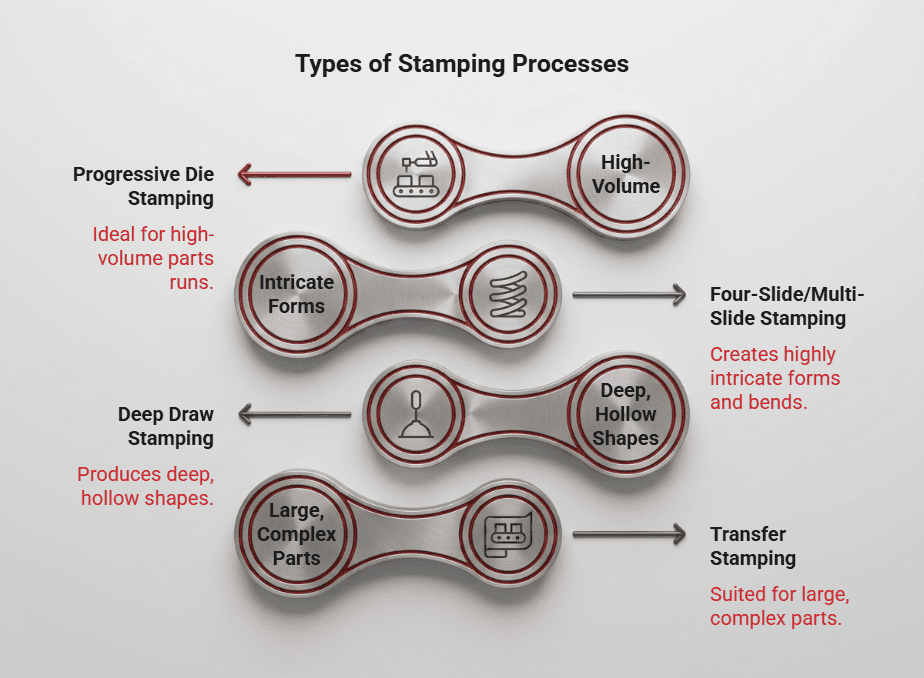
Each of these types of stamping processes is engineered to address specific manufacturing challenges. For example, the stamping process selected for a given project will consider factors such as material behavior, desired tolerances, and production scale to ensure optimal efficiency and part quality.
Advantages and typical applications:
Selecting the optimal stamping process depends on part geometry, volume, and tolerance. For high-volume runs up to 50 million parts, progressive die and four-slide stamping deliver exceptional speed and precision. Keats’ four-slide and multi-slide machines, backed by in-house tool-and-die development, achieve tolerances of ±0.0002 in. for stampings, essential for automotive electronics, medical devices, and industrial controls. Integrated secondary services like plating, heat-treating, and stress-relieving ensure components meet demanding mechanical and electrical standards.
This vertical integration benefits assemblies and custom shields where both performance and appearance matter. Material selection guides process choice; copper’s conductivity suits electrical terminals, while tougher alloys require specialized tooling to prevent springback or cracking. The ability to handle a wide range of metals, including advanced alloys and pre-plated materials, distinguishes industry leaders.
Rigorous process control, anchored by ISO 9001, ISO 14001, and IATF 16949, ensures quality from tool design through inspection, minimizing defects and supporting just-in-time delivery. For OEMs and supply chain managers, working with a partner offering in-house tool-and-die expertise and a lifetime tooling guarantee reduces risk and ensures reliable, scalable supply.
Stamping tolerance
Parts per run capacity
Campuses (IL, TX, Mexico)
What is a four-slide used for?
A four-slide stamping machine is purpose-built for forming and bending operations requiring multiple simultaneous manipulations. Unlike conventional presses, four-slide machines feature four tool-carrying slides arranged orthogonally, each capable of independent or synchronized movement. This configuration allows for:
Creation of complex forms not feasible with single-axis presses.
Multiple bends, twists, and cutouts completed in a single pass.
High repeatability at volumes up to 50 million parts.
What is a four-slide used for? Four-slide stamping is essential for manufacturing intricate wire forms, metal clips, and small assemblies with exacting tolerance requirements (down to ±0.0002 in.). This process is a cornerstone among the types of stamping processes available to manufacturers, offering unmatched flexibility for custom small metal stampings and assemblies. Common parts include electrical terminals, custom brackets, and spring clips. The process is highly adaptable, supporting rapid prototyping and just-in-time delivery for engineering-driven industries.
In-house tool and die development is a critical enabler of four-slide process flexibility. By designing and maintaining on-site tooling, manufacturers can rapidly iterate on part designs, implement engineering changes, and ensure tool longevity. This approach not only reduces lead times but also ensures that every die is optimized for the part’s specific material and geometry, resulting in consistent quality and minimized downtime. A lifetime guarantee on tooling further underscores the commitment to long-term reliability and cost control.
What is a copper terminal, and how are they made?
Copper terminals are critical components in electrical and mechanical systems, providing secure, conductive connections in wiring harnesses, switchgear, and control panels. During the stamping process for copper terminals, a high-conductivity copper strip is precisely formed, cut, and optionally plated to ensure optimal electrical performance. Among the types of stamping processes available, progressive die stamping and four-slide stamping are most frequently utilized, as these methods support the tight tolerances and high-volume production required for reliable electrical connectivity.
Copper is selected for its:
- Superior electrical conductivity
- Corrosion resistance
- Malleability for precise forming
Related products include copper brackets for copper pipe, which are stamped to exacting tolerances to support and secure piping in HVAC, plumbing, and industrial applications. These components benefit from the same high-precision, high-volume stamping processes that define advanced terminal manufacturing.
The production of copper terminals often incorporates secondary operations such as selective plating, stress relieving, and automated inspection to ensure both functional and regulatory compliance. For applications in automotive, aerospace, and industrial controls, copper terminals must meet stringent dimensional and performance criteria, including resistance to vibration, thermal cycling, and environmental exposure. The ability to deliver these components at scale, with consistent quality and traceability, is a direct result of advanced process control and integrated quality management systems.
What is the best material for a busbar, and how are they made?
Material selection for busbars in particular hinges on one property above all others: electrical conductivity, balanced against cost, corrosion resistance, and formability under high-speed stamping. Among the types of stamping process available, copper remains the default choice for high-current applications, while aluminum is increasingly specified where weight and cost savings outweigh its lower conductivity.
The industry standard for most electrical busbar systems due to its exceptional conductivity, ductility, and oxidation resistance. See copper alloys for stamping.
Selected for applications demanding higher mechanical strength, structural rigidity, or cost efficiency, though at the expense of conductivity. See aluminum alloys for stamping.
Electrical busbar systems are engineered for low-resistance, high-current environments, such as switchboards, substations, and industrial control panels. Material choice directly impacts system efficiency, heat dissipation, and long-term reliability.
Busbar manufacturing processes must accommodate both the electrical and structural demands of the end-use environment. Progressive die stamping and four-slide stamping are frequently employed to create busbars with complex profiles, mounting features, and integrated insulation barriers. Advanced quality assurance protocols, including dimensional inspection and material certification, ensure that each busbar meets the precise specifications required for safe and efficient operation in mission-critical systems.
What types of materials are best suited for these stamping operations?
Material selection for stamping is driven by the interplay of mechanical properties, conductivity, corrosion resistance, and end-use requirements. Among the types of stamping processes utilized in high-volume manufacturing, the following materials are most commonly chosen for their compatibility and performance:
- Copper: Preferred for electrical components (terminals, busbars) due to conductivity and malleability.
- Aluminum: Lightweight, corrosion-resistant; used in applications where weight savings are critical.
Material properties such as hardness, thickness, and ductility influence the choice of stamping process. For instance, intricate forms with tight tolerances may require four-slide or progressive-die stamping, while deep drawing is reserved for ductile materials in deep-drawn geometries.
In high-volume industrial and engineering applications, the ability to work with a wide range of alloys, including stainless steel, beryllium copper, bronze, and specialty spring steels, ensures that the finished components meet stringent requirements for electrical conductivity, mechanical performance, and environmental resistance. The selection process often involves close collaboration between engineering teams and material suppliers to balance manufacturability with end-use demands, especially when parts must maintain performance under thermal, electrical, or corrosive stress. Advanced simulation and CAD/CAM modeling further optimize material selection by predicting formability and the functionality of the final part before production begins.
Can you explain some common defects that can occur during the stamping process and how to prevent them?
Common defects in stamping include:
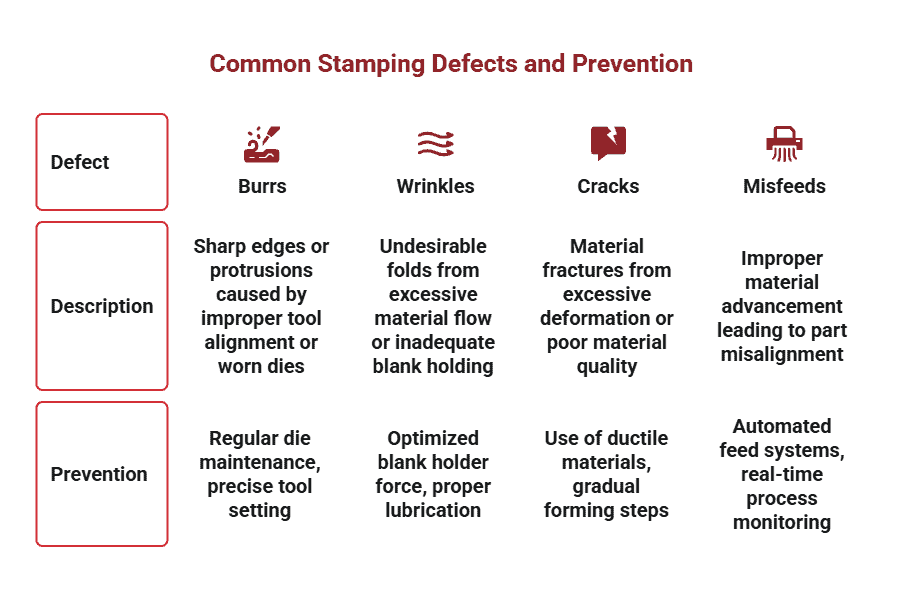
Rigorous process control, in-house tool & die development, and adherence to ISO 9001 and IATF 16949 standards are essential to defect mitigation. For detailed troubleshooting guidance, consult our stamping process.
Integrating advanced process monitoring systems and digital simulation tools — core elements of Industry 4.0 manufacturing — enables real-time detection and correction of process deviations. By digitally modeling the stamping process, potential issues such as springback, thinning, or excessive stress concentrations can be identified and resolved before tooling is finalized.
This proactive approach minimizes costly rework and ensures dimensional accuracy from the first production run. In addition, comprehensive documentation and traceability protocols, supported by ISO 14001 environmental management systems, further reduce the risk of nonconforming parts entering downstream assembly or customer supply chains.
For more information on quality control in stamping, see What quality control measures are commonly used during and after the metal stamping process?
How does the setup time and tooling cost for four-slide stamping compare to progressive die stamping?
Four-slide stamping offers significant advantages in tooling cost for certain applications. When considering what a four-slide is used for, it is important to note that four-slide machines are engineered for highly intricate, multi-bend components where rapid tool change and flexible production are critical. This makes four-slide stamping a preferred choice for custom small metal stampings, wire forms, and assemblies that require multiple forming operations in a single cycle. Conversely, progressive die stamping is more cost-efficient for extremely high-volume, single-plane parts due to its automation and speed.
For high-volume production of metal wire clips with intricate bends, four-slide stamping enables faster tooling changes and lower upfront costs, whereas a progressive die is preferred for flat, high-speed-stamped parts.
Keats Manufacturing’s ownership of one of the largest fleets of four-slide machines in North America, including unique Wünsch multi-slide machines, provides unmatched flexibility for custom small metal stampings and wire forms. This extensive equipment base allows for rapid scaling from prototype to full production, with tooling developed and maintained in-house under a lifetime guarantee. The result is minimized downtime, reduced total cost of ownership, and consistent part quality — even for highly complex geometries or when frequent design iterations are required.
What are the benefits of stamping?
The benefits of modern types of stamping process are far-reaching for high-volume, precision-driven industries:
High-speed, automated production reduces per-part costs, making stamping the most scalable solution for both standard and custom components.
Advanced stamping technologies routinely achieve tolerances as tight as ±0.0002 in. for stampings, supporting mission-critical applications such as electrical busbar system components and custom assemblies.
Stamping supports a wide range of metals, including copper, steel, and aluminum. Specialized products such as copper brackets for copper pipe are manufactured to exacting tolerances, ensuring reliable performance in demanding environments like HVAC and industrial piping.
Modern stamping processes enable the creation of complex forms and geometries, from intricate wire forms to multi-bend brackets to highly engineered parts found in an electrical busbar system. This flexibility supports rapid prototyping and iterative design, reducing time to market for new products.
Capable of producing up to 50 million parts with just-in-time delivery, stamping processes are engineered to support both prototype runs and sustained, high-volume production for industries such as automotive, electronics, and industrial controls.
Integrated secondary services, including plating, heat-treating, stress relieving, kitting, and automated screw insertion, streamline production and shorten lead times. This vertical integration delivers stamped parts ready for assembly, minimizing vendor handoffs. With advanced campuses in Illinois, Texas, and Mexico, Keats Manufacturing ensures just-in-time delivery and supply chain reliability across North America.
What factors should I consider when outsourcing four slide production to a service provider?
Key considerations include:
Evaluating which types of stamping processes best fit your application will impact tooling, production agility, and long-term scalability. For organizations that prioritize rapid prototyping, frequent design changes, or custom assemblies with complex geometries, understanding what a four-slide is used for can be a deciding factor in whether to invest in capital equipment or leverage an experienced manufacturing partner.
Outsourcing to a specialized partner gives you instant access to advanced manufacturing, expert engineering, and rigorous quality systems, without capital or maintenance burdens. This approach supports rapid scaling, design agility, and strict compliance. Choosing a provider with in-house tool & die development and a lifetime tooling guarantee ensures consistent quality and responsive support. Fully integrated prototyping, high-volume production, and secondary services streamline complexity and speed time to market.
Discover how four-slide stamping can streamline your manufacturing process with greater precision and efficiency. Whether you need custom small metal stampings, wire forms, or complex assemblies, a vertically integrated partner with advanced capabilities ensures your project’s success from concept through delivery.
Ready to find the right stamping process for your project?
Request a quote to discuss your requirements or receive a personalized quote from Keats Manufacturing. Visit keatsmfg.com or reach out to our engineering team directly.